Physics Library
 An open source physics library
Encyclopedia | Forums | Docs | Random  

[parent] GRE Physics Companion: Driven Harmonic Motion and Resonance

(Example)

GRE Physics Companion: Driven Harmonic Motion and Resonance

For

m ¨x + b˙x + kx = F0 cosωt,
(1)

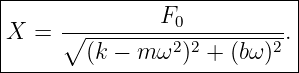
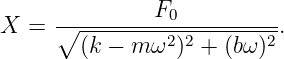
the steady-state displacement amplitude is

|----------------------------|
|X  = ∘---------F0----------.|
|        (k − m ω2 )2 + (bω )2 |
-----------------------------
(2)

The phase lag is

|----------(------------)--|
|δ = atan2  bω, k − m ω2  .|
---------------------------
(3)

PIC

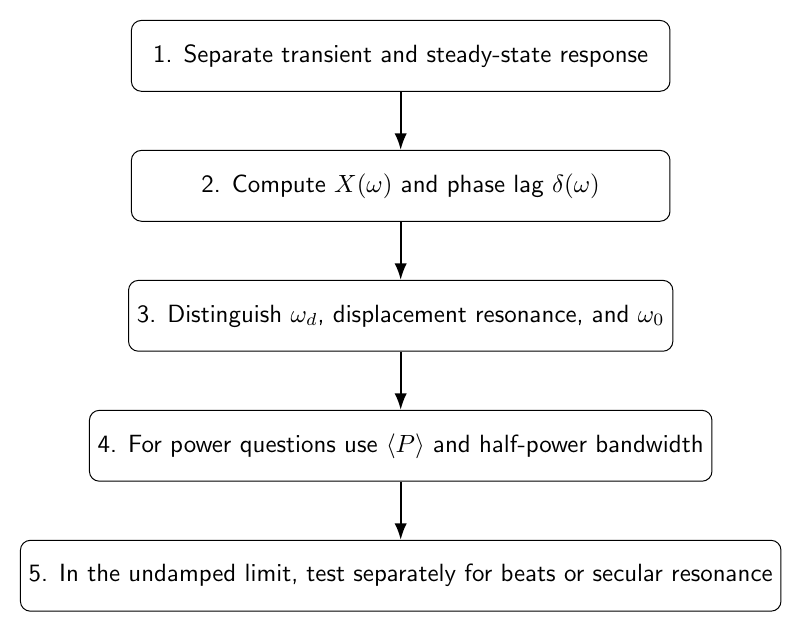
Figure 1. A compact driven-oscillator strategy: separate transient and steady state, compute amplitude and phase, distinguish displacement resonance from power resonance, and use bandwidth or Q as a consistency check.

1 High-value GRE facts

  1. The steady-state response oscillates at the driving frequency.
  2. Initial conditions determine the transient, not the long-time steady-state amplitude.
  3. X = F0∕∘ --------2-2-------2
  (k − m ω ) +  (bω).
  4. δ = π∕2 at ω = ω0.
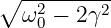
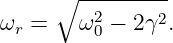
  5. displacement resonance occurs at ωr = ∘  ---------
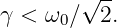
   ω20 − 2γ2 when γ < ω0∕√--
 2.
  6. velocity amplitude and average absorbed Power peak at ω0.
  7. The half-power bandwidth is Δω = 2γ = b∕m.
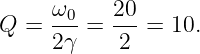
  8. Q = ω0∕(2γ) = mω0∕b.
  9. Low-frequency displacement tends to F0∕k.
  10. Exact undamped Resonance produces amplitude growing linearly with time.

Part I: Original GRE-style problems

Problem 1: steady-state frequency

A damped oscillator is driven sinusoidally at angular frequency ω. After transients disappear, the displacement oscillates at

  1. ω0 only
  2. ωd only
  3. ω
  4. ω + ω0
  5. zero frequency

Problem 2: amplitude

The steady-state amplitude is

  1. F0∕(k − mω2)
  2. F0∕∘ -------------------
  (k − m ω2)2 + (bω)2
  3. F0∕(bω) for all ω
  4. F0∕k for all ω
  5. F0mω2

Problem 3: phase at natural frequency

At

ω = ω0,
(4)

the displacement lags the force by

  1. 0
  2. π∕4
  3. π∕2
  4. 3π∕2
  5. 2π

Problem 4: displacement resonance

If damping is weak enough for a nonzero displacement-response maximum,

ωr
(5)

equals

  1. ∘ --2----2
  ω 0 + γ
  2. ∘ --2-----
  ω 0 − γ2
  3. ∘ ---------
  ω20 − 2γ2
  4. 2γ
  5. ω0 + γ

Problem 5: resonance condition

A nonzero-frequency displacement peak exists if

  1. γ > ω0
  2. γ = ω0
  3. γ < ω0∕√ --
  2
  4. γ > ω0∕√ --
  2
  5. b = 0 only

Problem 6: power resonance

The average absorbed power is maximum at

  1. ω = 0
  2. ω = ωr
  3. ω = ωd
  4. ω = ω0
  5. ω = 2ω0

Problem 7: bandwidth

For viscous damping, the half-power bandwidth is

  1. γ
  2. 2γ
  3. ω0
  4. ω0∕γ
  5. γ2∕ω 0

Problem 8: quality factor

If

                         −1
ω0 = 20rad ∕s,    γ = 1 s  ,
(6)

then

Q
(7)

is

  1. 5
  2. 10
  3. 20
  4. 40
  5. 400

Problem 9: low-frequency response

As

ω →  0,
(8)

the displacement amplitude approaches

  1. zero
  2. F0∕k
  3. F0∕b
  4. F0∕m
  5. infinity

Problem 10: high-frequency response

For

ω ≫  ω0,
(9)

the displacement amplitude scales approximately as

  1. ω2
  2. ω
  3. 1∕ω
  4. 1∕ω2
  5. a constant

Problem 11: exact undamped resonance

For

b = 0,    ω =  ω0,
(10)

a resonant particular solution is proportional to

  1. cos ω0t
  2. e−ω0t
  3. t sin ω0t
  4. t2
  5. sin 2ω0t

Problem 12: impedance

At

ω = ω0,
(11)

the mechanical impedance

Z =  b + i(m ω − k ∕ω)
(12)

becomes

  1. 0
  2. ib
  3. b
  4. mω0
  5. k∕ω0

Part II: Complete worked solutions

Solution 1

A linear time-invariant system driven at one sinusoidal frequency responds in steady state at that same frequency. The natural frequency appears in the amplitude and phase, not as a different long-time response frequency. Answer: (C).

Solution 2

The spring-inertia term and damping term combine in quadrature:

               F0
X  = ∘----------2-2------2-.
        (k − m ω  ) + (bω )
(13)

Answer: (B).

Solution 3

At

ω = ω0,
(14)

        2
k − m ω  = 0.
(15)

Thus the phase denominator is purely quadrature and

δ =  π∕2.
(16)

Answer: (C).

Solution 4

Maximizing displacement response gives

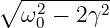
      ∘ ---------
ωr =    ω20 − 2γ2.
(17)

Answer: (C).

Solution 5

The quantity under the square root must be positive:

ω20 − 2γ2 > 0.
(18)

Therefore

        √ --
γ < ω0 ∕  2.
(19)

Answer: (C).

Solution 6

For viscous damping the average absorbed power peaks exactly at

ω = ω0.
(20)

Answer: (D).

Solution 7

The exact half-power bandwidth is

Δ ω =  2γ = b∕m.
(21)

Answer: (B).

Solution 8

Q =  ω0-=  20-= 10.
     2γ    2
(22)

Answer: (B).

Solution 9

At very low frequency the response is quasistatic:

      F0
X  →  ---.
      k
(23)

Answer: (B).

Solution 10

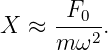
At high frequency inertia dominates:

X  ≈  -F0-.
      m ω2
(24)

Thus

X  ∝ ω− 2.
(25)

Answer: (D).

Solution 11

At exact undamped resonance the ordinary sinusoidal trial duplicates a homogeneous solution. Multiplying by

t
(26)

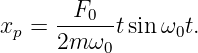
gives

       F0
xp = ------tsinω0t.
     2m  ω0
(27)

Answer: (C).

Solution 12

Since

        2
k = m ω 0,
(28)

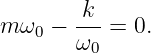
        k
m ω0 −  ---= 0.
        ω0
(29)

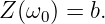
Therefore

Z (ω0) = b.
(30)

Answer: (C).

2 GRE checklist

  1. Separate transient and steady-state behavior before solving.
  2. Remember that the steady-state frequency is the drive frequency.
  3. Use atan2 for the response phase.
  4. Distinguish ωd, ωr, and ω0.
  5. Remember that displacement resonance and power resonance are not identical with finite damping.
  6. Use Δω = 2γ and Q = ω0∕Δω as fast resonance checks.
  7. At exact undamped resonance, use the secular t sin ω0t solution.
  8. At ω0, the mechanical impedance is purely dissipative.

References

References

[1]   PhysicsLibrary, M06-02, Damped Harmonic Motion.

[2]   PhysicsLibrary, M06-01, Simple Harmonic Motion.

[3]   A. P. French, Vibrations and Waves, W. W. Norton, 1971.

[4]   J. R. Taylor, Classical Mechanics, University Science Books, 2005.


"GRE Physics Companion: Driven Harmonic Motion and Resonance" is owned by bloftin.
(view preamble)
View style:
Other names:  M06-03G
Keywords:  GRE physics, driven oscillator, forced oscillator, resonance, frequency response, phase lag, quality factor, bandwidth, average power, mechanical impedance, beating

This object's parent.

Cross-references: power resonance, square, natural frequency, system, mechanical impedance, viscous damping, force, angular frequency, oscillator, Resonance, half-power bandwidth, Power, velocity, displacement resonance, frequency, steady-state response, phase, amplitude, displacement

This is version 1 of GRE Physics Companion: Driven Harmonic Motion and Resonance, born on 2026-10-18.
Object id is 1493, canonical name is GREPhysicsCompanionDrivenHarmonicMotionAndResonance.
Accessed 9 times total.

Classification:
Physics Classification: 45.50.-j (Dynamics and kinematics of a particle and a system of particles)
 45.05.+x (General theory of classical mechanics of discrete systems)

Pending Errata and Addenda

None.

Discussion

No messages.

Interact