Physics Library
 An open source physics library
Encyclopedia | Forums | Docs | Random  

[parent] examples of Complex Numbers as Vectors in the Complex Plane

(Example)

Complex Numbers as Vectors in the Complex Plane: Exercises and Complete Worked Solutions

This companion develops calculation skill with the geometric interpretation of complex numbers. It reinforces Cartesian form, real and imaginary parts, modulus, argument, principal argument, polar and exponential forms, conjugation, complex-plane displacement, and the real projection of a rotating complex vector. The exercises deliberately stop short of the later theorem that general complex multiplication multiplies magnitudes and adds angles.

Throughout the article,

j2 = − 1,
(1)

and the principal argument is chosen in the range

− π < Arg (z ) ≤ π.
(2)

Useful relations are

      √ -------
|z| =   a2 + b2,
(3)

Arg (z) = atan2(b,a),
(4)

z = r(cos𝜃 + j sin 𝜃) = rej𝜃,
(5)

and

z∗ = a − jb.
(6)

Part I: Exercises

Exercise 1: read Cartesian components

For

z = − 7 + 24j,
(7)

identify Re(z), Im(z), and the corresponding real two-dimensional vector.

Exercise 2: addition as vector addition

Let

z1 = 2 + 3j,     z2 = − 5 + j.
(8)

Find z1 + z2 and show that the result agrees with ordinary component-wise vector addition in the complex plane.

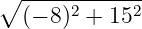
Exercise 3: modulus from geometry

Find the modulus of

z = − 8 + 15j.
(9)

Interpret the calculation geometrically.

Exercise 4: argument in quadrant I

For

         √ --
z = 5 + 5  3j,
(10)

find the modulus and principal argument. Give the argument in both radians and degrees.

Exercise 5: diagnose a quadrant mistake

A student evaluates

z = − 3 + 4j
(11)

using

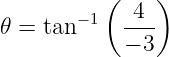
          (    )
        −1  -4-
𝜃 = tan     − 3
(12)

and reports

           ∘
𝜃 = − 53.13 .
(13)

Explain why this is geometrically wrong and find the correct principal argument.

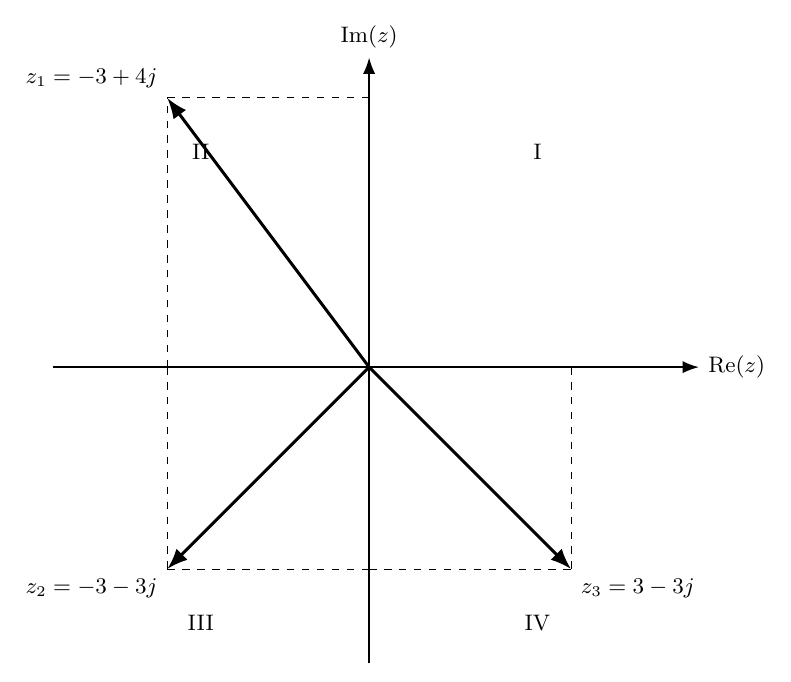
PIC

Figure 1. The sign of the real and imaginary parts fixes the quadrant. A one-argument inverse tangent cannot distinguish all four quadrants.

Exercise 6: Cartesian to polar and exponential form

Convert

z = − 5 + 12j
(14)

to

r(cos𝜃 + j sin𝜃 )
(15)

and to

rej𝜃.
(16)

Give the principal angle in radians and degrees.

Exercise 7: polar to Cartesian form

Convert

z = 7e−j2π∕3
(17)

to Cartesian form a + jb.

Exercise 8: all arguments and the principal argument

For

      √ --
z = −   3 − j,
(18)

find:

  1. the modulus;
  2. one convenient argument;
  3. the complete family of arguments; and
  4. the principal argument.

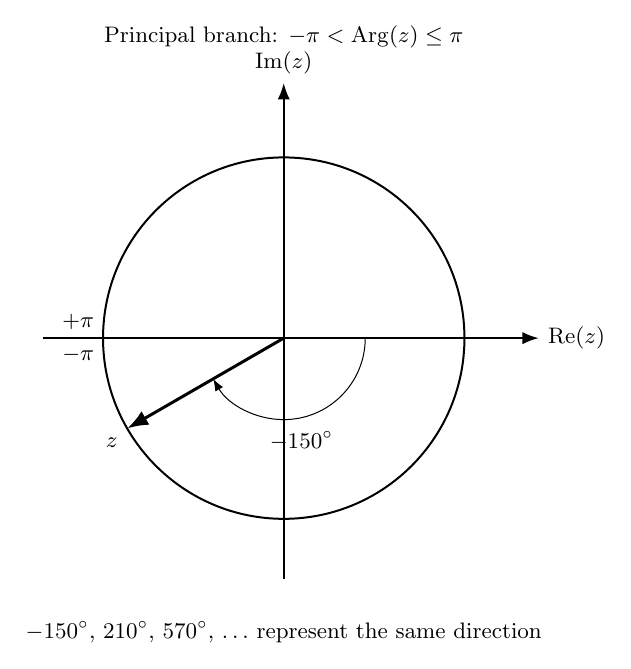
PIC

Figure 2. Arguments differing by integer multiples of 2π represent the same direction. The principal argument selects one representative from a chosen branch.

Exercise 9: conjugation as reflection

Let

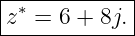
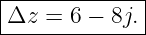
z = 6 − 8j.
(19)

Find z∗, |z|, |z∗|, Arg(z), and Arg(z∗). Describe the geometry.

Exercise 10: identities involving the conjugate

For a general complex number

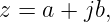
z = a + jb,
(20)

prove that

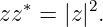
  ∗     2
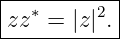
zz =  |z |.
(21)

Then show that

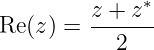
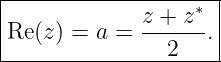
         z-+-z∗
Re (z) =   2
(22)

and

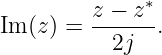
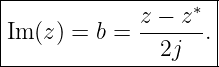
         z − z∗
Im(z) =  ------.
          2j
(23)

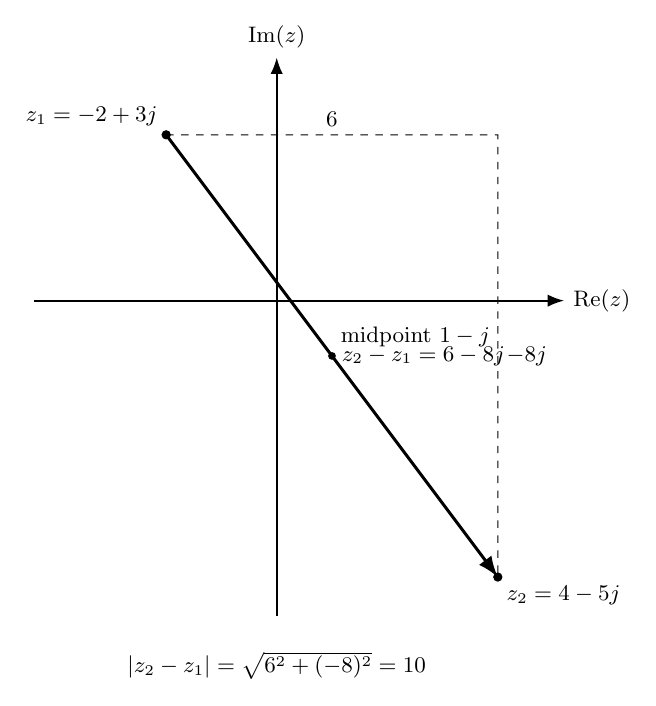
Exercise 11: complex-plane displacement and distance

Let

z =  − 2 + 3j,    z =  4 − 5j.
 1                 2
(24)

Define the complex-plane displacement from z1 to z2 by

Δz  = z −  z .
       2    1
(25)

Find Δz, the distance |Δz|, and the midpoint between the two points.

PIC

Figure 3. Subtracting two complex numbers gives the displacement between their points in the complex plane. The modulus of that displacement is the ordinary Euclidean distance.

Exercise 12: a circle described by complex notation

Interpret geometrically the locus

|z − (2 − j)| = 3.
(26)

State its center and radius, then write its equation in Cartesian coordinates x and y where z = x + jy.

Exercise 13: the unit circle and special directions

Evaluate each expression in Cartesian form:

ej0, ejπ∕2, ejπ, ej3π∕2, e−jπ∕4. (27)

Identify which of these lie on the coordinate axes and which lies in a quadrant.

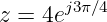
Exercise 14: exponential form with a non-unit modulus

Convert

       j3π∕4
z = 4e
(28)

to Cartesian form. Verify directly from the Cartesian components that its modulus is 4.

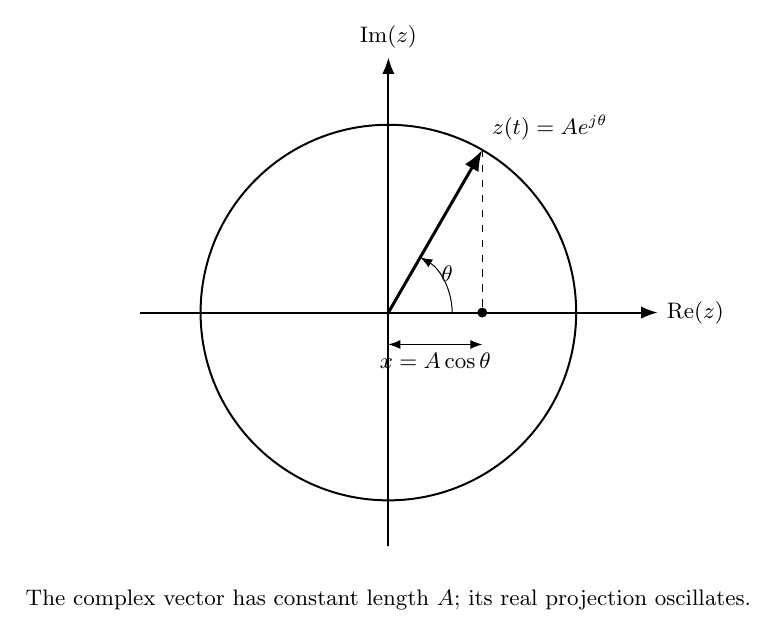
Exercise 15: rotating complex vector and real projection

Consider

         j(2t+π∕6)
z(t) = 5e       .
(29)

Find the real projection

x(t) = Re {z(t)}.
(30)

Then evaluate z(t) and x(t) at

t = 0,     t = π-,     t = π.
               12          6
(31)

Explain what remains constant as the complex vector rotates.

PIC

Figure 4. A rotating complex vector can have constant modulus while its real projection varies sinusoidally.

Exercise 16: comprehensive representation check

For

z =  − 6 − 8j,
(32)

find:

  1. Re(z) and Im(z);
  2. |z|;
  3. the principal argument in degrees and radians;
  4. the polar form;
  5. the exponential form;
  6. the conjugate z∗;
  7. zz∗; and
  8. the unit complex number z∕|z| pointing in the same direction as z.

Part II: Complete Worked Solutions

Solution 1: read Cartesian components

For

z = − 7 + 24j,
(33)

the real coefficient is −7 and the coefficient of j is 24. Therefore

|----------------------------|
Re-(z)-=-−-7,----Im-(z)-=-24.-
(34)

The corresponding real two-dimensional vector is

[----]-|
| − 7  |
| 24  .|
--------
(35)

Solution 2: addition as vector addition

Add real parts and imaginary parts separately:

z1 + z2 = (2 + 3j) + (−5 + j) (36)
= (2 − 5) + j(3 + 1) (37)
= −3 + 4j. (38)

In vector form,

[ ]   [    ]   [   ]
 2  +   − 5 =   − 3 .
 3       1       4
(39)

Thus

|------------------|
|z + z  = − 3 + 4j.|
--1---2-------------
(40)

Complex addition is therefore identical to component-wise vector addition in the complex plane.

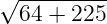
Solution 3: modulus from geometry

For

z = − 8 + 15j,
(41)

we have

|z| = ∘ ------------
  (− 8)2 + 152 (42)
= √ ---------
  64 + 225 (43)
= √ ----
  289 (44)
= 17. (45)

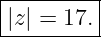
Hence

|--------|
|z|-=-17.-
(46)

Geometrically, this is simply the hypotenuse of a right triangle with legs of lengths 8 and 15.

Solution 4: argument in quadrant I

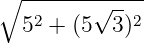
The modulus is

|z| = ∘ -------√----
  52 + (5  3)2 (47)
= √ --------
  25 + 75 (48)
= 10. (49)

The point lies in quadrant I, so

𝜃 = tan −1(  √ -)
  5  3
  -----
   5 (50)
= tan −1(√ --
  3) (51)
= π
--
3. (52)

Thus

|--------------------------------|
|                       π      ∘ |
||z| = 10,    Arg (z) = 3-=  60 .|
---------------------------------
(53)

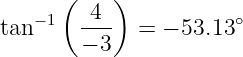
Solution 5: diagnose a quadrant mistake

The calculation

      (  4 )
tan−1   ---  = − 53.13∘
        − 3
(54)

identifies an angle with the correct tangent, but it points into quadrant IV. The actual point (−3, 4) has negative real part and positive imaginary part, so it lies in quadrant II.

The quadrant-II angle is

180∘ − 53.13∘ = 126.87∘.
(55)

Therefore

|-------------------------------------|
Arg (− 3 + 4j ) = 126.87 ∘ ≈ 2.2143 rad.
---------------------------------------
(56)

A two-argument arctangent, atan2(4,−3), returns the correct quadrant automatically.

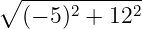
Solution 6: Cartesian to polar and exponential form

The modulus is

r = ∘ -----2-----2
  (− 5) +  12 (57)
= √ ----
  169 (58)
= 13. (59)

Because the point lies in quadrant II,

                                          ∘
𝜃 = atan2 (12, − 5 ) ≈ 1.96559 rad ≈ 112.620 .
(60)

Hence

|------------------------------------|
|z = 13 (cos 112.620∘ + j sin112.620 ∘)
-------------------------------------
(61)

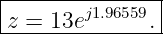
and

|--------------|
-z =-13ej1.96559.-
(62)

Solution 7: polar to Cartesian form

Use Euler’s formula:

z = 7[    (   2π)        (   2π ) ]
  cos  − ---  + j sin − ---
         3               3. (63)

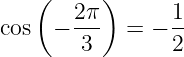
Since

   (   2π)      1
cos  − ---  = − --
       3        2
(64)

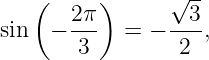
and

   (     )      √ --
sin  − 2-π  =  − --3,
       3         2
(65)

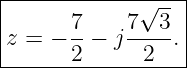
we obtain

|----------------|
|            √ --|
z = − 7-−  j7--3.|
------2------2----
(66)

Numerically,

z ≈  − 3.500 − 6.062j.
(67)

Solution 8: all arguments and the principal argument

For

      √ --
z = −   3 − j,
(68)

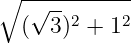
the modulus is

|z| = ∘ -----------
   √ --2    2
  (  3) +  1 (69)
= 2. (70)

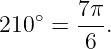
The point lies in quadrant III. One convenient positive argument is

        7π
210 ∘ = --.
        6
(71)

Therefore the full family of arguments may be written

|-----------------------------|
|       7π-                   |
arg z =  6 +  2πn,     n ∈ ℤ. |
-------------------------------
(72)

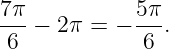
To place the angle in the principal range (−π,π], subtract 2π:

7π-          5π-
6  − 2π =  − 6 .
(73)

Thus

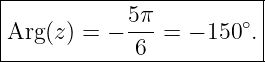
--------------------------
|           5π           |
|Arg(z) = − --- = − 150∘.|
-------------6------------
(74)

Solution 9: conjugation as reflection

For

z = 6 − 8j,
(75)

the conjugate is

|-∗----------|
-z-=--6 +-8j.|
(76)

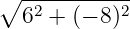
The moduli are

        ∗   √ -2----2
|z| = |z | =  6  + 8  = 10.
(77)

The principal arguments are

Arg (z ) ≈ − 53.13∘
(78)

and

Arg (z∗) ≈ +53.13 ∘.
(79)

Thus conjugation leaves the real coordinate and modulus unchanged while reversing the sign of the imaginary coordinate and reflecting the point across the real axis.

Solution 10: identities involving the conjugate

Start with

                 ∗
z = a + jb,     z =  a − jb.
(80)

Then

zz∗ = (a + jb)(a − jb) (81)
= a2 − jab + jab − j2b2 (82)
= a2 + b2. (83)

Since

|z |2 = a2 + b2,
(84)

we have

|----------|
|zz∗ = |z |2.|
------------
(85)

Next,

z + z∗ = (a + jb) + (a − jb) (86)
= 2a, (87)

so

|--------------------|
|             z +-z∗ |
|Re(z) = a =    2   .|
----------------------
(88)

Similarly,

z − z∗ = (a + jb) − (a − jb) (89)
= 2jb, (90)

so

|--------------------|
|             z −-z∗ |
|Im(z ) = b =  2j   .|
---------------------
(91)

Solution 11: complex-plane displacement and distance

The displacement is

Δz = z2 − z1 (92)
= (4 − 5j) − (−2 + 3j) (93)
= 6 − 8j. (94)

Therefore

|------------|
Δz  = 6 − 8j.|
--------------
(95)

Its modulus is

|Δz| = ∘ --2-------2
  6  + (− 8) (96)
= 10. (97)

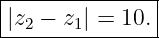
Thus the Euclidean distance between the points is

|--------------|
||z2 − z1| = 10.|
----------------
(98)

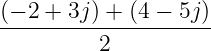
The midpoint is the average:

zm = z1 + z2
-------
   2 (99)
= (−-2-+-3j)-+-(4 −-5j)
          2 (100)
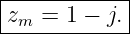
= 1 − j. (101)

Hence

|------------|
|zm =  1 − j.|
-------------
(102)

Solution 12: a circle described by complex notation

Write

z = x + jy.
(103)

Then

z − (2 − j) = (x − 2) + j(y + 1). (104)

The condition

|z − (2 − j)| = 3
(105)

means that every allowed point is a distance 3 from the point 2 −j. Therefore the locus is a circle centered at

|-------|
(2,−-1)--
(106)

with radius

|--|
-3.-
(107)

Squaring the modulus gives the Cartesian equation

|------------------------|
|(x − 2)2 + (y + 1 )2 = 9.|
-------------------------
(108)

Solution 13: the unit circle and special directions

Using Euler’s formula,

ej0 = 1, (109)
ejπ∕2 = j, (110)
ejπ = −1, (111)
ej3π∕2 = −j. (112)

For the last value,

e−jπ∕4 = cos (   π)
  − --
    4 + j sin (   π)
  − --
    4 (113)
= √1--
  2 − j√1--
  2. (114)

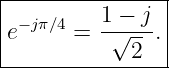
Thus

|---------------|
|− jπ∕4   1-−-j  |
e      =  √ --. |
------------2----
(115)

The first four values lie on the real or imaginary axes. The final value lies in quadrant IV.

Solution 14: exponential form with a non-unit modulus

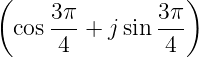
Use Euler’s formula:

z = 4(                 )
 cos 3π-+  j sin 3π
      4         4 (116)
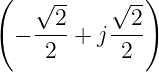
= 4(   √ --   √ -)
  − --2+  j--2-
     2      2 (117)
= −2√ --
  2 + 2√ --
  2 j. (118)

Therefore

|-------------------|
|      √ --   √ --  |
z-=-−-2--2-+-2--2-j.--
(119)

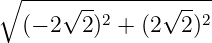
Check the modulus directly:

|z| = ∘  -------------------
      √ --2     √ --2
   (− 2  2)  + (2  2) (120)
= √ -----
  8 + 8 (121)
= 4. (122)

This agrees with the radial factor in the exponential form.

Solution 15: rotating complex vector and real projection

Euler’s formula gives

z(t) = 5 cos (     π )
  2t +--
       6 + j5 sin (      π)
  2t + --
       6. (123)

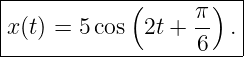
Therefore the real projection is

|----------------------|
|           (      π)  |
|x(t) = 5 cos 2t + 6- .|
------------------------
(124)

At t = 0,

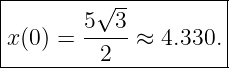
z(0) = 5ejπ∕6 (125)
=  √ --
5--3-
  2 + j5-
2, (126)

so

|--------√-----------|
|       5--3-        |
x (0 ) =  2   ≈ 4.330.|
----------------------
(127)

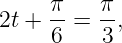
At t = π∕12,

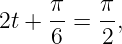
2t + π-= π-,
     6   3
(128)

so

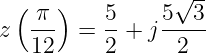
                √ --
 ( π-)    5-   5--3-
z  12  =  2 + j  2
(129)

and

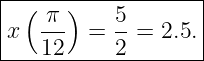
|------------------|
| ( π-)    5-      |
|x  12  =  2 = 2.5.|
--------------------
(130)

At t = π∕6,

     π   π
2t + --= --,
     6   2
(131)

so

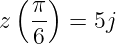
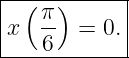
  (  )
z  π-  = 5j
   6
(132)

and

|--(--)------|
|   π-       |
-x---6--=-0.-|
(133)

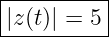
Throughout the motion,

|----------|
||z(t)| = 5 |
-----------
(134)

remains constant. The complex vector rotates while its real projection oscillates.

Solution 16: comprehensive representation check

For

z =  − 6 − 8j,
(135)

we immediately have

|------------------------------|
|Re (z) = − 6,    Im (z) = − 8.|
-------------------------------
(136)

The modulus is

|z| = ∘ --------------
  (− 6)2 + (− 8)2 (137)
= 10. (138)

The point lies in quadrant III. The principal argument is

|-----------------∘-----------------|
Arg-(z) ≈-−-126.87-≈--−-2.21430-rad.--
(139)

Hence the polar form is

|----------------------------------------|
|z = 10 [cos(− 126.87∘) + j sin(− 126.87∘)]
-----------------------------------------
(140)

and the exponential form is

|----------------|
-z-=-10e−-j2.21430.|
(141)

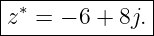
The conjugate is

|--------------|
|z∗ = − 6 + 8j.|
---------------
(142)

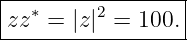
Also,

|--∗-----2-------|
zz--=--|z|--=-100.-
(143)

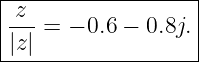
Finally,

-z-
|z| = −-6-−-8j
   10 (144)
= −0.6 − 0.8j. (145)

Thus

|------------------|
|-z-=  − 0.6 − 0.8j.
||z|               |
--------------------
(146)

This final quantity has unit modulus and preserves only the direction of z.

Problem-solving checklist

For basic complex-plane problems, a reliable sequence is:

  • read the real and imaginary coordinates directly from z = a + jb;
  • compute the modulus with the Pythagorean theorem;
  • determine the quadrant before interpreting an inverse tangent;
  • use atan2(b,a) when numerical software is available;
  • remember that arguments differing by 2πn describe the same direction;
  • use conjugation as reflection across the real axis; and
  • distinguish the constant modulus of a rotating complex vector from its time-varying real or imaginary projection.

References

[1]   F. S. Crawford, Jr., Waves, Berkeley Physics Course, Vol. 3, McGraw-Hill, 1968.

[2]   M. L. Boas, Mathematical Methods in the Physical Sciences, 3rd ed., Wiley, 2006.

[3]   J. W. Brown and R. V. Churchill, Complex Variables and Applications, 9th ed., McGraw-Hill Education, 2014.


"examples of Complex Numbers as Vectors in the Complex Plane" is owned by bloftin.
(view preamble)
View style:
Keywords:  complex number, complex plane, Cartesian form, vector representation, modulus, argument, principal argument, atan2, polar form, exponential form, complex conjugate, complex-plane distance, unit circle, rotating complex vector, exercises, worked solutions

This object's parent.

Cross-references: formula, unit, Cartesian coordinates, complex plane, vector addition, two-dimensional, relations, magnitudes, theorem, vector, displacement, conjugation, principal argument

This is version 1 of examples of Complex Numbers as Vectors in the Complex Plane, born on 2026-10-11.
Object id is 1468, canonical name is ExamplesOfComplexNumbersAsVectorsInTheComplexPlane.
Accessed 9 times total.

Classification:
Physics Classification: 02.30.-f (Function theory, analysis)
 02.10.-v (Logic, set theory, and algebra)

Pending Errata and Addenda

None.

Discussion

No messages.

Interact