|
|
|
|||||||
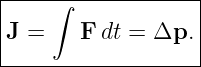
and
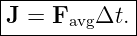
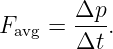
For a constant or average force,
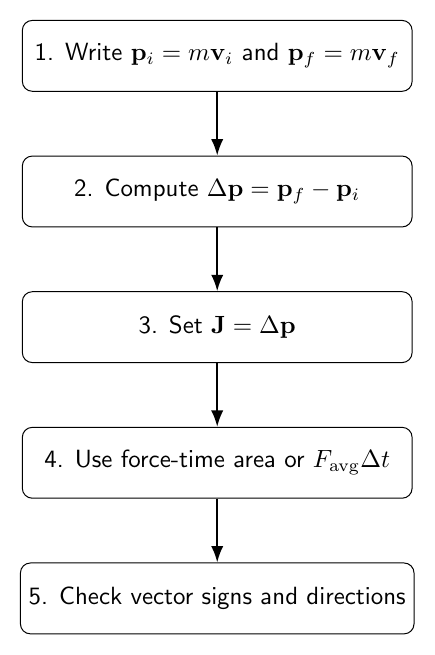
Figure 1. A compact strategy for momentum and impulse problems. Start from the vector momentum change, then relate it to force time area or average force.
1 High-value GRE facts
Part I: Original GRE-style problems
Problem 1: momentumA 3.0 kg object moves at 4.0 m∕s. Its momentum magnitude is
Problem 2: impulse from constant forceA constant force of 20 N acts for 0.30 s. The impulse magnitude is
Problem 3: velocity reversalA particle of mass m moves initially at velocity +v and finally at −v. Its momentum change is
Problem 4: triangular force pulseA force time pulse is triangular with base Δt and peak force F0. Its impulse is
Problem 5: average forceA particle’s momentum changes by 15 kg m∕s during 0.050 s. The average net force magnitude is
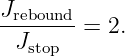
Problem 6: stopping versus reboundA ball approaches a wall with speed v. Case 1: it stops. Case 2: it rebounds with speed v. The ratio of impulse magnitudes is
Problem 7: impulse directionA puck initially has momentum 3ex kg m∕s and finally has momentum 3ey kg m∕s. Its impulse is
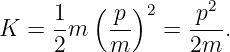
Problem 8: momentum and kinetic energyA particle has momentum magnitude p and mass m. Its kinetic energy is
Problem 9: collision-time scalingA fixed momentum change occurs over twice the original collision time. The average force magnitude becomes
Problem 10: force time areaA constant force F0 acts from 0 to T, followed by a force −F0 from T to 2T. The net impulse is
Problem 11: two-dimensional impulseA 2.0 kg particle changes velocity from (3, 0) m∕s to (0, 4) m∕s. The impulse vector is
Problem 12: momentum conservation bridgeIf the net external impulse on a particle system is zero, then
Part II: Complete worked solutions
Solution 1
Answer: (C).
Solution 2
Answer: (B).
Solution 3
Answer: (D).
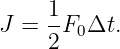
Solution 4The area of the triangular force time graph is
Answer: (B).
Solution 5
Answer: (D).
Solution 6Stopping changes momentum magnitude by mv. Rebounding with equal speed changes it by 2mv.
Answer: (C).
Solution 7
Answer: (B).
Solution 8Since p = mv, v = p∕m. Therefore
Answer: (D).
Solution 9For fixed Δp,
Doubling Δt halves Favg. Answer: (B).
Solution 10The positive and negative force time areas cancel:
Answer: (C).
Solution 11
Answer: (C).
Solution 12For a system,
If Jext = 0, then
Answer: (C).
2 GRE checklist
References
References
"example of Linear Momentum and Impulse" is owned by bloftin.
This object's parent. Cross-references: energy, internal forces, external force, system, speed, velocity, mass, particle, magnitude, impulse momentum theorem, dimensions, kinetic energy, work, collision, graph, force, vector, impulse, momentum, average force, relations This is version 1 of example of Linear Momentum and Impulse, born on 2026-10-04. Object id is 1390, canonical name is ExampleOfLinearMomentumAndImpulse. Accessed 11 times total. Classification:
|
|
|
|
Pending Errata and AddendaNone.
|
DiscussionNo messages.
|
Interact |
![[parent]](https://images.physicslibrary.org/images/uparrow.png)