|
|
|
|||||||
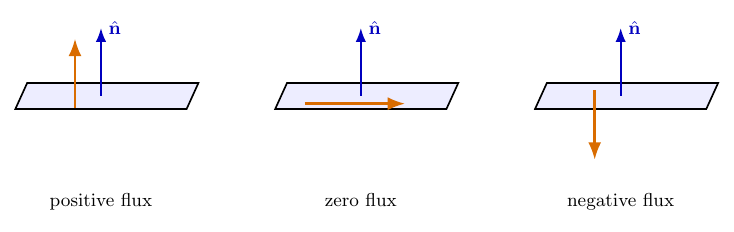
The angle 𝜃 is between the electric field and the chosen normal, not between the field and the surface itself. For a closed surface, the normal points outward by convention. Units: (N∕C)m2 = N m2∕C.
Figure 1. Positive, zero, and negative signed flux for the same magnitude of field through a planar patch. Only the normal orientation changes.
2 2. Worked example 1: a tilted rectangular plateA rectangular plate has side lengths 0.20 m and 0.35 m. A uniform electric field has magnitude E0 = 1200 N∕C and makes 60∘ with the chosen positive plate normal. Find the flux. The area is
Because the field is uniform and the normal is constant,
A rotation that changes the angle to 120∘ gives −42 N m2∕C. The negative sign states that the field crosses toward the negative side of the oriented plate. If the plane itself makes angle 30∘ with the field, the angle to its normal is 60∘, so confusing the angles would produce the wrong cosine factor.
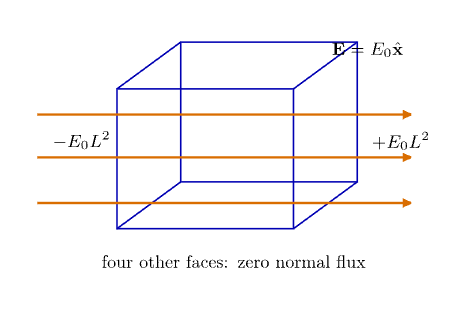
3 3. Worked example 2: flux through a cube in a uniform fieldLet a cube have side L, with its faces normal to the coordinate axes. Take E = E0x. The face at x = L has outward normal +x and area L2, hence
The opposite face has normal −x, so Φx=0 = −E0L2. The other four faces have normals perpendicular to x, and their contributions vanish. Consequently,
This is fully consistent with Gauss’s law because the uniform external field carries no source charge inside the cube. It does not mean that the field on the cube is zero.
Figure 2. A cube in a uniform field. The outward flux through the right face cancels the inward flux through the left face; the remaining four fluxes vanish.
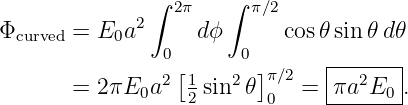
4 4. Worked example 3: curved hemisphere in a uniform fieldConsider the curved upper hemisphere of radius a, with E = E0z. Parametrize the sphere by polar angle 0 ≤ 𝜃 ≤ π∕2 from +z and azimuth 0 ≤ ϕ < 2π. The outward normal is r, with z ⋅r = cos 𝜃, and
Hence the curved-surface flux is
Why is this just E0 times the projected circular area? Because cos 𝜃 dA is the signed projection of each curved patch onto a plane normal to the field. To make a closed upper-half-ball, add the flat base disk at z = 0. Its outward normal is −z and its flux is −E0πa2. The closed-surface total is again zero.
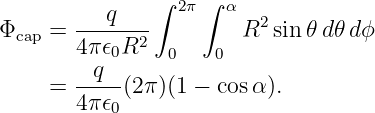
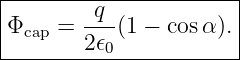
5 5. Worked example 4: a radial Coulomb field through a spherical capPlace a point charge q at the center of a sphere of radius R. Find the outward flux through the spherical cap 0 ≤ 𝜃 ≤ α. The field is radial and has magnitude ER = q∕(4π𝜖0R2) for q > 0. Thus
Therefore
At α = π∕2, the cap is a hemisphere and the flux is q∕(2𝜖0). At α = π, the cap is the full sphere and gives q∕𝜖0. Unlike the previous hemisphere problem, this field is radial rather than uniform. The integral remains simple because the field is constant in magnitude and normal to the centered sphere.
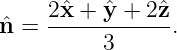
6 6. Worked example 5: off-axis orientation and a coordinate surfaceTake E = 2E0x − E0y + 3E0z. A planar patch of area A is oriented with unit normal
Verify normalization first: n ⋅n = (4 + 1 + 4)∕9 = 1. The dot product is
The flux is ΦE = 3E0A. This problem illustrates that vector-component calculation, rather than geometric visualization of the entire 3D angle, can often be the clearest method.
7 7. When Gauss’s law applies, and when it does not yield EAn open patch does not by itself enclose a charge, so Φ = qenc∕𝜖0 cannot be applied to that patch alone. One may close the patch with additional surfaces, compute the other fluxes, and subtract. Likewise, for an arbitrary closed surface the net flux gives only a single integral, not the local E without symmetry.
8 8. Exercises
9 9. Complete solutions
References
References
"example of Electric Flux: Orientations, Open Surfaces, and Closed Surfaces" is owned by bloftin.
This object's parent. Cross-references: enclosed charge, section, dot product, charge, source charge, flux, magnitude, units, electric field, vector, scalar, Normal, Gauss's Law There are 29 references to this object. This is version 1 of example of Electric Flux: Orientations, Open Surfaces, and Closed Surfaces, born on 2026-11-27. Object id is 1617, canonical name is ExampleOfElectricFluxOrientationsOpenSurfacesAndClosedSurfaces. Accessed 20 times total. Classification:
|
|
|
|
Pending Errata and AddendaNone.
|
DiscussionNo messages.
|
Interact |