The angular momentum p = m![[r˙r]](https://images.physicslibrary.org/cache/objects/611/make4ht/AngularMomentumOfASystemOfParticles0x.png) of a particle is equal to 2m times the ‘areal’ velocity of the
radius vector. The vector sum ∑
mk
of a particle is equal to 2m times the ‘areal’ velocity of the
radius vector. The vector sum ∑
mk![[rkr˙k]](https://images.physicslibrary.org/cache/objects/611/make4ht/AngularMomentumOfASystemOfParticles1x.png) , called the total angular momentum
of a system of particles, is one of the most important quantities in mechanics. We
shall now investigate the properties of this quantity. For this purpose we multiply the
equations of motion for a particle vectorially by rk and sum over all the particles. The result
is
, called the total angular momentum
of a system of particles, is one of the most important quantities in mechanics. We
shall now investigate the properties of this quantity. For this purpose we multiply the
equations of motion for a particle vectorially by rk and sum over all the particles. The result
is
The left member represents the time derivative of the quantity ∑
mk![[rk˙rk]](https://images.physicslibrary.org/cache/objects/611/make4ht/AngularMomentumOfASystemOfParticles3x.png) , that is, of the total
angular momentum. Further, the vector product of the radius vector to the point of application of
a force by the force vector is called the moment of the force Fk. We denote it by Mk. The
magnitude of Mk corresponds to the product of force by lever arm, in relation to turning about O.
The total moment of the external forces is given by ∑
, that is, of the total
angular momentum. Further, the vector product of the radius vector to the point of application of
a force by the force vector is called the moment of the force Fk. We denote it by Mk. The
magnitude of Mk corresponds to the product of force by lever arm, in relation to turning about O.
The total moment of the external forces is given by ∑
![[rkFk ]](https://images.physicslibrary.org/cache/objects/611/make4ht/AngularMomentumOfASystemOfParticles4x.png) . The second term in the right
member of (5), which represents the resultant of the moments of the internal forces, vanishes
if the internal forces between two particles have the direction of the line joining the
particles, i.e. if the forces are central. Thus, since Fjk = −Fkj, we have for any pair of
particles
. The second term in the right
member of (5), which represents the resultant of the moments of the internal forces, vanishes
if the internal forces between two particles have the direction of the line joining the
particles, i.e. if the forces are central. Thus, since Fjk = −Fkj, we have for any pair of
particles
But the vector product on the right vanishes, , since we are assuming that Fjk is in the direction of
rk − rj. There remains, therefore,
For a system of particles in which the forces between any two particles are in
the direction of the line joining these particles, the rate of change of the
total angular momentum is equal to the sum of the moments of the applied
forces.
The limitation made above is actually of little importance. From considerations of symmetry, it is
difficult to imagine a force acting between two points which does not coincide in direction with the
line joining them, for there is no other pre-eminent direction. If the Biot-Savart law
seems an exception, it must be remembered that this law deals with the force between a
magnetpole and an elementary segment (i.e. not a point or particle) of an Electrical
Conductor.
In the particular case in which there are no external forces acting, or if the total moment of the
forces vanishes, then, according to equation (7), the total angular momentum of the system
remains constant. In this form the theorem explains a large variety of phenomena of
everyday life, e.g. the method by which a child sets a swing in motion, the ability of a
falling cat to right itself before landing, the familiar turntable experiments, etc. This law
finds one of its most beautiful applications in explaining the Einstein-de Haas Effect in
Magnetism.
In general, the value of the total angular momentum depends upon the choice of the reference
point O. If, however, the center of gravity of the system is at rest, this quantity becomes
independent of the choice of O. If we denote the radius vector to a new center O′ by r
0 and a
radius vector emanating from O′ by r
k′, then
The angular momentum, referred to O, is
and referred to O′
If we put r0 + rk′ for r
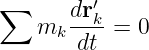
k in P, we have, on account of r0 = 0,
But the first term vanishes if
i.e. if the center of gravity is at rest.
0.1 References
[1] Joos, Georg. ”Theoretical physics” 3rd Edition, Hafner Publishing Company; New York,
1954.
This entry is a derivative of the Public domain work [1].

![[ ]
∑ d2rk- ∑ ∑ ∑
mk rk dt2 = [rkFk ] + [rkFjk ]
k k k j](https://images.physicslibrary.org/cache/objects/611/make4ht/AngularMomentumOfASystemOfParticles2x.png)
![[rkFjk] + [rjFkj ] = [(rk − rj)Fjk]](https://images.physicslibrary.org/cache/objects/611/make4ht/AngularMomentumOfASystemOfParticles5x.png)
![∑ ∑ [ ]
-d [rk˙rk] = dP- = rkF˙k = M
dt k dt k](https://images.physicslibrary.org/cache/objects/611/make4ht/AngularMomentumOfASystemOfParticles6x.png)

![∑
P = mk [rkr˙k ]
k](https://images.physicslibrary.org/cache/objects/611/make4ht/AngularMomentumOfASystemOfParticles8x.png)
![∑ [ ]
P ′ = m r′˙r′
k k k
k](https://images.physicslibrary.org/cache/objects/611/make4ht/AngularMomentumOfASystemOfParticles9x.png)
![∑ [ ] [ ∑ ]
P = m (r + r′)r˙′ = r m ˙r′ + P′
k 0 k k 0 k k
k k](https://images.physicslibrary.org/cache/objects/611/make4ht/AngularMomentumOfASystemOfParticles10x.png)