|
|
|
|||||||
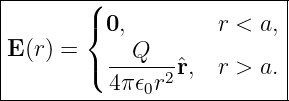
For r > a, the enclosed charge is Q, hence
At the charged surface itself, treat the field as one-sided limits. For Q > 0 the outward normal component jumps from 0 to Q∕(4π𝜖0a2), equal to σ∕𝜖 0 with σ = Q∕(4πa2).
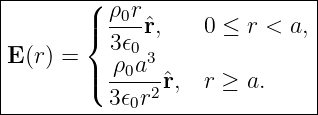
3 3. Worked example 2: uniformly charged solid sphereConsider a solid insulating ball of radius a and constant volume density ρ0. The enclosed charge at radius r < a is not the charge of the entire ball:
Gauss’s law gives
At r = a, both formulas give ρ0a∕(3𝜖0). The absence of a separate surface charge makes the normal field continuous. At the center the field tends to zero because no direction is preferred.
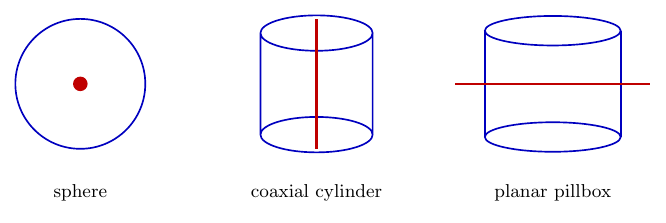
4 4. Worked example 3: infinite charged lineA straight, infinitely long line carries uniform line density λ > 0. Rotational symmetry about the line and translational symmetry along it require E = Es(s)s. Use a coaxial cylinder of radius s and length L. The side contributes Es(2πsL); the caps have axial normals, perpendicular to the field, so their flux is zero. The enclosed line charge is λL. Therefore
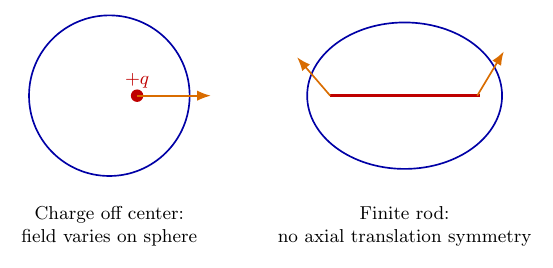
A finite rod does not possess translational invariance. Near its ends the field has an axial component, so this Gaussian argument cannot determine its pointwise field. The correct finite-rod calculation uses direct Coulomb integration.
5 5. Worked example 4: infinite uniform sheetLet an ideal infinite sheet at z = 0 carry uniform surface density σ > 0. Reflection symmetry across the sheet, combined with translations in the plane, demands a field normal to the sheet, equal in magnitude and opposite in sign on its two sides. The top and bottom caps of a pillbox of cross-sectional area A contribute EA each. The lateral sides contribute zero because their normals are parallel to the sheet. Since Qenc = σA,
The magnitude is independent of distance because the transverse dimensions are assumed infinite. If the sheet is finite, edge fringing invalidates the infinite-plane symmetry.
Figure 2. A finite charged rod and off-center point charge show why the Gaussian surface alone cannot create the translational or spherical symmetry needed to extract a local electric field.
6 6. Worked example 5: a conducting shell with a cavity chargeA conductor in electrostatic equilibrium has E = 0 within the metal. An isolated, initially neutral conductor contains a hollow cavity. A point charge +q is placed inside the cavity without touching the metal. Choose a Gaussian surface lying wholly within the conductor but surrounding the cavity. Its flux vanishes because the field in the metal is zero, so the total charge enclosed must vanish. The charge induced on the cavity wall must therefore be −q. Since the conductor began neutral, its exterior surface must have net charge +q. This is a global result; the inner-wall density is generally nonuniform if the point charge is off center. The exterior field need not be spherical unless the outer surface and other boundary conditions provide that symmetry.
7 7. Worked example 6: when Gaussian symmetry failsPlace two point charges of magnitudes +q at x = −a and +q at x = +a. Draw a Gaussian sphere centered midway between them, with radius r > a. The enclosed charge is 2q, so the total flux is 2q∕𝜖0. However, the two-source field is not spherically symmetric, and the component normal to the sphere varies with position. Therefore the formula E = 2q∕(4π𝜖0r2) cannot be used as the actual local field. It expresses the field of a hypothetical monopole at the center or the leading distant approximation, not the exact field of the separated pair.
8 8. Exercises
9 9. Complete solutions
References
References
"Gauss's Law by Symmetry: Sheets, Lines, Spheres, and Their Limits" is owned by bloftin.
This object's parent. Cross-references: charge conservation, position, boundary, net charge, electrostatic equilibrium, conductor, dimensions, formulas, volume density, solid, outward normal, spherical shell, types, magnitude, Normal, charge, enclosed charge, flux, Electric Field, Gauss's Law There are 14 references to this object. This is version 1 of Gauss's Law by Symmetry: Sheets, Lines, Spheres, and Their Limits, born on 2026-11-27. Object id is 1618, canonical name is GausssLawBySymmetrySheetsLinesSpheresAndTheirLimits. Accessed 15 times total. Classification:
|
|
|
|
Pending Errata and AddendaNone.
|
DiscussionNo messages.
|
Interact |