Physics Library
 An open source physics library
Encyclopedia | Forums | Docs | Random  

[parent] From a Charged Disk to an Infinite Sheet

(Example)

From a Charged Disk to an Infinite Sheet

1 Problem

A thin disk of radius R has uniform surface charge density σ > 0. Derive the axial field for z > 0. Take the infinite-radius limit at fixed z and the far-field limit at fixed R.

PIC

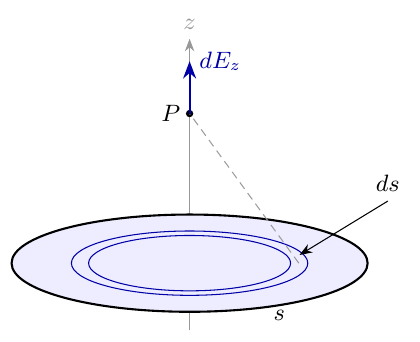
Figure 1. Partition the disk into annuli. The highlighted annulus at radius (s) has width (ds).

Try first. Use the ring result with dq = 2πsσ ds. Keep z fixed while integrating over radius s.

2 Worked solution

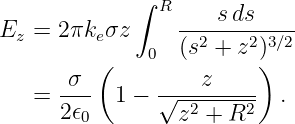
Each ring yields dEz = kez dq∕(s2 + z2)3∕2. Therefore

             ∫
                R ---s-ds-----
Ez  = 2πkeσz      (s2 + z2)3∕2
          (    0         )
    = -σ-  1 −  √---z----- .
      2𝜖0        z2 + R2
(1)

The antiderivative is −1∕√ -------
  s2 + z2, and the lower limit gives 1∕z for z > 0. For R →∞ at fixed z, the second term vanishes and Ez = σ∕(2𝜖0). For z ≫ R at fixed R, expand z∕√z2-+-R2- ≃ 1 − R2∕(2z2). Then E z ≃ ke(πR2σ)∕z2.

Check. The near-side field is positive and the far-side result contains the total disk charge. Reflection reverses Ez below the disk.

3 Practice variation

At what positive z is the field half its immediate above-surface value?

Solution. Set the bracket to 1∕2. This gives z∕√ --------
  z2 + R2 = 1∕2, hence z = R∕√ --
  3.

4 Track the annulus measure and both limits

The surface charge density σ is signed charge per unit area. For a uniformly charged disk the annulus measure gives dq = 2πσsds. In the field integral put u = s2 + z2, so sds = du∕2 and the new limits are z2 and R2 + z2. Its primitive is −1
2(2)u−1∕2 = −u−1∕2 including the substitution factor. Evaluating at the lower end gives 1∕|z| before multiplying by z. This explains why the sign reverses below the disk.

The infinite-sheet limit takes R →∞ while holding z≠0 and σ fixed. It holds charge per area fixed, so total charge diverges. By contrast, the distant-point limit keeps R and total charge fixed. For x = R2∕z2 ≪ 1 on the positive side, the expansion is

                  x   3x2
1 − (1 + x)−1∕2 = --− ---- + O (x3 ).
                  2     8
(2)

The first relative correction to the point-charge field is −3R2∕(4z2).

5 Worked example 2: derive the potential

For a finite disk choose zero potential at infinity. The ring potential contributes dV = ke dq∕√s2-+--z2. Using the same substitution but exponent −1∕2 gives

               √------- R          √ --------
V (z) = 2πke σ[ s2 + z2]0 = 2πke σ(  R2 + z2 − |z|).
(3)

The potential is continuous at zero. Its derivative away from zero reproduces the signed field. At fixed z, the potential itself diverges in the infinite-sheet limit with this reference. Differences between finite heights remain finite after the common leading 2πkeσR cancels.

PIC

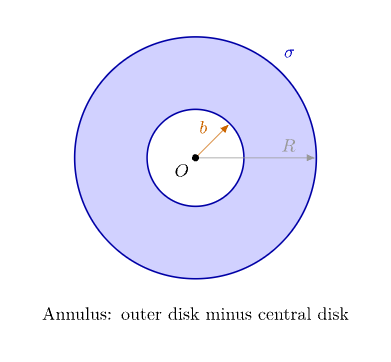
Figure 2. A uniform annulus is represented by subtracting a smaller disk from a larger disk with the same positive surface charge density.

6 Worked example 3: a uniformly charged annulus

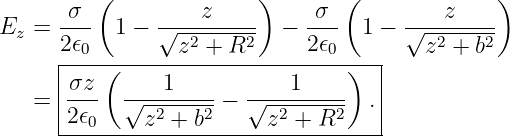
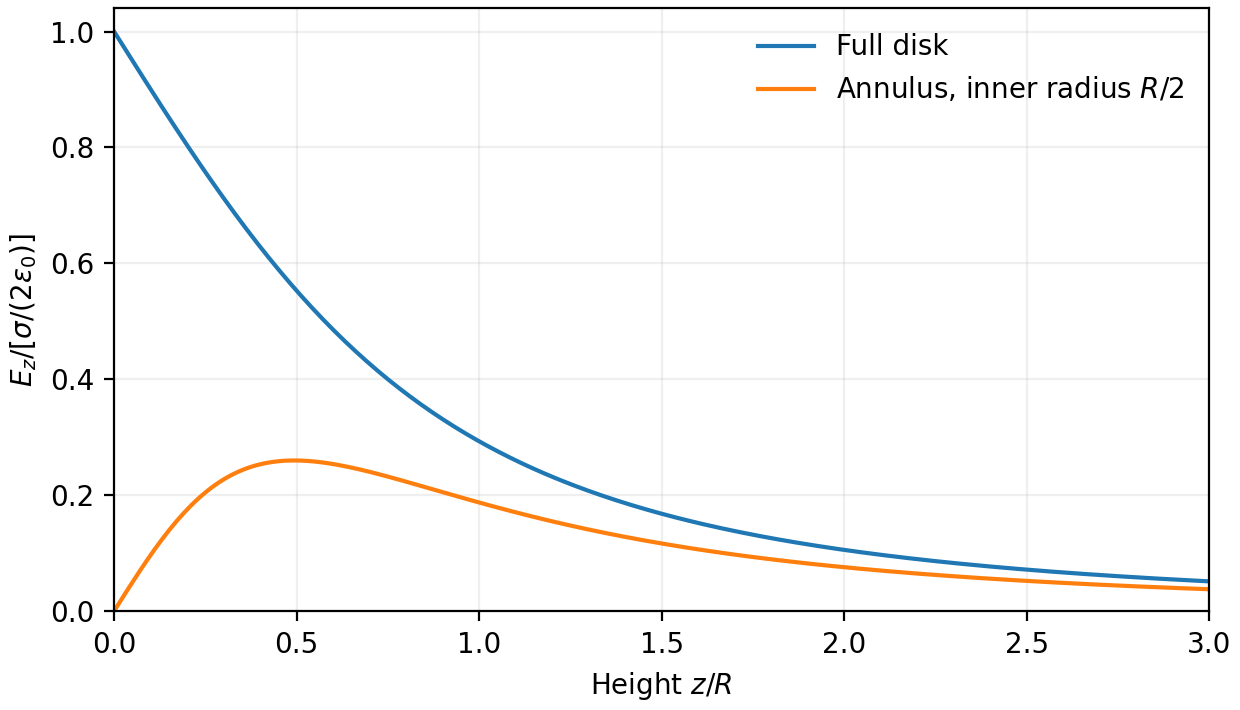
A disk with a circular hole of radius b and outer radius R (0 < b < R) has uniform density σ > 0. Regard it as a positive disk of radius R minus a positive disk of radius b. For z > 0, superposition yields

         (               )       (              )
Ez =  -σ-  1 − √---z-----  − -σ-   1 − √--z-----
      2𝜖0        z2 + R2     2 𝜖0         z2 + b2
      |---(----------------------)---|
   =  -σz   √---1----−  √---1----- . |
      2-𝜖0-----z2 +-b2-----z2 +-R2-----
(4)

The field vanishes at the center of the hole, z = 0, because the charged material never approaches the axis closer than b. For positive z it points upward. Far from the annulus, the total charge is Q = πσ(R2 − b2), so E z ≃ keQ∕z2.

7 Worked example 4: disk with charge increasing radially

Let the surface charge density vary as

σ(s) = σ0-s,     0 ≤ s ≤ R,
         R
(5)

where s is the source-ring radius. The total charge is

     ∫
        R   s-           2πσ0R2--
Q  =     σ0 R (2 πsds ) =    3   .
      0
(6)

For an axial observer at z > 0, the ring contribution gives

               ∫
      2πke-σ0z   R ---s2ds-----
Ez  =    R         (s2 + z2 )3∕2.
                0
(7)

Write s2 = (s2 + z2) − z2. The integral becomes

∫     ds       2 ∫      ds                          s
   √--2---2-− z     --2---2-3∕2-= arsinh (s∕z) − √--2----2.
     s + z          (s + z )                      s +  z
(8)

Both terms vanish at s = 0, so the final field is

|-----------------[-------------------------]----------|
|E  (z ) = 2πkeσ0z- arsinh(R ∕z) − √---R----- ,  z >  0.|
|  z         R                      R2 + z2            |
-------------------------------------------------------
(9)

At z ≫ R, the bracket is R3∕(3z3) + ⋅⋅⋅ ; therefore E z ≃ 2πkeσ0R2∕(3z2) = k eQ∕z2. As z → 0+ the field approaches zero, consistent with σ(0) = 0 and the circular symmetry of the surrounding charge. The logarithm in the bracket diverges, but its product with z tends to zero.

PIC

Figure 3. Normalized fields of a full disk and an annulus with inner radius R∕2. The annular field vanishes at the center of its hole, while the full disk has a nonzero one-sided field there.

8 Worked example 5: compare two different infinite-radius limits

There are two physically distinct ways to let the disk radius R grow. In the first, hold σ fixed. Total charge Q = πR2σ then grows without bound, and the fixed-height field approaches σ∕(2𝜖0).

In the second, hold the total charge Q fixed. Then σ = Q∕(πR2) falls as R−2, so

             (               )
Ez =  --Q----  1 − √---z-----  − → 0   (R →  ∞,  z > 0 fixed ).
      2π𝜖0R2         z2 + R2
(10)

The geometry is similar, but the amount of charge in the limiting process is not. A physically meaningful limit must specify which parameters remain fixed.

9 Exercises

Exercise 1. Take the field immediately below the disk center and compare to the field immediately above.

Solution. The one-sided values are −σ∕(2𝜖0) and +σ∕(2𝜖0), respectively. Their difference in the +z Normal direction is σ∕𝜖0.

Exercise 2. Take R →∞ while holding total charge Q fixed at positive z.

Solution. Now σ = Q∕(πR2) falls to zero. The parenthetical factor tends to one, so the field tends to zero, unlike the fixed-density limit.

10 Further exercises and complete solutions

  1. A disk has R = 10 cm and σ = 2.0 μC∕m2. Find the field immediately above its center. Solution. Ez(0+) = σ∕(2𝜖 0) = (2.0 × 10⁻⁶)∕(2 × 8.854 × 10−12) ≃ 1.13 × 10⁵ N∕C.
  2. A uniform annulus has b = R∕2. What fraction of a full uniform disk’s total charge does it carry? Solution. Qann∕Qdisk = (R2 − b2)∕R2 = 1 − 1∕4 = 3∕4.
  3. Why is the field continuous through the center of the annulus but discontinuous through charged portions of the ideal disk? Solution. The hole has no surface charge at the center and the surrounding sources are at finite distance. Across a charged sheet the normal field jumps by σ∕𝜖0, while at the hole center σ = 0 and the field remains continuous.
  4. For a uniform disk, estimate the first correction to a point-charge field at z ≫ R. Solution. Expand 1−(1+R2∕z2)−1∕2 = R2∕(2z2)−3R4∕(8z4)+⋅⋅⋅ . After multiplying by σ∕(2𝜖0), the point-charge result receives relative correction −3R2∕(4z2).

References

References

[1]   P. Dourmashkin et al., Electricity and Magnetism, MIT TEAL, chapter 2.

[2]   D. J. Griffiths, Introduction to Electrodynamics, 4th ed., chapters 2–3.

[3]   Massachusetts Institute of Technology, Electricity and Magnetism: Electrostatics, MIT Open Learning Library, 8.02.1x, course materials.


"From a Charged Disk to an Infinite Sheet" is owned by bloftin.
(view preamble)
View style:
Other names:  ES02E8
Keywords:  charged disk, surface charge, ring integration, infinite-sheet limit

This object's parent.

Cross-references: Normal, parameters, superposition, unit, charge, surface charge density

This is version 1 of From a Charged Disk to an Infinite Sheet, born on 2026-11-27.
Object id is 1615, canonical name is FromAChargedDiskToAnInfiniteSheet.
Accessed 11 times total.

Classification:
Physics Classification: 41.20.Cv (Electrostatics; Poisson and Laplace equations, boundary-value)

Pending Errata and Addenda

None.

Discussion

No messages.

Interact