Physics Library
 An open source physics library
Encyclopedia | Forums | Docs | Random  

[parent] GRE Physics Companion: Variable-Mass Systems and the Rocket Equation

(Example)

GRE Physics Companion: Variable Mass Systems and the Rocket Equation

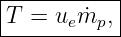
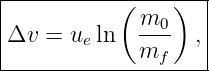
The core rocket relations are

|----------|
T--=-uem˙p,--
(1)

|----------(----)--|
Δv  = ue ln   m0-  ,|
|            mf    |
--------------------
(2)

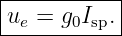
and

|----------|
ue =  g0Isp.|
------------
(3)

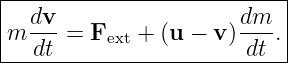
For a one-stream variable mass system,

|--------------------------|
|  dv-                 dm--|
|m dt = Fext + (u − v )dt .|
----------------------------
(4)

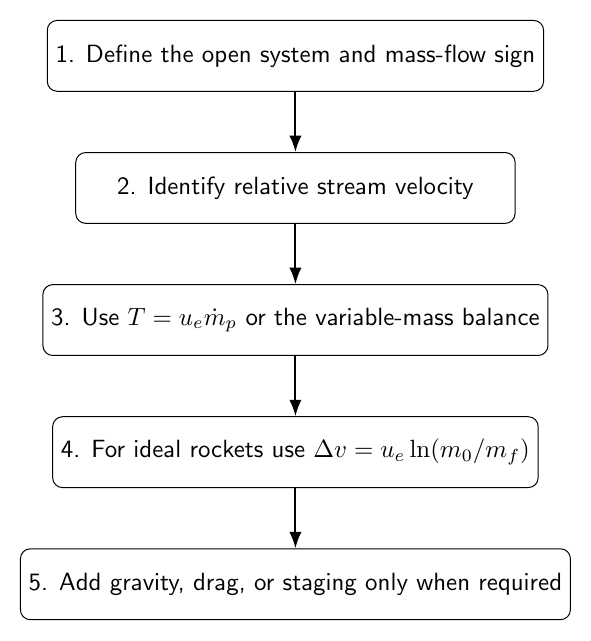
PIC

Figure 1. A compact strategy for variable mass and rocket problems. Define the mass-flow sign convention first, then use momentum flux, thrust, and the logarithmic mass-ratio relation consistently.

1 High-value GRE facts

  1. A rocket body alone is an open variable mass system.
  2. Momentum carried by exhaust must appear in the momentum balance.
  3. For a rocket, dm∕dt < 0 while positive propellant flow is ṁp = −dm∕dt.
  4. Thrust is T = ueṁp.
  5. Ideal delta-v is logarithmic in mass ratio.
  6. Required mass ratio is exponential in desired delta-v.
  7. specific impulse satisfies ue = g0Isp.
  8. Constant thrust does not imply constant acceleration because mass changes.
  9. Gravity and drag reduce actual velocity gain relative to ideal propulsive delta-v.
  10. Ideal stage delta-v values add.

Part I: Original GRE-style problems

Problem 1: thrust

An engine ejects propellant at effective exhaust speed 2500 m∕s with propellant flow rate 20 kg∕s. The thrust is

  1. 125 N
  2. 2500 N
  3. 12500 N
  4. 50000 N
  5. 100000 N

Problem 2: ideal delta-v

A rocket has mass ratio m0∕mf = e and exhaust speed ue. Its ideal delta-v is

  1. ue∕e
  2. ue
  3. eue
  4. ue2
  5. zero

Problem 3: mass ratio

A rocket requires ideal delta-v 2ue. Its required mass ratio is

  1. 2
  2. e
  3. e2
  4. 2e
  5. 4

Problem 4: specific impulse

An engine has Isp = 300 s. Taking g0 ≈ 9.8 m∕s2, its effective exhaust speed is closest to

  1. 30 m∕s
  2. 300 m∕s
  3. 980 m∕s
  4. 2940 m∕s
  5. 9800 m∕s

Problem 5: acceleration during burn

A rocket produces constant thrust while its mass decreases. Neglecting external forces, its acceleration magnitude

  1. decreases
  2. remains constant
  3. increases
  4. is always zero
  5. depends only on exhaust direction

Problem 6: rocket mass sign

During an ordinary rocket burn,

  1. dm∕dt > 0
  2. dm∕dt = 0
  3. dm∕dt < 0
  4. mass is undefined
  5. the sign depends on velocity

Problem 7: simplified gravity loss

A vertical rocket burn lasts 50 s. With constant g = 9.8 m∕s2 and no drag, the simple gravity loss is

  1. 49 m∕s
  2. 98 m∕s
  3. 245 m∕s
  4. 490 m∕s
  5. 980 m∕s

Problem 8: accreting cart

A cart with no external horizontal force captures stationary material. As its mass increases, its speed

  1. increases so that mv2 is constant
  2. decreases so that mv is constant
  3. remains constant
  4. becomes zero immediately
  5. increases linearly with mass

Problem 9: staging

Two ideal rocket stages provide delta-v values Δv1 and Δv2. Neglecting losses, total delta-v is

  1. Δv1 − Δv2
  2. Δv1Δv2
  3. Δv1 + Δv2
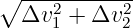
  4. ∘ -----------
  Δv21 + Δv22
  5. the larger of the two

Problem 10: propellant fraction

A rocket has mass ratio R = 4. Its idealized propellant fraction is

  1. 0.25
  2. 0.50
  3. 0.75
  4. 0.80
  5. 1.00

Problem 11: why momentum flux matters

Why is d(mv)∕dt = Fext not, by itself, a complete equation for the rocket body alone?

  1. Newton’s laws fail in vacuum.
  2. Mass crossing the rocket boundary carries momentum.
  3. Momentum is not conserved.
  4. Exhaust has zero velocity.
  5. Gravity must always be present.

Problem 12: complete material system

For rocket plus all expelled exhaust, with zero external force, the center-of-mass velocity

  1. increases with rocket speed
  2. decreases with rocket mass
  3. remains constant
  4. is always zero
  5. equals exhaust speed

Part II: Complete worked solutions

Solution 1

T = uem˙p  = (2500 )(20 ) = 50000 N.
(5)

Answer: (D).

Solution 2

Δv =  ueln e = ue.
(6)

Answer: (B).

Solution 3

R = eΔv∕ue = e2.
(7)

Answer: (C).

Solution 4

ue = g0Isp ≈ (9.8)(300 ) = 2940 m∕s.
(8)

Answer: (D).

Solution 5

    -T
a = m  .
(9)

As m decreases, a increases. Answer: (C).

Solution 6

During a burn the rocket loses mass:

dm--< 0.
dt
(10)

Answer: (C).

Solution 7

gtb = (9.8)(50) = 490 m ∕s.
(11)

Answer: (D).

Solution 8

For stationary incoming material and zero external horizontal force,

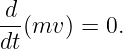
d-(mv ) = 0.
dt
(12)

Speed decreases as mass increases. Answer: (B).

Solution 9

Δv     =  Δv  + Δv  .
   total      1     2
(13)

Answer: (C).

Solution 10

fp = 1 − 1- = 1 − 1-=  0.75.
         R        4
(14)

Answer: (C).

Solution 11

The rocket body is an open system. Exhaust crossing the boundary carries momentum, so a momentum-flux term must be included. Answer: (B).

Solution 12

Rocket plus exhaust forms a closed material system. With zero external force, total momentum and center-of-mass velocity remain constant. Answer: (C).

2 GRE checklist

  1. State the mass-flow sign convention before writing equations.
  2. Use positive propellant flow ṁp = −dm∕dt when computing thrust.
  3. Use relative exhaust speed in the rocket equation.
  4. Remember the logarithm in Δv = ue ln(m0∕mf).
  5. Convert specific impulse with ue = g0Isp.
  6. For constant thrust, acceleration rises as mass falls.
  7. Subtract simple gravity loss from ideal delta-v.
  8. Treat accretion and exhaust as momentum-transfer problems, not fixed-mass problems.

References

References

[1]   G. P. Sutton and O. Biblarz, Rocket Propulsion Elements, 9th ed., Wiley, 2017.

[2]   J. R. Taylor, Classical Mechanics, University Science Books, 2005.

[3]   D. Kleppner and R. Kolenkow, An Introduction to Mechanics, 2nd ed., Cambridge University Press, 2014.


"GRE Physics Companion: Variable-Mass Systems and the Rocket Equation" is owned by bloftin.
(view preamble)
View style:
Other names:  M04-06G
Keywords:  GRE physics, variable mass, rocket equation, Tsiolkovsky equation, thrust, exhaust velocity, specific impulse, mass ratio, staging, momentum flux

This object's parent.

Cross-references: rocket equation, total momentum, system, open system, boundary, Newton's laws, force, magnitude, acceleration, external forces, speed, velocity, drag, constant acceleration, specific impulse, thrust, flux, momentum, mass, variable mass system, relations

This is version 1 of GRE Physics Companion: Variable-Mass Systems and the Rocket Equation, born on 2026-10-04.
Object id is 1399, canonical name is GREPhysicsCompanionVariableMassSystemsAndTheRocketEquation.
Accessed 5 times total.

Classification:
Physics Classification: 45.50.-j (Dynamics and kinematics of a particle and a system of particles)
 45.20.Dd (Newtonian mechanics)

Pending Errata and Addenda

None.

Discussion

No messages.

Interact