Physics Library
 An open source physics library
Encyclopedia | Forums | Docs | Random  

[parent] example of Linear Momentum and Impulse

(Example)

GRE Physics Companion: Linear Momentum and Impulse

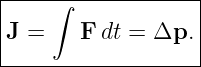
The central relations are

|--------|
-p-=-mv---
(1)

and

|----∫-------------|
|J =    F dt = Δp. |
--------------------
(2)

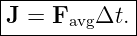
For a constant or average force,

|------------|
|J = FavgΔt. |
--------------
(3)

PIC

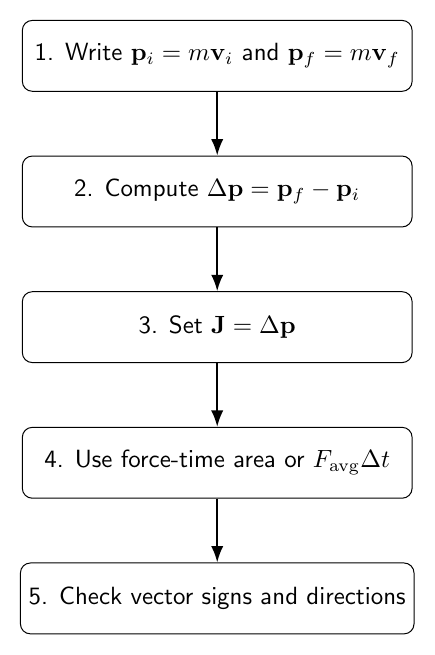
Figure 1. A compact strategy for momentum and impulse problems. Start from the vector momentum change, then relate it to force time area or average force.

1 High-value GRE facts

  1. Momentum is a vector: p = mv.
  2. Impulse is a vector: J = Δp.
  3. Area under a force time graph is impulse.
  4. Average force is Δp∕Δt.
  5. A rebound usually produces a larger momentum change than merely stopping.
  6. Increasing collision time lowers average force for fixed Δp.
  7. Impulse changes momentum; work changes kinetic energy.
  8. Momentum and kinetic energy are related by K = p2∕(2m).
  9. In two dimensions, apply the impulse momentum theorem component by component.
  10. During a very short impact, slowly varying forces may have negligible impulse, but this must be checked.

Part I: Original GRE-style problems

Problem 1: momentum

A 3.0 kg object moves at 4.0 m∕s. Its momentum magnitude is

  1. 0.75 kg m∕s
  2. 7.0 kg m∕s
  3. 12 kg m∕s
  4. 16 kg m∕s
  5. 48 kg m∕s

Problem 2: impulse from constant force

A constant force of 20 N acts for 0.30 s. The impulse magnitude is

  1. 0.067 N s
  2. 6.0 N s
  3. 20 N s
  4. 60 N s
  5. 66.7 N s

Problem 3: velocity reversal

A particle of mass m moves initially at velocity +v and finally at −v. Its momentum change is

  1. 0
  2. −mv
  3. +mv
  4. −2mv
  5. +2mv

Problem 4: triangular force pulse

A force time pulse is triangular with base Δt and peak force F0. Its impulse is

  1. F0∕Δt
  2. 1
2F0Δt
  3. F0Δt
  4. 2F0Δt
  5. F0Δt2

Problem 5: average force

A particle’s momentum changes by 15 kg m∕s during 0.050 s. The average net force magnitude is

  1. 0.75 N
  2. 30 N
  3. 75 N
  4. 300 N
  5. 750 N

Problem 6: stopping versus rebound

A ball approaches a wall with speed v. Case 1: it stops. Case 2: it rebounds with speed v. The ratio of impulse magnitudes is

  1. 1∕2
  2. 1
  3. 2
  4. 4
  5. depends on mass

Problem 7: impulse direction

A puck initially has momentum 3ex kg m∕s and finally has momentum 3ey kg m∕s. Its impulse is

  1. 3(ex + ey)
  2. 3(ey − ex)
  3. 6ex
  4. 6ey
  5. zero

Problem 8: momentum and kinetic energy

A particle has momentum magnitude p and mass m. Its kinetic energy is

  1. pm
  2. p∕m
  3. p2∕m
  4. p2∕(2m)
  5. 2p2∕m

Problem 9: collision-time scaling

A fixed momentum change occurs over twice the original collision time. The average force magnitude becomes

  1. one fourth as large
  2. one half as large
  3. unchanged
  4. twice as large
  5. four times as large

Problem 10: force time area

A constant force F0 acts from 0 to T, followed by a force −F0 from T to 2T. The net impulse is

  1. −2F0T
  2. −F0T
  3. 0
  4. F0T
  5. 2F0T

Problem 11: two-dimensional impulse

A 2.0 kg particle changes velocity from (3, 0) m∕s to (0, 4) m∕s. The impulse vector is

  1. (3, 4) N s
  2. (−3, 4) N s
  3. (−6, 8) N s
  4. (6, 8) N s
  5. (0, 10) N s

Problem 12: momentum conservation bridge

If the net external impulse on a particle system is zero, then

  1. each particle’s momentum is constant
  2. the system’s total kinetic energy is constant
  3. the system’s total momentum is constant
  4. every external force is zero
  5. all internal forces are zero

Part II: Complete worked solutions

Solution 1

p =  mv =  (3.0)(4.0) = 12 kgm ∕s.
(4)

Answer: (C).

Solution 2

J = F Δt =  (20)(0.30 ) = 6.0 N s.
(5)

Answer: (B).

Solution 3

Δp = m(−v) − m(+v) (6)
= −2mv. (7)

Answer: (D).

Solution 4

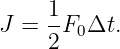
The area of the triangular force time graph is

    1
J = --F0Δt.
    2
(8)

Answer: (B).

Solution 5

F   =  Δp- = --15--=  300N.
 avg   Δt    0.050
(9)

Answer: (D).

Solution 6

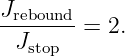
Stopping changes momentum magnitude by mv. Rebounding with equal speed changes it by 2mv.

Jrebound-= 2.
 Jstop
(10)

Answer: (C).

Solution 7

J = pf − pi (11)
= 3ey − 3ex (12)
= 3(ey − ex). (13)

Answer: (B).

Solution 8

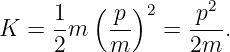
Since p = mv, v = p∕m. Therefore

        (   )
     1-   -p  2   p2--
K =  2m   m    =  2m .
(14)

Answer: (D).

Solution 9

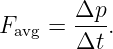
For fixed Δp,

       Δp
Favg = --- .
       Δt
(15)

Doubling Δt halves Favg. Answer: (B).

Solution 10

The positive and negative force time areas cancel:

J = F0T  − F0T =  0.
(16)

Answer: (C).

Solution 11

J = m(vf − vi) (17)
= 2[(0, 4) − (3, 0)] (18)
= (−6, 8) N s. (19)

Answer: (C).

Solution 12

For a system,

Jext = ΔP.
(20)

If Jext = 0, then

ΔP   = 0.
(21)

Answer: (C).

2 GRE checklist

  1. Write momentum with signs or vector components before calculating impulse.
  2. Use J = pf − pi.
  3. Use force time area when the force varies.
  4. Use Favg = Δp∕Δt only for the average force over the specified interval.
  5. For rebounds, carefully include the reversal of velocity.
  6. In two dimensions, work component by component.
  7. Do not substitute energy methods for impulse unless the problem actually asks for energy.
  8. For system questions, distinguish external impulse from internal forces.

References

References

[1]   J. R. Taylor, Classical Mechanics, University Science Books, 2005.

[2]   D. Kleppner and R. Kolenkow, An Introduction to Mechanics, 2nd ed., Cambridge University Press, 2014.

[3]   OpenStax, University Physics, Volume 1, Rice University, 2016.


"example of Linear Momentum and Impulse" is owned by bloftin.
(view preamble)
View style:
Other names:  M04-01G
Keywords:  GRE physics, momentum, impulse, impulse momentum theorem, average force, force time graph, collision force, vector momentum, impact

This object's parent.

Cross-references: energy, internal forces, external force, system, speed, velocity, mass, particle, magnitude, impulse momentum theorem, dimensions, kinetic energy, work, collision, graph, force, vector, impulse, momentum, average force, relations

This is version 1 of example of Linear Momentum and Impulse, born on 2026-10-04.
Object id is 1390, canonical name is ExampleOfLinearMomentumAndImpulse.
Accessed 10 times total.

Classification:
Physics Classification: 45.50.-j (Dynamics and kinematics of a particle and a system of particles)
 45.20.Dd (Newtonian mechanics)
Pending Errata and Addenda
None.
Discussion
Style: Expand: Order:

No messages.

Interact
rate | post | correct | update request | add example | add (any)