Physics Library
 An open source physics library
Encyclopedia | Forums | Docs | Random  

[parent] GRE Physics Companion: Work by Variable Forces

(Example)

GRE Physics Companion: Work by Variable Forces

Variable-force work problems are usually testing one of four ideas:

  1. recognizing work as a signed area under an Fx versus x graph,
  2. evaluating a simple integral,
  3. using Hooke’s law correctly,
  4. combining variable-force work with Wnet = ΔK.

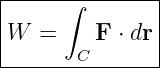
The central formulas are

|-----∫--------|
|W  =    F ⋅ dr|
-------C--------
(1)

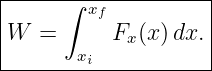
and, in one dimension,

|-----∫-------------|
|       xf          |
W  =      Fx (x )dx. |
-------xi------------
(2)

PIC

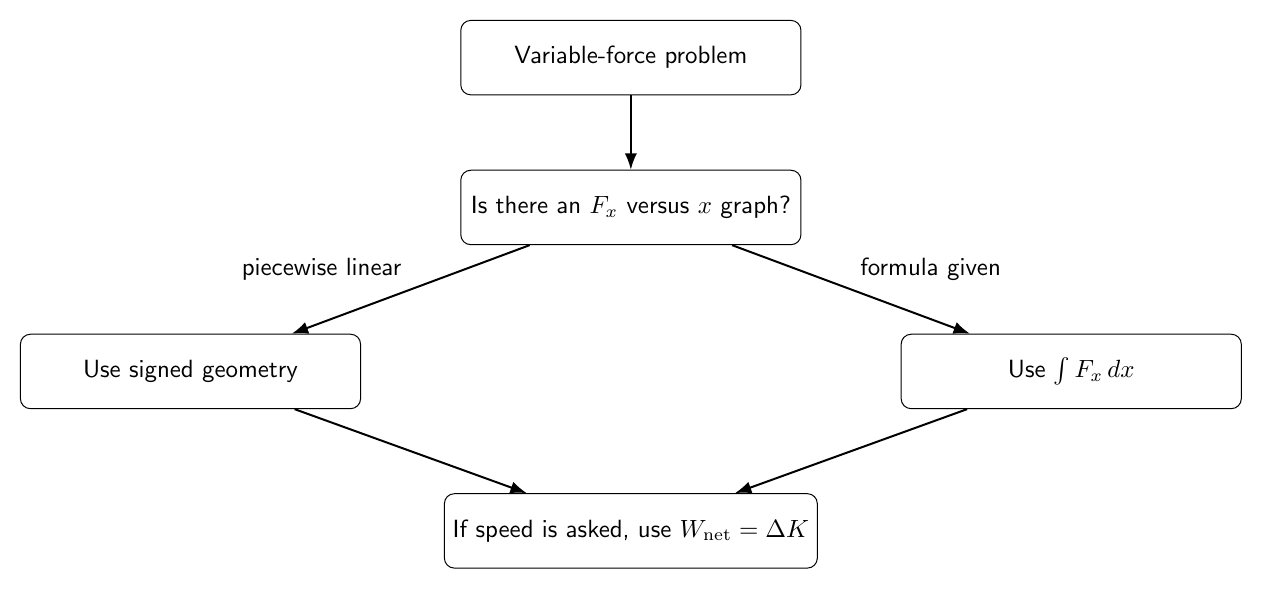
Figure 1. A fast GRE workflow for variable-force work. Identify whether the problem is geometric, integral-based, spring-based, or a work-energy problem, then use the corresponding shortest method.

1 High-value GRE facts

  1. Area under an Fx versus x graph has units of joules.
  2. Area under an Fx versus t graph has units of newton-seconds, not joules.
  3. Regions below the x axis on an Fx versus x graph contribute negative work.
  4. A linear force-position segment is usually fastest to handle with triangle or trapezoid area.
  5. For a spring, the force is Fx = −kx.
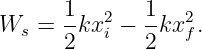
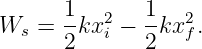
  6. Work done by a spring from xi to xf is
    W  =  1kx2 −  1kx2 .
  s   2   i   2   f
    (3)

  7. If a slowly applied external force stretches a spring from 0 to x, the external work is +1
2kx2.
  8. Reversing the same path reverses the sign of the work.
  9. In more than one dimension, the path can matter.
  10. The fastest route to speed is often
    Wnet = ΔK.
    (4)

Part I: Original GRE-style problems

Problem 1: linear force graph

A force increases linearly from 0 at x = 0 to 12 N at x = 4.0 m. The work done from x = 0 to x = 4.0 m is

  1. 12 J
  2. 18 J
  3. 24 J
  4. 36 J
  5. 48 J

Problem 2: positive and negative graph areas

From x = 0 to x = 6 m, the area between an Fx versus x curve and the axis is +30 J above the axis and 12 J below the axis. The net work is

  1. −42 J
  2. −18 J
  3. 18 J
  4. 30 J
  5. 42 J

Problem 3: power-law force

A one-dimensional force is

Fx = ax2.
(5)

The work done from x = 0 to x = L is

  1. aL
  2. aL2∕2
  3. aL3∕3
  4. aL3
  5. 2aL3

Problem 4: spring work

An ideal spring has k = 200 N∕m. What work does the spring do as it moves from x = 0.20 m to equilibrium?

  1. −8.0 J
  2. −4.0 J
  3. 0
  4. 4.0 J
  5. 8.0 J

Problem 5: stretching a spring farther

A spring with constant k is stretched slowly from x to 2x. The work done by the external agent during this part of the stretch is

  1. 1
2kx2
  2. kx2
  3. 3
2kx2
  4. 2kx2
  5. 4kx2

Problem 6: work-energy with variable force

A 2.0 kg particle starts from rest at x = 0 under the net force

Fx = 6x
(6)

in SI units. Its speed at x = 2.0 m is closest to

  1. 2.0 m∕s
  2. 3.5 m∕s
  3. 4.9 m∕s
  4. 6.0 m∕s
  5. 12 m∕s

Problem 7: average force

A force increases linearly with position from 4 N to 10 N over a displacement of 3.0 m. The work is

  1. 7 J
  2. 14 J
  3. 18 J
  4. 21 J
  5. 30 J

Problem 8: identifying the correct graph

Which graph has an area that directly equals mechanical work in one-dimensional motion?

  1. acceleration versus time
  2. velocity versus time
  3. force versus time
  4. force versus position
  5. momentum versus time

Problem 9: path dependence

A force field is

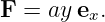
F = ay ex.
(7)

A particle moves from (0, 0) to (L,L).

Path A goes first along x at y = 0, then vertically at x = L. Path B goes first vertically to y = L, then horizontally to x = L.

Which statement is correct?

  1. Both paths give zero work.
  2. Both paths give aL2.
  3. Path A gives 0 and Path B gives aL2.
  4. Path A gives aL2 and Path B gives 0.
  5. The work is undefined because the endpoints are different.

Problem 10: reversing a path

A force does +15 J of work as a particle moves along a specified path from A to B. If the same geometric path is traversed from B back to A while the same force field applies, the work is

  1. −30 J
  2. −15 J
  3. 0
  4. +15 J
  5. +30 J

Part II: Complete worked solutions

Solution 1

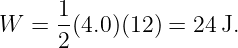
The force-position graph is a triangle:

W  =  1(4.0)(12) = 24J.
      2
(8)

Answer: (C).

Solution 2

Signed areas add:

W  = 30 − 12 = 18 J.
(9)

Answer: (C).

Solution 3

Integrate:

W = ∫ 0Lax2 dx (10)
= a[  3]
  x--
  30L (11)
=    3
aL--
 3. (12)

Answer: (C).

Solution 4

The spring work is

W  =  1kx2 −  1kx2 .
  s   2   i   2   f
(13)

Here

xi = 0.20 m,     xf =  0.
(14)

Thus

Ws = 1-
2(200)(0.20)2 (15)
= 4.0 J. (16)

The spring does positive work while returning toward equilibrium.

Answer: (D).

Solution 5

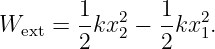
For a slow stretch, the external work from x1 to x2 is

        1   2   1  2
Wext =  -kx 2 − -kx1.
        2       2
(17)

With

x1 = x,    x2 =  2x,
(18)

we obtain

Wext = 1-
2k(2x)2 −1-
2kx2 (19)
= 2kx2 −1
--
2kx2 (20)
= 3
--
2kx2. (21)

Answer: (C).

Solution 6

The net work is

Wnet = ∫ 026xdx (22)
= [  2]
 3x 02 (23)
= 12 J. (24)

Since the particle starts from rest,

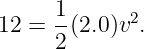
12 = 1(2.0)v2.
     2
(25)

Therefore

 2
v =  12,
(26)

so

v = 3.46 m∕s.
(27)

Answer: (B).

Solution 7

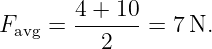
For a linearly varying force, the average force is the arithmetic mean:

        4 + 10
Favg =  -------= 7 N.
          2
(28)

Therefore

W  =  FavgΔx  = (7)(3.0 ) = 21 J.
(29)

Answer: (D).

Solution 8

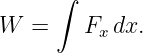
In one dimension,

     ∫
W  =    Fx dx.
(30)

Thus the signed area under a force-versus-position graph is work.

Answer: (D).

Solution 9

For Path A, the horizontal segment lies at y = 0, so

F  = 0.
(31)

The vertical segment is perpendicular to the force. Therefore

WA  = 0.
(32)

For Path B, the first vertical segment again gives zero work. The top horizontal segment lies at y = L, so

F  = aL e .
         x
(33)

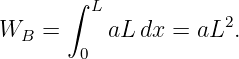
Hence

       ∫ L
WB  =     aL  dx = aL2.
        0
(34)

Answer: (C).

Solution 10

Reversing the same path changes

dr →  − dr.
(35)

Therefore

Wreverse = − Wforward = − 15J.
(36)

Answer: (B).

2 GRE checklist

Before integrating, ask whether geometry is faster.

  1. Is the force-position graph made of rectangles, triangles, or trapezoids?
  2. Have I included the sign of areas below the axis?
  3. If the force is a simple function, can I integrate it directly?
  4. If a spring appears, did I use F = −kx and distinguish work by the spring from work on the spring?
  5. If speed is requested, can I immediately use Wnet = ΔK?
  6. If the problem is multidimensional, has the path been specified?
  7. Am I integrating with respect to position rather than time when calculating work?

References

References

[1]   J. R. Taylor, Classical Mechanics, University Science Books, 2005.

[2]   D. Kleppner and R. Kolenkow, An Introduction to Mechanics, 2nd ed., Cambridge University Press, 2014.

[3]   OpenStax, University Physics, Volume 1, Rice University, 2016.


"GRE Physics Companion: Work by Variable Forces" is owned by bloftin.
(view preamble)
View style:
Other names:  M03-03G
Keywords:  GRE physics, variable force, work integral, force-position graph, Hooke's law, spring work, line integral, work-energy theorem, mechanics problems

This object's parent.

Cross-references: function, field, momentum, velocity, acceleration, motion, mechanical work, displacement, position, particle, equilibrium, net work, speed, external force, force, units, dimension, formulas, Hooke's law, graph, testing, work

This is version 1 of GRE Physics Companion: Work by Variable Forces, born on 2026-10-03.
Object id is 1376, canonical name is GREPhysicsCompanionWorkByVariableForces.
Accessed 5 times total.

Classification:
Physics Classification: 45.20.Dd (Newtonian mechanics)
 45.50.-j (Dynamics and kinematics of a particle and a system of particles)
Pending Errata and Addenda
None.
Discussion
Style: Expand: Order:

No messages.

Interact
rate | post | correct | update request | add example | add (any)