GRE Physics Companion: Drag Forces and Terminal Velocity
Drag problems are usually tests of force direction, terminal-state reasoning, and proportional
scaling. The quickest reliable method is to identify the velocity relative to the fluid, choose the
stated drag law, and then decide whether the problem concerns instantaneous acceleration or the
terminal condition.
1 Core relations
Relative velocity is
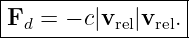
Linear drag is
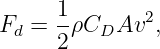
Quadratic drag is
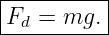
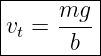
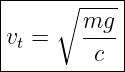
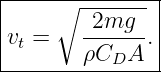
For downward terminal motion with negligible buoyancy,
Thus
for linear drag and
for quadratic drag.
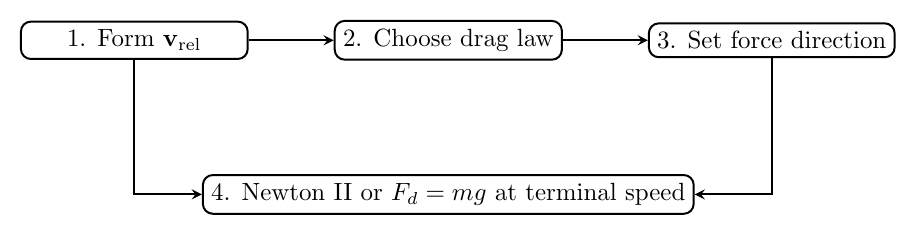
Figure 1. A compact drag-problem workflow: form the fluid-relative velocity, identify the drag
law, determine direction, then use Newton’s second law or the terminal-force balance.
2 High-value quadratic scaling
When
terminal speed is
Therefore
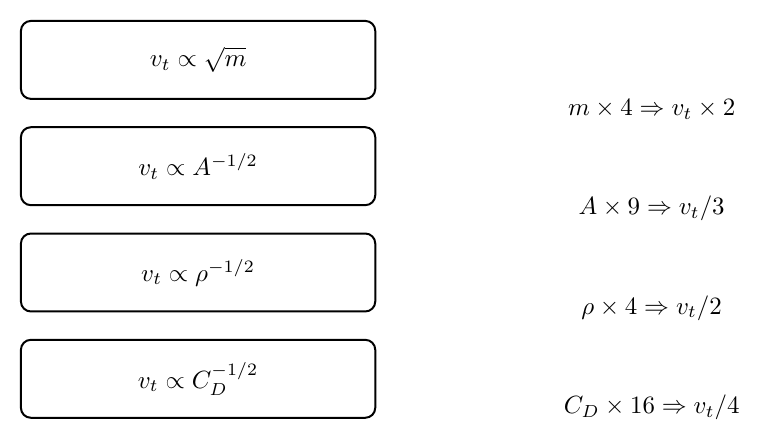
Figure 2. Quadratic-drag terminal-speed scaling. Multiplicative changes in mass or drag
parameters enter through square roots.
3 Worked GRE example 1: scaling without recomputing
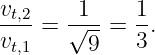
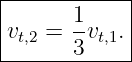
A falling object is modeled with quadratic drag. Its frontal area is increased by a factor of
9, while mass, fluid density, and CD remain unchanged. How does its terminal speed
change?
Since
we have
Therefore
4 Worked GRE example 2: instantaneous acceleration below terminal speed
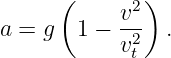
A body falls downward under quadratic drag and has terminal speed 30.0 m∕s. Find its downward
acceleration when its speed is 18.0 m∕s.
For quadratic drag,
Therefore
Thus
5 GRE speed questions
- A falling body has reached terminal velocity. Which statement is correct? (A) Its
velocity is zero. (B) Its acceleration is zero. (C) The drag force is zero. (D) Gravity no
longer acts.
- Under quadratic drag, the mass of a falling body is multiplied by 4 while all drag
parameters remain unchanged. Its terminal speed becomes (A) half as large (B)
unchanged (C) twice as large (D) four times as large.
- Under quadratic drag, the product CDA is multiplied by 16. The terminal speed
becomes (A) one-sixteenth as large (B) one-fourth as large (C) half as large (D) four
times as large.
- A runner moves east at 8 m∕s while the air moves east at 3 m∕s. The runner’s
air-relative speed is (A) 3 m∕s (B) 5 m∕s (C) 8 m∕s (D) 11 m∕s.
6 Answers and rationales
- B. Terminal velocity is a zero-net-force state, so acceleration is zero while velocity
remains nonzero.
- C. Quadratic-drag terminal speed scales as
 .
.
- B. Quadratic-drag terminal speed scales as (CDA)−1∕2.
- B. The relative velocity is 8 − 3 = 5 m∕s east.
7 Common GRE traps
- Setting velocity to zero at terminal speed instead of acceleration.
- Using the object’s ground speed instead of its fluid-relative speed.
- Forgetting that quadratic-drag terminal speed contains a square root.
- Using Fd = mg away from terminal conditions.
- Assuming drag always points upward; it opposes relative motion, whatever that
direction is.
References
[1] PhysicsLibrary, M02-10, Drag Forces and Terminal Velocity.
[2] PhysicsLibrary, M02-01, Newton’s Laws of Motion.
[3] OpenStax, University Physics, Volume 1, CC BY 4.0.

![[parent]](https://images.physicslibrary.org/images/uparrow.png)




![[ ( ) ]
18.0 2 2
a = 9.81 1 − 30.0 = 6.28 m ∕s.](https://images.physicslibrary.org/cache/objects/1368/make4ht/GREPhysicsCompanionDragForcesAndTerminalVelocity13x.png)
