GRE Physics Companion: Motion Graphs
This entry is the GRE-oriented companion to M01-04. The core article develops the slope and area
relationships among position, velocity, and acceleration graphs. Here the emphasis is rapid
recognition and efficient graphical reasoning.
1 Fast graph triage
Before calculating, identify two things:
- Which quantity is on the vertical axis?
- Is the problem asking for an instantaneous rate or an accumulated change?
For an instantaneous rate, use a slope:
For accumulated change, use signed area:
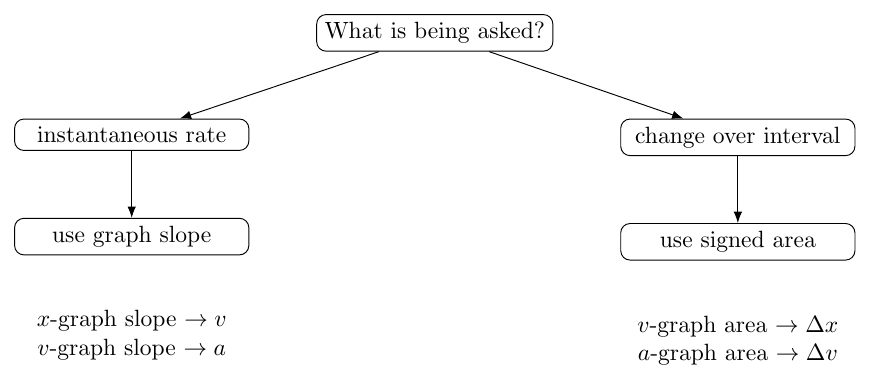
Figure 1. Test-day graph triage: use slope for instantaneous derivative information and signed
area for accumulated change.
2 High-frequency traps
- x = 0 means the object is at the origin, not necessarily at rest.
- v = 0 means momentary rest in that direction; a sign change indicates reversal.
- A horizontal v-t graph means a = 0, not v = 0.
- Area below a v-t axis is negative displacement.
- Distance traveled uses the magnitudes of positive and negative velocity areas.
- Area under an a-t graph gives Δv, not vf unless vi = 0.
- Concavity of x(t) gives the sign of acceleration; slope gives the sign of velocity.
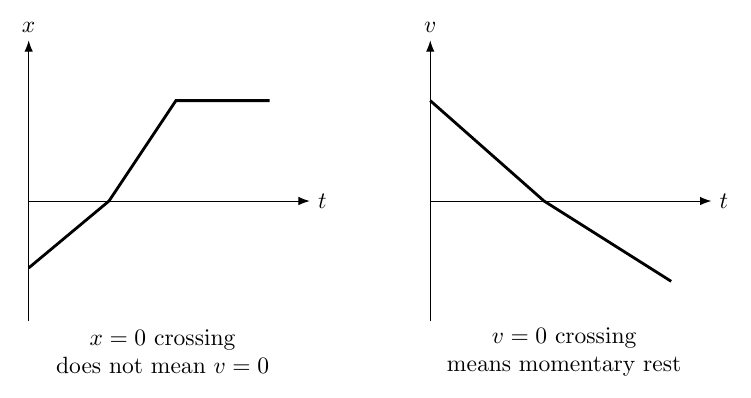
Figure 2. Two common graph-reading traps: crossing the position origin is different from crossing
zero velocity.
3 Worked GRE example 1: triangular velocity graph
A velocity-time graph rises linearly from 0 to 8 mm∕s during the first 4 s, then falls linearly back
to zero during the next 4 s. Find the displacement over the full 8 s.
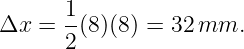
The displacement is the area under the graph. The graph is a triangle with base 8 s and height
8 mm∕s:
GRE shortcut: if the graph is made of triangles and rectangles, use geometry before attempting
an integral.
4 Worked GRE example 2: identify the turning point
A smooth position-time graph reaches a local maximum at t = 3 s. What can be stated about the
velocity at that instant?
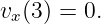
At a smooth local maximum, the tangent slope is zero. Therefore
If the slope changes from positive before 3 s to negative after 3 s, the particle reverses direction
there.
GRE shortcut: on an x-t graph, maxima and minima correspond to zero velocity when the graph
is differentiable.
5 GRE-speed questions
M01-04G-Q01
A position-time graph is a straight line of positive slope. The motion has
(A) positive constant velocity (B) positive constant acceleration (C) increasing speed
(D) zero velocity
M01-04G-Q02
A velocity-time graph is horizontal at −6 mm∕s. The acceleration is
(A) −6 mm∕s2 (B) 0 (C) +6 mm∕s2 (D) impossible to determine
M01-04G-Q03
A velocity-time graph is constant at +5 mm∕s for 4 s. The displacement is
(A) 1.25 mm (B) 9 mm (C) 20 mm (D) 25 mm
M01-04G-Q04
An acceleration-time graph is constant at −3 mm∕s2 for 2 s. The change in velocity
is
(A) −6 mm∕s (B) −1.5 mm∕s (C) 0 (D) +6 mm∕s
M01-04G-Q05
A velocity-time graph crosses from positive values to negative values. At the crossing the
particle
(A) must be at the origin (B) is momentarily at rest and reverses direction (C) has zero
acceleration (D) has maximum speed
M01-04G-Q06
A smooth position-time graph is increasing and concave downward. Which signs are
correct?
(A) v > 0, a > 0 (B) v > 0, a < 0 (C) v < 0, a > 0 (D) v < 0, a < 0
M01-04G-Q07
The signed area under a velocity-time graph over an interval is zero. Which statement must be
true?
(A) The particle never moved. (B) Its final position equals its initial position. (C) Its
speed was always zero. (D) Its acceleration was zero.
M01-04G-Q08
The area under an acceleration-time graph from 0 to 5 s is +12 mm∕s. If the initial velocity is
−4 mm∕s, the final velocity is
(A) −16 mm∕s (B) −8 mm∕s (C) +8 mm∕s (D) +12 mm∕s
6 Answers and brief rationales
- Q01: A. Constant slope on an x-t graph means constant velocity.
- Q02: B. Acceleration is the slope of the v-t graph, which is zero.
- Q03: C. Displacement is rectangular area: (5)(4) = 20 m.
- Q04: A. The area under a(t) is Δv = (−3)(2) = −6 m/s.
- Q05: B. Zero velocity with a sign change indicates reversal.
- Q06: B. Positive slope means positive velocity; concave downward means negative
acceleration.
- Q07: B. Zero signed velocity area means zero displacement, even if distance traveled
is nonzero.
- Q08: C. vf = vi + Δv = −4 + 12 = 8 m/s.
7 Test-day summary
The four most useful graph rules are
and
When a graph contains straight segments, triangles, or rectangles, geometry is usually faster than
symbolic integration.
References
[1] PhysicsLibrary, M01-04: Motion Graphs in Kinematics, core companion article.
[2] OpenStax / cnxuniphysics, University Physics Volume 1, archived 2016 BCcampus
clone, CC BY 4.0.
[3] University of California, Davis, Physics 9A: Classical Mechanics, Physics LibreTexts,
CC BY-SA 4.0.

![[parent]](https://images.physicslibrary.org/images/uparrow.png)