Velocity in Mechanics
Velocity describes how position changes with time. In one dimension it may be represented by a
signed scalar component such as vx. In two or three dimensions it is a vector: it has both
magnitude and direction.
This article develops velocity from the position and displacement concepts of M01-01. The central
ideas are
for average velocity and
for instantaneous velocity.
The magnitude of velocity is the speed,
These definitions are simple, but they encode several important distinctions: average versus
instantaneous quantities, vector velocity versus scalar speed, endpoint displacement versus path
length, and coordinate components versus the physical velocity vector.
1 Average velocity
Suppose a particle moves from position r1 at time t1 to position r2 at time t2. The displacement
is
and the elapsed time is
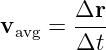
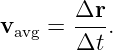
The average velocity over that interval is defined as
Average velocity therefore points in the direction of the net displacement, not necessarily along
every part of the path traveled.
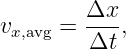
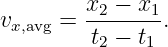
In one-dimensional motion along the x axis,
The SI unit is metre per second,
2 Instantaneous velocity as a limit
Average velocity describes an entire finite time interval. To determine the velocity at one instant,
shrink the interval around that instant.
Let the particle have position r(t) at time t and r(t + Δt) a short time later. The displacement
is
The secant velocity is
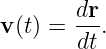
The instantaneous velocity is the limit
This is precisely the derivative of the position vector:
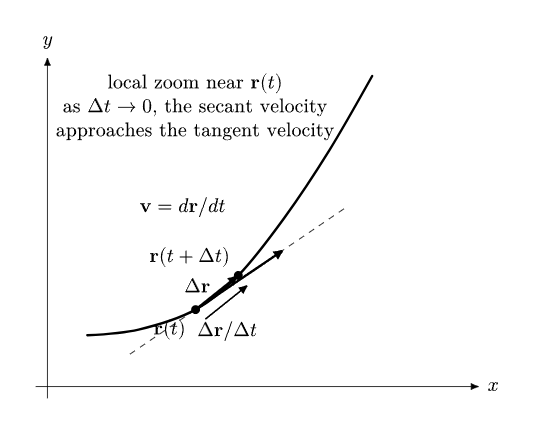
Figure 1. The finite displacement Δr joins two nearby positions. As Δt shrinks, the secant
velocity Δr∕Δt approaches the tangent velocity dr∕dt.
The direction of v is tangent to the trajectory at the particle’s instantaneous position, provided
the derivative exists and the velocity is nonzero.
3 Velocity components in Cartesian coordinates
For a particle with
where the Cartesian basis vectors are fixed in time,
Thus
The dot notation means differentiation with respect to time.
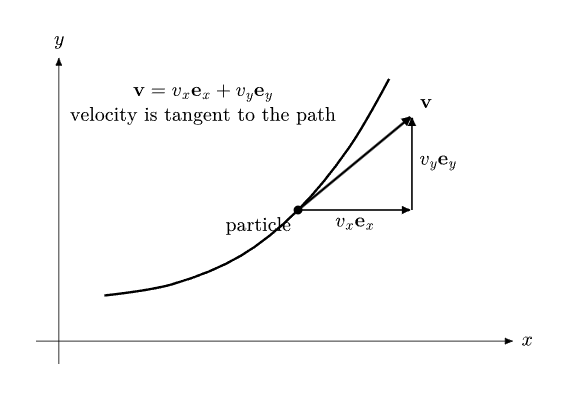
Figure 2. The physical velocity vector may be resolved into Cartesian components. Its direction is
tangent to the trajectory.
The speed is
4 Speed versus velocity
Velocity is a vector. Speed is the magnitude of that vector.
In one-dimensional motion, velocity can be positive, negative, or zero depending on direction.
Speed is always nonnegative:
A particle can therefore have the same speed at two instants while having different velocities
because its direction has changed.
Likewise, average speed and the magnitude of average velocity are generally not equal.
Average speed is
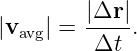
whereas the magnitude of average velocity is
Because total distance traveled is at least as large as the displacement magnitude,
Equality occurs when the path length over the interval equals the straight-line endpoint
separation.
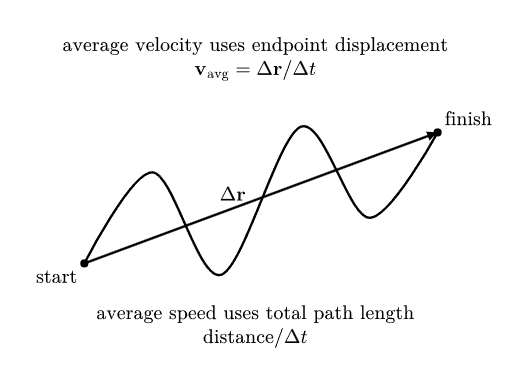
Figure 3. Average speed uses total path length, while average velocity uses the endpoint
displacement. Reversal or curvature can make the two differ greatly.
5 Velocity from a position-time graph
For one-dimensional motion, a graph of x versus t contains velocity information in its
slope.
Over a finite interval,
which is the slope of a secant line through two points on the position-time graph.
At an instant,
which is the slope of the tangent line.
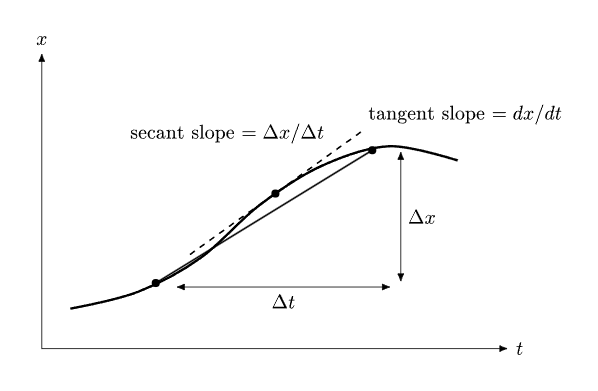
Figure 4. Average velocity is represented by a secant slope on an x-t graph; instantaneous velocity
is the tangent slope.
A positive slope means positive velocity, a negative slope means negative velocity, and a horizontal
tangent means zero instantaneous velocity.
A steeper position-time slope corresponds to a larger speed in one dimension.
6 Velocity along a curved trajectory
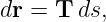
For motion along a smooth curve, the infinitesimal displacement may be written
where T is the unit tangent vector and ds is a positive differential of path length.
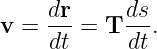
Dividing by dt gives
Therefore
with
This gives a precise geometric interpretation: speed tells how rapidly path length is accumulated,
while the unit tangent gives the instantaneous direction of motion.
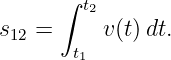
Consequently, the distance traveled from t1 to t2 is
This integral uses speed, not signed one-dimensional velocity and not the vector velocity
itself.
7 Velocity depends on the reference frame
Velocity is not an absolute quantity in Newtonian mechanics. If frame S′ moves with constant
velocity V relative to frame S, then the Galilean velocity transformation is
Thus two inertial observers can assign different velocities to the same particle.
This frame dependence does not make velocity ambiguous. It means that every velocity statement
must be understood relative to a specified observer or reference frame.
M00-06 develops these transformations in detail.
8 Worked example 1: average velocity and average speed
A student walks 30 m east in 20 s and then 10 m west in 10 s. Find the average velocity and
average speed for the full trip.
Take east as positive. The total displacement is
The total elapsed time is
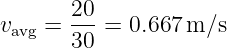
Therefore
in the eastward direction.
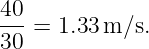
The distance traveled is
Hence the average speed is
The two averages differ because part of the path retraces earlier motion.
9 Worked example 2: instantaneous velocity from position
A particle moves along the x axis according to
with x in metres and t in seconds. Find the velocity at t = 2 s and determine whether the particle
is moving in the positive or negative x direction.
Differentiate:
At t = 2 s,
Thus the particle is instantaneously at rest at that instant. The sign of velocity just before and
just after t = 2 s must be checked to determine how the motion changes through that
point.
10 Worked example 3: velocity of a particle in two dimensions
Let
with position in metres. Find the velocity and speed at t = 1 s.
Differentiate componentwise:
At t = 1 s,
The speed is
The velocity vector gives both the instantaneous speed and the tangent direction of
motion.
11 Common mistakes
- Confusing average speed with the magnitude of average velocity.
- Using total distance traveled in the average-velocity formula instead of displacement.
- Treating instantaneous velocity as x∕t rather than dx∕dt.
- Forgetting that negative one-dimensional velocity indicates direction, not negative
speed.
- Reading the height of an x-t graph as velocity. Velocity is represented by the graph’s
slope.
- Assuming zero instantaneous velocity means zero acceleration. A turning point can
have v = 0 while acceleration is nonzero.
- Forgetting to specify the reference frame when comparing velocities measured by
different observers.
12 Practice problems
M01-02-P01
A particle moves from x = −5 m at t = 2 s to x = 11 m at t = 6 s. Find the average
velocity.
M01-02-P02
A runner completes one 400 m lap in 80 s and stops at the starting point. Find the average speed
and average velocity.
M01-02-P03
For x(t) = 5 + 3t − 2t2, find v
x(t) and evaluate it at t = 2 s.
M01-02-P04
For x(t) = t3 − 6t2 + 9t, find every time at which the particle is instantaneously at
rest.
M01-02-P05
A particle has r(t) = 2tex + t2e
y. Find v(t) and its speed at t = 3 s.
M01-02-P06
A CAR travels 60 km east in 1.0 h and then 30 km west in 0.5 h. Find the average velocity and
average speed for the whole trip.
M01-02-P07
A particle moves on a circle of radius R at constant speed v. Explain why the velocity is not
constant even though the speed is constant.
M01-02-P08
Suppose v = 3ex − 4ey m∕s. Find the speed and the direction angle measured from
+x.
M01-02-P09
A particle moves with vx(t) = 4 − 2t and begins at x(0) = 3 m. Find x(t) and the displacement
from t = 0 to t = 3 s.
M01-02-P10
A frame S′ moves at 5 m∕s in the +x direction relative to frame S. A particle has velocity 12 m∕s
in S. Find its velocity in S′.
13 Answer check
- P01: 4.0 m∕s.
- P02: average speed 5.0 m∕s; average velocity 0.
- P03: vx = 3 − 4t; vx(2) = −5 m∕s.
- P04: t = 1 s and t = 3 s.
- P05: v = 2ex + 2tey; at t = 3, v =
 ≈ 6.32 m∕s.
- P06: average velocity 20 km∕h east; average speed 60 km∕h.
- P07: the tangent direction changes continuously around the circle.
- P08: speed 5 m∕s; direction 53.1∘ below the +x axis.
- P09: x(t) = 3 + 4t − t2; Δx = 3 m from 0 to 3 s.
- P10: 7 m∕s in the +x direction.
14 Bridge to acceleration
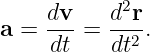
Velocity describes the first time derivative of position. The next kinematic quantity measures how
velocity changes:
M01-03 develops acceleration, including the crucial fact that acceleration can arise from a change
in speed, a change in direction, or both.
15 Source and licensing note
This article upgrades and expands the existing PhysicsLibrary entry Velocity (object id 74). The
treatment was also cross-checked against the archived 2016 University Physics Volume 1 material
and the UCD Physics 9A classical-mechanics sequence. The organization, derivations, examples,
exercises, and figures in this M01-02 entry were prepared specifically for PhysicsLibrary. Unless
otherwise noted, the intended license is CC BY-SA 4.0.
References
[1] PhysicsLibrary, Velocity, object id 74.
[2] PhysicsLibrary, M01-01: Position and Displacement in Mechanics.
[3] OpenStax / cnxuniphysics, University Physics Volume 1, archived 2016 BCcampus
clone, CC BY 4.0.
[4] University of California, Davis, Physics 9A: Classical Mechanics, Physics LibreTexts,
CC BY-SA 4.0.
[5] J. R. Taylor, Classical Mechanics, University Science Books, 2005. Reference used
for scope and mechanics notation; no restricted text reproduced.





![[v ] = m ∕s.](https://images.physicslibrary.org/cache/objects/1310/make4ht/VelocityInMechanics7x.png)