GRE Physics Companion: Reference Frames in Newtonian Mechanics
This companion is attached to M00-06 and contains only GRE-oriented strategy and speed
practice. The core mechanics concepts, derivations, and ordinary problems belong in
M00-06.
1 Fast frame triage
For a short mechanics question, first ask whether the second frame is related to the first by
constant translational velocity, translational acceleration, or rotation.
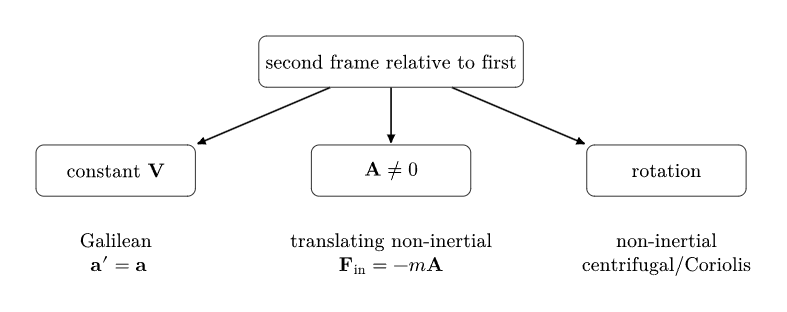
Figure 1. Fast classification of Newtonian frame changes for GRE-style problems.
The three most useful formulas are
and
If V is constant, then A = 0 and
That single observation resolves many timed questions immediately.
2 High-frequency GRE traps
- Constant relative velocity changes measured velocity but not acceleration.
- Equal acceleration in two Galilean frames does not imply equal velocity.
- Displacement of one particle over the same time interval is generally frame dependent.
- In an accelerating frame, the inertial force is opposite the frame acceleration: −mA.
- Constant angular speed does not make a rotating frame inertial.
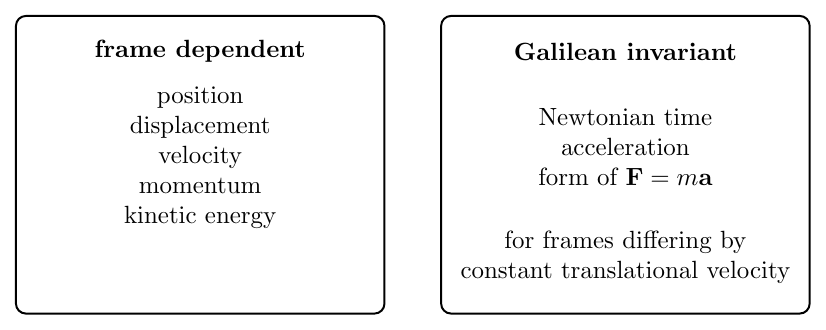
Figure 2. Useful timed-test distinction between frame-dependent quantities and the key Galilean
invariant used in Newtonian dynamics.
3 Worked GRE example 1: identify the invariant
Two inertial frames move at constant relative velocity. Which quantity for a given particle must
have the same value in both frames: position, velocity, momentum, kinetic energy, or
acceleration?
Because the transformation velocity is constant,
The correct choice is acceleration. The other listed quantities generally change under a Galilean
transformation.
4 Worked GRE example 2: accelerating-frame sign
A free 2 kg mass is observed from a CAR accelerating east at 3 m∕s2. What apparent force is
assigned to the mass in the car frame?
For a free particle, a = 0 in an inertial frame. Therefore
The apparent force is
Its magnitude is
directed west.
5 GRE-speed questions
M00-06G-Q01
Frame S′ moves east at 10 m∕s relative to S. A particle moves east at 14 m∕s in S. Its velocity in
S′ is
(A) 4 m∕s east (B) 4 m∕s west (C) 10 m∕s east (D) 14 m∕s east (E) 24 m∕s
east.
M00-06G-Q02
Two inertial frames are related by a Galilean transformation. Which quantity for a particle is
necessarily identical in both?
(A) position (B) velocity (C) acceleration (D) momentum (E) kinetic energy.
M00-06G-Q03
A car accelerates north at 2 m∕s2. A free 3 kg object is described in the car frame. The
inertial-force term is
(A) 6 N north (B) 6 N south (C) 3 N north (D) 3 N south (E) zero.
M00-06G-Q04
A disk rotates at constant angular speed. A point fixed to the disk is stationary in the disk frame.
Which statement is correct?
(A) The disk frame is inertial because the point is stationary.
(B) The disk frame is inertial because angular speed is constant.
(C) The point has zero acceleration in every frame.
(D) The disk frame is non-inertial because a fixed point can have centripetal acceleration in an
inertial frame.
(E) Newtonian mechanics cannot describe the disk.
M00-06G-Q05
A passenger walks at 2 m∕s forward inside a train moving at 18 m∕s relative to the ground. The
passenger speed relative to the ground is
(A) 2 m∕s (B) 16 m∕s (C) 18 m∕s (D) 20 m∕s (E) 36 m∕s.
6 Answers and brief rationales
- Q01: A. Use u′ = u − V = 14 − 10 = 4 m∕s east.
- Q02: C. Constant relative velocity implies a′ = a.
- Q03: B. Finertial = −mA, so the direction is south and the magnitude is 6 N.
- Q04: D. Rotation makes the frame non-inertial even when angular speed is constant.
- Q05: D. u = V + u′ = 18 + 2 = 20 m∕s.
References
[1] J. R. Taylor, Classical Mechanics, University Science Books, 2005.
[2] University of California, Davis, Physics 9A: Classical Mechanics, LibreTexts, CC
BY-SA 4.0.
[3] PhysicsLibrary, M00-06 Reference Frames in Newtonian Mechanics, core companion
article.

![[parent]](https://images.physicslibrary.org/images/uparrow.png)