Reference Frames in Newtonian Mechanics
Motion is always described relative to something. A statement such as “the particle moves at
20 m∕s” is incomplete until the observer or reference frame is identified. In Newtonian mechanics,
reference frames provide the setting in which positions, velocities, accelerations, forces, and
conservation laws are interpreted. The most important distinction is between inertial frames, in
which Newton’s laws have their standard form, and non-inertial frames, which accelerate or rotate
relative to an inertial frame.
This article develops the Newtonian framework needed for introductory and intermediate
mechanics. Rotating-frame dynamics, Coriolis force, and other three-dimensional non-inertial
effects are previewed here and treated in detail later in the mechanics sequence.
1 Reference frame and coordinate system are not the same thing
A reference frame specifies the physical state of motion of an observer or measuring system. It
includes an origin, a clock, and spatial axes carried by that observer.
A coordinate system is a numerical labeling scheme used inside a frame. Cartesian, cylindrical,
spherical, or other coordinates may all be used by the same observer without changing the physical
reference frame.
For example, a laboratory fixed to a building may describe a particle in Cartesian coordinates
(x,y,z) or cylindrical coordinates (ρ,ϕ,z). That is a coordinate change. Switching from the
laboratory to a train moving past the building is a change of reference frame.
2 Two translating frames
Let S be a reference frame with origin O, and let S′ have origin O′. Let
be the position of O′ measured from O. A particle P has position r in S and r′ in S′.
When the axes remain parallel and do not rotate relative to one another, geometry
gives
Equivalently,
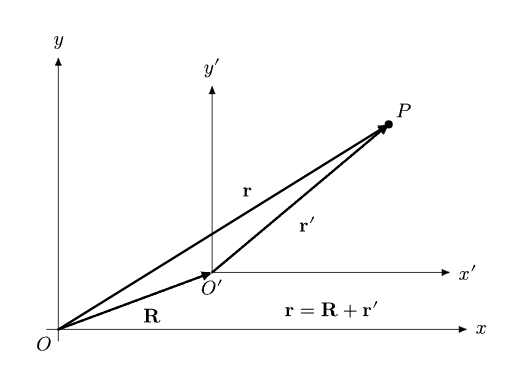
Figure 1. Two nonrotating frames with parallel axes. The particle position satisfies r = R + r′.
Differentiate with respect to Newtonian time t:
where
Therefore
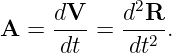
Differentiate again:
where
Thus
This sign is important: if the origin of S′ accelerates in the positive direction while a free particle
keeps constant velocity in S, the free particle appears to accelerate in the opposite direction in
S′.
3 Inertial frames
An inertial frame is a frame in which a free particle moves with constant velocity. Equivalently,
Newton’s first law holds in its standard form. Newton’s second law then takes the familiar
form
No laboratory is perfectly isolated from all motion and gravitation, so an inertial frame is an
idealization. In practical mechanics one asks whether a chosen frame is inertial enough for the
desired accuracy and duration.
If S is inertial and S′ moves with constant velocity relative to S, then
Hence
Therefore S′ is also inertial. This gives a whole family of inertial frames related by constant
relative velocities.
4 Galilean transformations
Suppose S′ moves at constant velocity V in the +x direction relative to S, the axes
remain parallel, and the origins coincide at t = 0. Newtonian mechanics assumes absolute
time,
The Galilean transformation is
The inverse relation is
Differentiating gives the velocity transformation
with
and
Differentiating once more gives
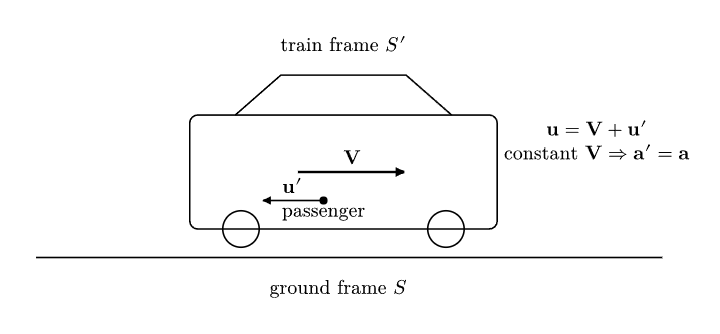
Figure 2. A train moving at constant velocity relative to the ground illustrates a Galilean
transformation between two inertial frames.
5 What is and is not Galilean invariant
The phrase Galilean invariance does not mean that every measured quantity is identical in every
inertial frame.
Quantities that generally depend on the inertial frame include position, displacement of one
particle over a time interval, velocity, momentum, and kinetic energy. For example,
Acceleration, however, is unchanged between inertial frames related by a Galilean transformation:
If mass is unchanged, then Newton’s second law has the same form in both frames:
This form invariance of Newtonian dynamics is the essential physical content.
6 Worked example 1: walking on a train
A train moves east at
relative to the ground. A passenger walks west inside the train at
relative to the train, where east is positive.
Using
we obtain
Thus the passenger still moves east relative to the ground even though the passenger walks west
relative to the train.
If the passenger maintains that speed for 10 s, the ground-frame displacement is
In the train frame,
The two inertial frames therefore do not measure the same displacement for the passenger.
7 Worked example 2: a ball thrown vertically inside a moving train
A train moves horizontally at
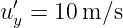
relative to the ground. A passenger throws a ball vertically upward at
relative to the train. Neglect air resistance.
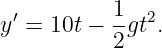
In the train frame,
and
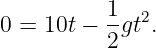
The ball returns to its launch height when
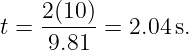
For the nonzero root,
In the ground frame the horizontal velocity is 20 m∕s, so the ball moves horizontally
The trajectory is vertical in the train frame and parabolic in the ground frame, but both observers
agree on the acceleration
8 Translating non-inertial frames
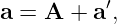
Now let S′ accelerate relative to inertial frame S. Since
and
we obtain
If one wants Newton’s second law to look like a force balance in S′, define the translational inertial
or apparent force
Then
The inertial force is not a new physical interaction. It appears because the chosen frame is
accelerating.
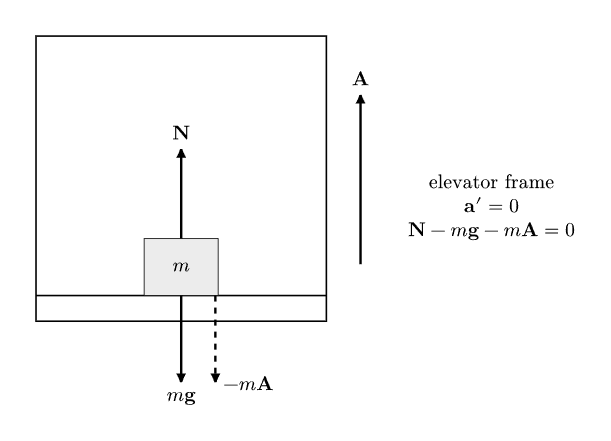
Figure 3. In an upward-accelerating elevator, the mass is at rest relative to the elevator but the
elevator frame is non-inertial. The inertial force −mA allows a Newton-like force balance in that
frame.
9 Worked example 3: apparent weight in an accelerating elevator
A mass
rests on the floor of an elevator accelerating upward at
In the inertial ground frame,
Therefore
Numerically,
In the elevator frame the mass has
Include the downward inertial force mA. The force balance is
which gives the same result,
The physical contact force is the same in both descriptions. The difference is whether
the frame acceleration is placed in the kinematics or represented by an inertial-force
term.
10 Rotating frames: preview only
A frame can have a fixed origin and still be non-inertial if its axes rotate. A point fixed to a
rotating disk can have zero velocity relative to the disk while having nonzero centripetal
acceleration relative to an inertial observer.
Rotating frames introduce additional acceleration terms associated with angular velocity, including
centrifugal and Coriolis terms. Those effects require vector differentiation in moving bases and are
developed later in the dedicated non-inertial-frame sequence.
For the present article, the key lesson is simple:
whereas
11 Earth-fixed frames and useful approximations
A frame attached to Earth’s surface rotates with Earth and is therefore not exactly inertial.
Nevertheless, for many short-duration laboratory problems the rotational corrections are very small
compared with the dominant accelerations, so the laboratory frame is treated as approximately
inertial.
For long-range projectiles, atmospheric motion, pendula, navigation, or precision measurements,
Earth’s rotation becomes important. The adequacy of the inertial approximation depends on the
required accuracy and the spatial and temporal scale of the problem.
12 Center-of-mass frame
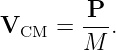
For a system of particles with total mass M and total momentum P, the center-of-mass velocity
is
The frame moving with VCM is called the center-of-mass frame. For an isolated system, P is
constant, so VCM is constant. If the laboratory frame is inertial, the center-of-mass frame of that
isolated system is therefore also inertial.
This frame is especially useful in collision and scattering problems because the total momentum is
zero there.
13 Common mistakes
- Confusing a coordinate change with a reference-frame change.
- Assuming that position, displacement, velocity, momentum, or kinetic energy must
have the same value in all inertial frames.
- Forgetting the sign in a′ = a − A.
- Treating an inertial force as a new physical interaction.
- Assuming that a rotating frame is inertial simply because its angular speed is constant.
- Mixing velocities or forces quoted in different frames without transforming them first.
14 Practice problems
M00-06-P01: Galilean position transformation
Frame S′ moves at 5 m∕s in the +x direction relative to S, and the origins coincide at t = 0. A
particle has x = 20 + 8t meters in S. Find x′(t) and x′ at t = 4 s.
M00-06-P02: Relative velocity
A boat moves north at 6 m∕s relative to the water while the water moves east at 4 m∕s relative to
the shore. Find the boat velocity and speed relative to the shore.
M00-06-P03: Acceleration invariance
A particle has x = 4 + 2t + t2 meters in inertial frame S. Frame S′ moves at constant velocity
7 m∕s in the +x direction. Find a and a′.
M00-06-P04: Displacement is frame dependent
A particle moves at 10 m∕s in S. Frame S′ moves at 4 m∕s in the same direction. Compare the two
displacements over 3 s.
M00-06-P05: Prove an inertial family
Starting from r = R0 + Vt + r′ with constant V, prove that if a free particle has constant velocity
in S, then it also has constant velocity in S′.
M00-06-P06: Accelerating observer
A free particle moves at constant velocity in inertial frame S. The origin of S′ has acceleration
+2ex m∕s2. Find the acceleration observed in S′ and the inertial force on a 4 kg particle in that
frame.
M00-06-P07: Accelerating car and hanging mass
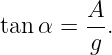
A car accelerates horizontally with magnitude A. A small mass hangs from the roof by a
string and is stationary relative to the car. Show that the string angle α from vertical
satisfies
M00-06-P08: Earth rotation estimate
Use Ω = 7.292 × 10⁻⁵ rad∕s and R = 6.37 × 10⁶ m to estimate Ω2R at the equator. Compare it
with g = 9.81 m∕s2 and comment on the laboratory inertial approximation.
15 Short answer check
- P01: x′ = 20 + 3t m; at 4 s, x′ = 32 m.
- P02: v = 4ex + 6ey m∕s; speed 7.21 m∕s.
- P03: a = a′ = 2 m∕s2.
- P04: Δx = 30 m, Δx′ = 18 m.
- P05: differentiate twice; a′ = a = 0.
- P06: a′ = −2ex m∕s2; F
inertial = −8ex N.
- P07: resolve tension against mg and mA.
- P08: approximately 0.0339 m∕s2, about 0.00346g.
References
[1] J. R. Taylor, Classical Mechanics, University Science Books, 2005.
[2] J. B. Marion and S. T. Thornton, Classical Dynamics of Particles and Systems, 5th
ed., Brooks/Cole, 2004.
[3] University of California, Davis, Physics 9A: Classical Mechanics, LibreTexts, CC
BY-SA 4.0.
[4] PhysicsLibrary, Reference Frames in Newtonian Physics, existing PhysicsLibrary
entry, revised and expanded by the present article.