Oscillations in Physics: A Detailed Worked Mass Spring Example
This article develops one problem in enough detail to connect most of the basic quantities
introduced in the PhysicsLibrary entry on oscillations. The goal is not merely to obtain
x(t), but to interpret the amplitude, phase, period, frequency, velocity, acceleration,
turning points, energy exchange, and phase-space trajectory as parts of one physical
oscillation.
The example is deliberately given nonzero initial displacement and nonzero initial velocity. This
prevents the phase constant from being hidden by a specially chosen initial condition and makes
the general sinusoidal solution physically meaningful.
Problem
A block of mass
slides without friction on a horizontal surface and is attached to an ideal spring of spring
constant
Let x = 0 denote the equilibrium position and let positive x point to the right. At t = 0 the block
is at
and is moving to the right with velocity
Determine and interpret the complete oscillation. In particular:
- derive the equation of motion from Newton’s second law;
- find the natural angular frequency, period, and frequency;
- solve for x(t) using the initial conditions;
- express the result in amplitude-phase form and determine A and ϕ;
- obtain v(t) and a(t);
- find the maximum speed and maximum acceleration;
- find the first positive turning point, the first equilibrium crossing, and the first negative
turning point after t = 0;
- calculate the total mechanical energy and verify it using the initial conditions;
- show how kinetic and potential energy exchange during the oscillation;
- derive the phase-space ellipse in the (x,v) plane.
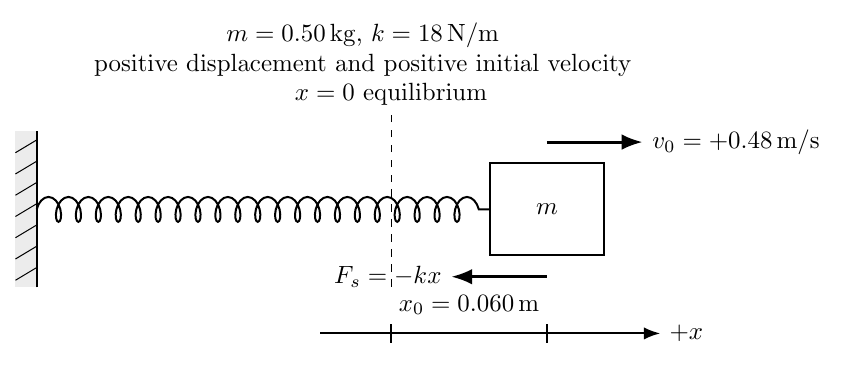
Figure 1. Mass spring system at t = 0. The block begins to the right of equilibrium and is initially
moving farther to the right, while the spring restoring force points back toward equilibrium.
Solution
1. Derive the equation of motion
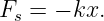
The spring force obeys Hooke’s law,
The minus sign is important. If x > 0, the spring force points toward negative x; if x < 0, the
spring force points toward positive x. The force is therefore restoring.
Newton’s second law gives
Move all terms to the left:
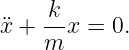
Dividing by m,
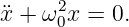
Define
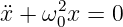
Then the equation becomes
This is the differential equation of an undamped simple harmonic oscillator.
2. Natural angular frequency, period, and frequency
For the given system,
The period is
The frequency is
Thus the block completes slightly less than one full cycle each second.
3. Solve the differential equation with the initial conditions
A convenient general solution is
With ω0 = 6, this becomes
At t = 0,
Since x(0) = 0.060 m,
Differentiate the general solution:
At t = 0,
Therefore
The motion is therefore
This form is already a complete solution. The amplitude-phase form, however, makes the geometry
of the oscillation easier to read.
4. Convert to amplitude-phase form
Write the same motion as
Using
we identify
and
Squaring and adding gives
Thus
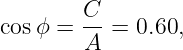
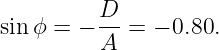
Now
while
Therefore the correct quadrant gives
The complete amplitude-phase solution is
The negative phase tells us that the oscillator is already partway through its cycle at t = 0.
Because the initial velocity is positive, the block has not yet reached its positive turning
point.
5. Velocity and acceleration
Differentiate the displacement:
Differentiate again:
Because
we can also write
This is the defining kinematic property of simple harmonic motion: acceleration is proportional to
displacement and always directed toward equilibrium.
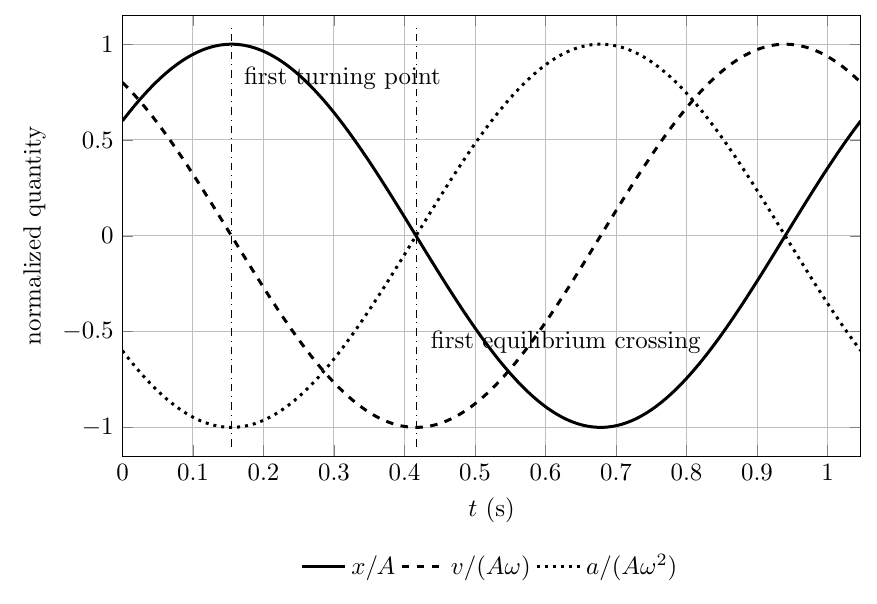
Figure 2. Normalized displacement, velocity, and acceleration over one period. Velocity is shifted
by one quarter cycle relative to displacement, while acceleration is exactly opposite in phase to
displacement.
6. Maximum speed and maximum acceleration
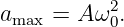
The velocity has amplitude
Therefore
The acceleration has amplitude
Thus
The maximum speed occurs at equilibrium, where all the mechanical energy is kinetic. The
maximum acceleration occurs at the turning points, where |x| = A.
7. Important times during the first cycle
Let the phase be
At t = 0,
Since the block is moving to the right, it first reaches the positive turning point when
Therefore
so
At this instant,
The first equilibrium crossing occurs when
Thus
At this crossing the block is moving toward negative x, so
The first negative turning point occurs when
Therefore
At this instant,
These times show the physical cycle directly: the block first moves farther right, stops,
reverses, passes through equilibrium at maximum speed, and then reaches the left turning
point.
8. Total mechanical energy
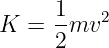
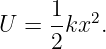
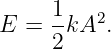
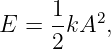
For an ideal horizontal mass spring oscillator,
where
and
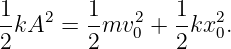
At a turning point v = 0 and |x| = A, so
Using k = 18 N∕m and A = 0.100 m,
We can verify this independently from the initial conditions. Initially,
and
Thus
The two calculations agree, as they must for an ideal conservative oscillator.
9. Energy exchange through the cycle
Substituting
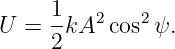
into the spring potential gives
Because
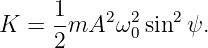
the kinetic energy is
But
so
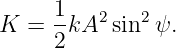
Adding,
Therefore
which is constant.
At a turning point, U = E and K = 0. At equilibrium, K = E and U = 0. Between those locations,
the energy is shared between the two forms.
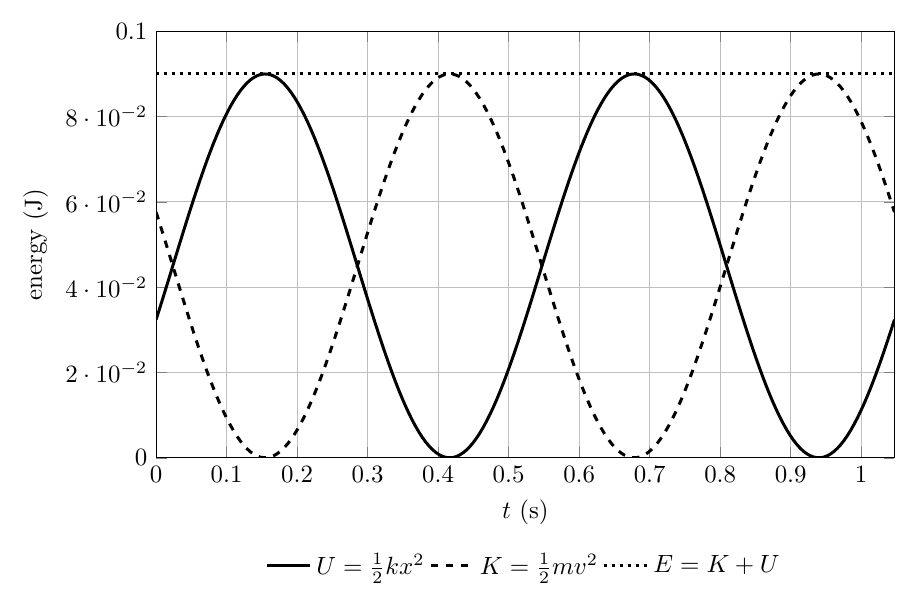
Figure 3. Kinetic and spring potential energy exchange twice per oscillation cycle, while their sum
remains constant at 0.090 J.
10. Phase-space ellipse
The displacement and velocity are
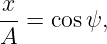
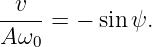
Divide the first equation by A and the second by Aω0:
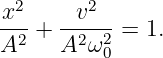
square and add:
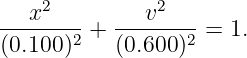
For this oscillator,
so the phase-space trajectory is
The oscillator therefore traces a closed ellipse in the (x,v) plane. A closed orbit is another way of
representing the periodic return of an ideal conservative oscillator to the same dynamical
state.
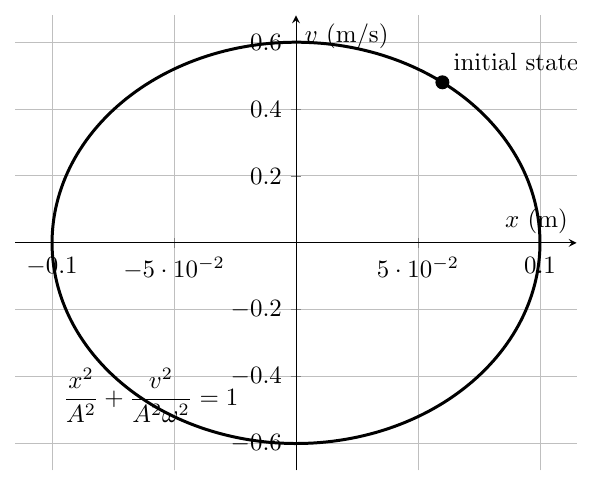
Figure 4. Phase-space trajectory of the oscillator. The initial state (x0,v0) = (0.060,0.480) lies on
the same constant-energy ellipse traced throughout the motion.
Physical interpretation of the complete motion
This one example contains most of the basic ideas used to describe an oscillation:
- The equilibrium is at x = 0.
- The restoring force F = −kx always points toward equilibrium.
- The amplitude A = 0.100 m sets the turning points.
- The angular frequency ω0 = 6.00 rad∕s is determined by k∕m, not by the initial
displacement or velocity.
- The phase constant ϕ = −0.9273 rad records where in the cycle the chosen clock starts.
- The period T = 1.047 s is the time required to return to the same position and velocity.
- Velocity is largest at equilibrium and zero at the turning points.
- Acceleration is zero at equilibrium and largest in magnitude at the turning points.
- Energy continuously transfers between kinetic and spring potential energy while the
total remains constant.
- The closed phase-space ellipse represents the same conserved-energy motion
geometrically.
The initial conditions change A and ϕ, but for an ideal linear mass spring oscillator they do not
change ω0. That separation between the properties of the system and the choice of initial state is
one of the most useful features of linear oscillation theory.
Checks on the result
Several quick checks help catch errors in oscillator calculations.
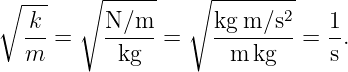
First, the units of angular frequency are inverse seconds:
Second, substituting x(t) into
must give zero.
Third, the initial conditions must be recovered exactly:
Fourth, the energy computed from the amplitude must equal the energy computed from the initial
position and velocity:
All four checks are satisfied here.
Summary of numerical results
For
the ideal oscillation is
with
and
The characteristic quantities are
and
References
References
[1] J. R. Taylor, Classical Mechanics, University Science Books, 2005.
[2] J. B. Marion and S. T. Thornton, Classical Dynamics of Particles and Systems, 5th
ed., Brooks/Cole, 2004.
[3] A. P. French, Vibrations and Waves, W. W. Norton, 1971.
[4] R. P. Feynman, R. B. Leighton, and M. Sands, The Feynman Lectures on Physics,
Vol. I, Basic Books.

![[parent]](https://images.physicslibrary.org/images/uparrow.png)