Vector Differentiation in Physics: Examples and Complete Worked Solutions
This companion entry develops the ideas from Vector Differentiation in Physics: Vector-Valued
Functions, Moving Bases, and Kinematics through a sequence of worked mechanics problems. The
problems begin with derivatives in a fixed Cartesian basis, move through dot and cross products
and changing vector magnitude, and then progress to moving unit vectors, curved motion,
polar coordinates, angular momentum, rotating frames, and the material derivative
[1, 2, 3].
All exercises are stated first. Complete solutions follow afterward so that the first half can be used
as a problem set without exposing the derivations immediately.
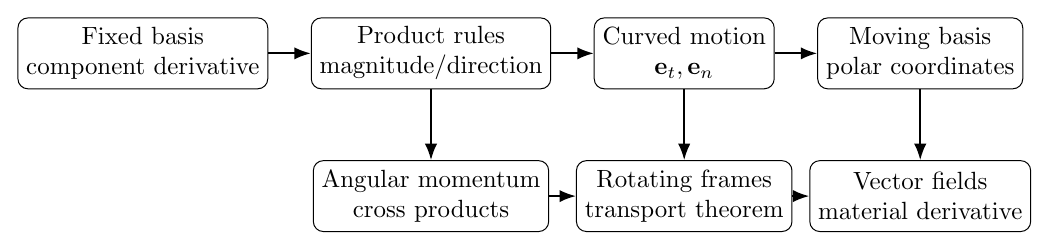
Figure 1. Progression of the problem set from ordinary component differentiation to moving bases
and frame-dependent derivatives.
Part I: Exercises
Exercise 1: componentwise vector differentiation
Let
Assume the Cartesian basis is fixed. Find dA∕dt and evaluate it at t = 0.
Exercise 2: derivative from the limit definition
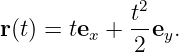
A particle moves in the plane according to
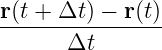
Use the difference quotient
to derive dr∕dt directly from the limit definition. Then find the velocity at t = 1.
Exercise 3: scalar-vector product rule
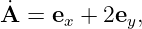
Let
and
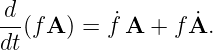
Find
and evaluate the result at t = π∕2.
Exercise 4: derivative of a dot product
Let
and
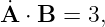
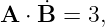
Find
in two ways: first by differentiating the scalar dot product directly, and second by using the vector
product rule. Evaluate the result at t = 1.
Exercise 5: rate of change of speed
A particle has velocity
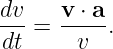
Find the acceleration, the speed, and dv∕dt. Evaluate dv∕dt at t = 2 and verify that
Exercise 6: differentiating a rotating unit vector
Let
Show that e is a unit vector. Find de∕dt, prove that it is perpendicular to e, and determine its
magnitude.
Exercise 7: uniform circular motion
A particle moves on a circle according to
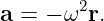
Derive the velocity and acceleration. Show that the speed is constant, that the acceleration points
toward the center, and that
For R = 3 m and ω = 2 rad/s, find the speed and acceleration magnitude.
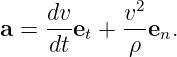
Exercise 8: tangential and normal acceleration on a curved path
A particle follows
At t = 1, find the velocity, speed, acceleration, tangential acceleration, normal acceleration, and
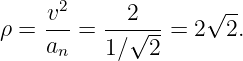
radius of curvature ρ using
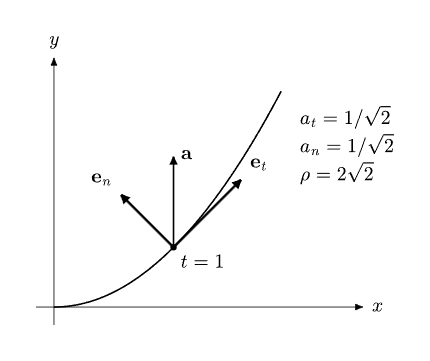
Figure 2. Geometry for Exercise 8. The acceleration is decomposed into components tangent and
normal to the trajectory.
Exercise 9: angular momentum and torque
A particle of mass m moves uniformly on a circle of radius a:
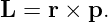
Find its momentum p, angular momentum L = r × p, and dL∕dt. Explain what the result implies
about the torque about the origin.
Exercise 10: velocity in plane polar coordinates
A particle is described by
Using
find the velocity at t = 1 in the polar basis.
Exercise 11: acceleration in plane polar coordinates
For the same motion as Exercise 10, use
to find the acceleration at t = 1.
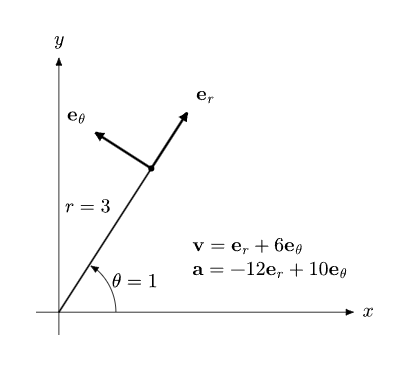
Figure 3. Polar basis for Exercises 10 and 11. Both the scalar components and the basis directions
vary during the motion.
Exercise 12: an expanding spiral
A particle follows the polar-coordinate motion
where a and ω are constants. Derive general expressions for v and a in the polar basis. Identify the
physical origin of each acceleration term.
Exercise 13: a vector fixed in a rotating body
A vector has constant components in a body-fixed frame:
The frame rotates relative to an inertial frame with constant angular velocity
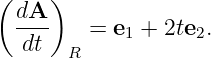
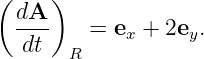
At the instant when e1 = ex, find the inertial derivative of A.
Exercise 14: applying the transport theorem
A rotating frame has angular velocity
A vector expressed in that rotating frame is
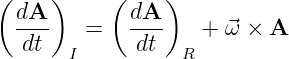
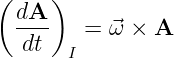
At t = 1, suppose e1 = ex and e2 = ey. Use the transport theorem
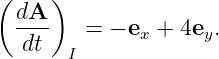
to find the inertial derivative.
Exercise 15: acceleration in a rotating frame
A frame rotates with constant angular velocity
about a fixed origin. At one instant a particle has, relative to the rotating frame,
Find the inertial acceleration using
Identify the Coriolis and rotational-position terms separately.
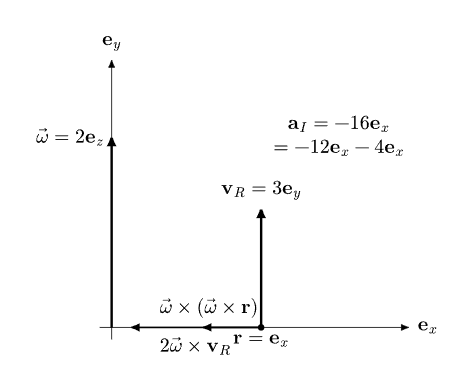
Figure 4. Instantaneous geometry for Exercise 15. The rotating observer measures a relative
velocity while the inertial derivative also includes basis rotation.
Exercise 16: material derivative of a vector field
Let the velocity field of a continuum be
with α = 0.5 s−1. Let another vector field be
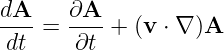
Use the material derivative
to find the rate of change experienced by a material particle at x = 1, y = 2, t = 1.
Part II: Complete Worked Solutions
Solution 1: componentwise vector differentiation
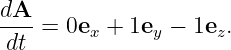
Because the Cartesian basis is fixed, differentiate each component:
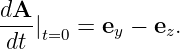
At t = 0,
Thus
The key assumption is that the basis vectors themselves have zero derivative.
Solution 2: derivative from the limit definition
First calculate
Subtract r(t):
Divide by Δt:
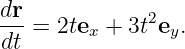
Taking the limit Δt → 0 gives
At t = 1,
Solution 3: scalar-vector product rule
Use
Here
and
Therefore
At t = π∕2,
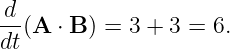
Hence
Solution 4: derivative of a dot product
First calculate the dot product itself:
Therefore
At t = 1 this equals
Now use the product rule. The derivatives are
At t = 1,
Thus
and
Both methods agree.
Solution 5: rate of change of speed
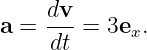
The acceleration is
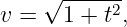
The speed is
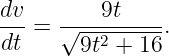
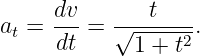
Differentiate:
At t = 2,
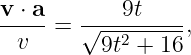
Now
so
which matches the direct derivative of the speed.
Solution 6: differentiating a rotating unit vector
The magnitude satisfies
Thus e is a unit vector. Differentiate:
The dot product with e is
Therefore the derivative is perpendicular to the unit vector. Its magnitude is
The vector changes direction at angular rate ω while preserving unit length.
Solution 7: uniform circular motion
Differentiate the position:
Its magnitude is
This is constant. Differentiate again:
Since
we have
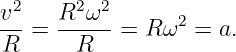
The acceleration therefore points inward toward the origin. Its magnitude is
Because v = Rω,
For R = 3 m and ω = 2 rad/s,
Solution 8: tangential and normal acceleration on a curved path
Differentiate the position:
At t = 1,
The speed is
so at t = 1,
The acceleration is
The tangential acceleration is the rate of change of speed:
At t = 1,
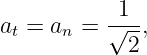
Since the total acceleration magnitude is 1,
Finally,
Therefore
Thus at t = 1,
Solution 9: angular momentum and torque
The velocity is
Thus
The angular momentum is
Only the z component survives. Its magnitude is
Therefore
This is constant, so
Since
the net torque about the origin is zero. The inward force is radial, so its moment arm is parallel to
the force direction and r × F = 0.
Solution 10: velocity in plane polar coordinates
We have
so
Also
so
At t = 1,
Thus
Solution 11: acceleration in plane polar coordinates
The needed derivatives are
At t = 1, r = 3 and 𝜃 = 2. The radial component is
The transverse component is
Therefore
The −12er term contains the centripetal contribution generated by rotation of the radial basis
direction.
Solution 12: an expanding spiral
For
we have
For
we have
The velocity is
The acceleration is
The radial term
is the inward centripetal-type contribution associated with angular motion at radius r = at. The
transverse term
arises because the radius changes while the particle also rotates. It is the polar-coordinate analogue
of a Coriolis-type coupling term.
Solution 13: a vector fixed in a rotating body
A vector whose components are constant in the rotating frame still changes in the inertial frame
because the basis rotates. The transport theorem gives
for a vector fixed in the rotating frame.
At the stated instant,
Therefore
The vector has zero derivative relative to the body but a nonzero inertial derivative.
Solution 14: applying the transport theorem
First differentiate only the rotating-frame components:
At t = 1 and at the stated alignment,
Also
The basis-rotation contribution is
Using
we obtain
Hence
so
Solution 15: acceleration in a rotating frame
The Coriolis contribution is
Since
we get
Now calculate the position-dependent rotational term. First,
Then
Since aR = 0,
Thus
The −12ex term is the Coriolis contribution and the −4ex term is the double-cross-product
contribution caused by the rotating position vector.
Solution 16: material derivative of a vector field
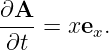
The vector field is
Its explicit time derivative is
At x = 1 this is
The velocity field at x = 1, y = 2 is
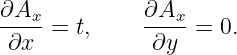
For the x component Ax = xt,
At t = 1,
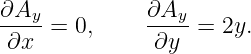
For the y component Ay = y2,
At y = 2,
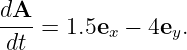
Therefore
Adding the explicit time derivative,
so
The result contains both local time variation and variation caused by the particle moving through
a spatially nonuniform field.
Summary of recurring methods
The examples illustrate a small set of ideas that repeatedly appear in mechanics:
- in a fixed Cartesian basis, differentiate vector components directly;
- use ordinary product rules for scalar-vector, dot-product, and cross-product
expressions;
- a perpendicular derivative changes direction without changing vector magnitude to
first order;
- curved motion naturally separates into tangential and normal acceleration;
- polar-coordinate differentiation requires derivatives of the basis vectors as well as the
scalar components;
- rotating-frame derivatives differ from inertial derivatives by ω × A;
- the material derivative combines explicit time change with change caused by motion
through a spatial field.
References
[1] J. R. Taylor, Classical Mechanics, University Science Books, 2005.
[2] J. B. Marion and S. T. Thornton, Classical Dynamics of Particles and Systems, 5th
ed., Brooks/Cole, 2004.
[3] H. Goldstein, C. Poole, and J. Safko, Classical Mechanics, 3rd ed., Addison-Wesley,
2002.

![[parent]](https://images.physicslibrary.org/images/uparrow.png)




![d
--[f(t)A (t)]
dt](https://images.physicslibrary.org/cache/objects/1281/make4ht/ExampleOfVectorDifferentiation5x.png)