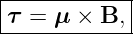
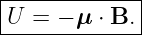
Electromagnetic Waves, Antennas, and RF: Magnetic Forces on Charges and Currents - Exercises
and Complete Worked Solutions
This companion article provides self-study exercises for EM10, Magnetic forces on charges
and Currents. All exercises are stated first. Complete worked solutions follow in Part
II.
The central microscopic magnetic-force law is
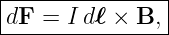
For a thin current element,
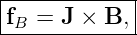
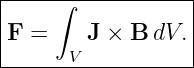
and for a continuous current distribution,
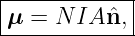
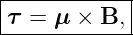
where fB is force per unit volume. For a planar N-turn current loop,
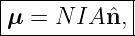
and
These are the same definitions and conventions developed in EM10 [1, 2, 3, 5].
How to use this problem set
Attempt every problem in Part I before consulting Part II. For vector-force problems, determine
the cross-product direction before inserting numerical values. For current-loop problems,
distinguish carefully among
A loop may have zero net force while still having nonzero torque.
Part I: Exercises
Exercise 1: magnetic force on a negative moving charge
A charge
moves with
through
Find the complete magnetic-force vector.
Exercise 2: from electron drift to force on a wire
A metal wire has mobile-electron number density
The electron charge is
and the drift velocity is
The wire cross-sectional area is
A length L = 0.20 m of the wire lies in
Find:
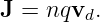
- the current-density vector J = nqvd;
- the conventional current I;
- the magnetic force on the wire segment.
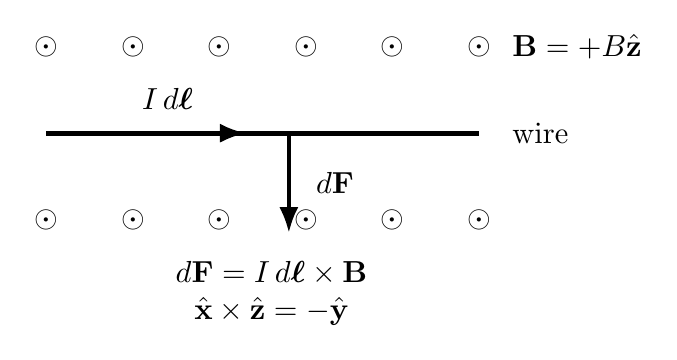
Figure. The current-element force follows from I dℓ× B. The wire direction is the
direction of conventional current.
Exercise 3: vector force on a straight conductor
A straight wire carries
along a vector length
The magnetic field is
Find the complete force vector.
Exercise 4: force magnitude for an oblique wire
A straight Conductor has
The angle between the current direction and the magnetic field is 60∘. Find the magnetic-force
magnitude.
Exercise 5: magnetic force density
A conductor carries uniform current density
in a magnetic field
Find the magnetic force density
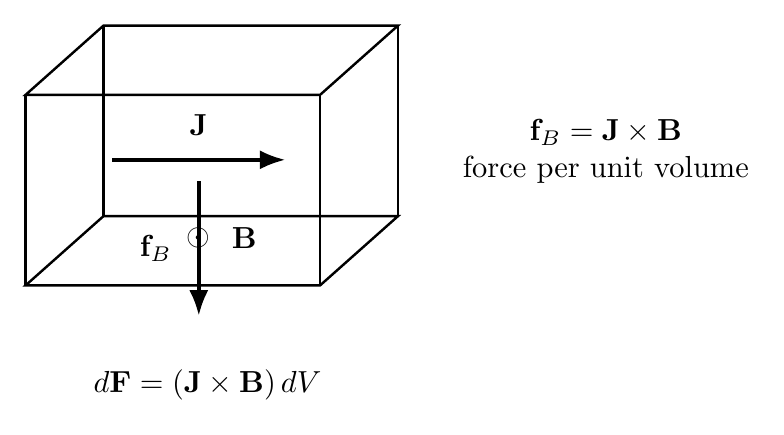
Figure. A distributed current density in a magnetic field produces a distributed magnetic
force density J × B.
Exercise 6: total force from a uniform force density
Inside a small conductor volume,
and
are uniform. The conductor volume is
Find the total magnetic force.
Exercise 7: curved wire in a uniform field
A wire carries current
from
to
along an arbitrary curved path. The magnetic field is uniform:
Use
to find the net force.
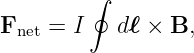
Exercise 8: closed loop in a uniform magnetic field
Starting from
show that a closed current loop in a uniform magnetic field has
Explain why this result does not imply zero torque.
Exercise 9: torque on a multiturn rectangular loop
A 20-turn loop carries
and encloses area
Its normal makes an angle 40∘ with a uniform field
Find the torque magnitude.
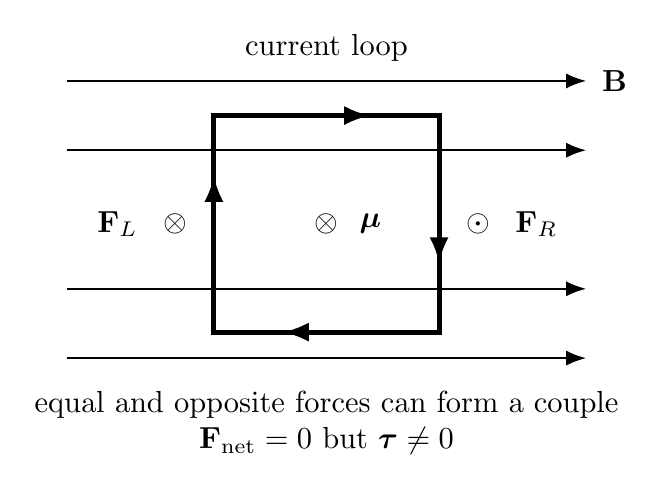
Figure. Opposite magnetic forces on a current loop can form a couple: zero net force but
nonzero torque.
Exercise 10: magnetic dipole moment
A circular 50-turn coil carries
and each turn encloses area
When viewed from the +z side, the current is counterclockwise.
Find:
- the magnitude of μ;
- its direction.
Exercise 11: vector torque from a dipole moment
A magnetic dipole has
in a field
Find the complete torque vector.
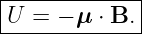
Exercise 12: magnetic potential-energy change
A dipole with
is in a uniform field
It rotates from
to the aligned state
Find Ui, Uf, and ΔU = Uf − Ui.
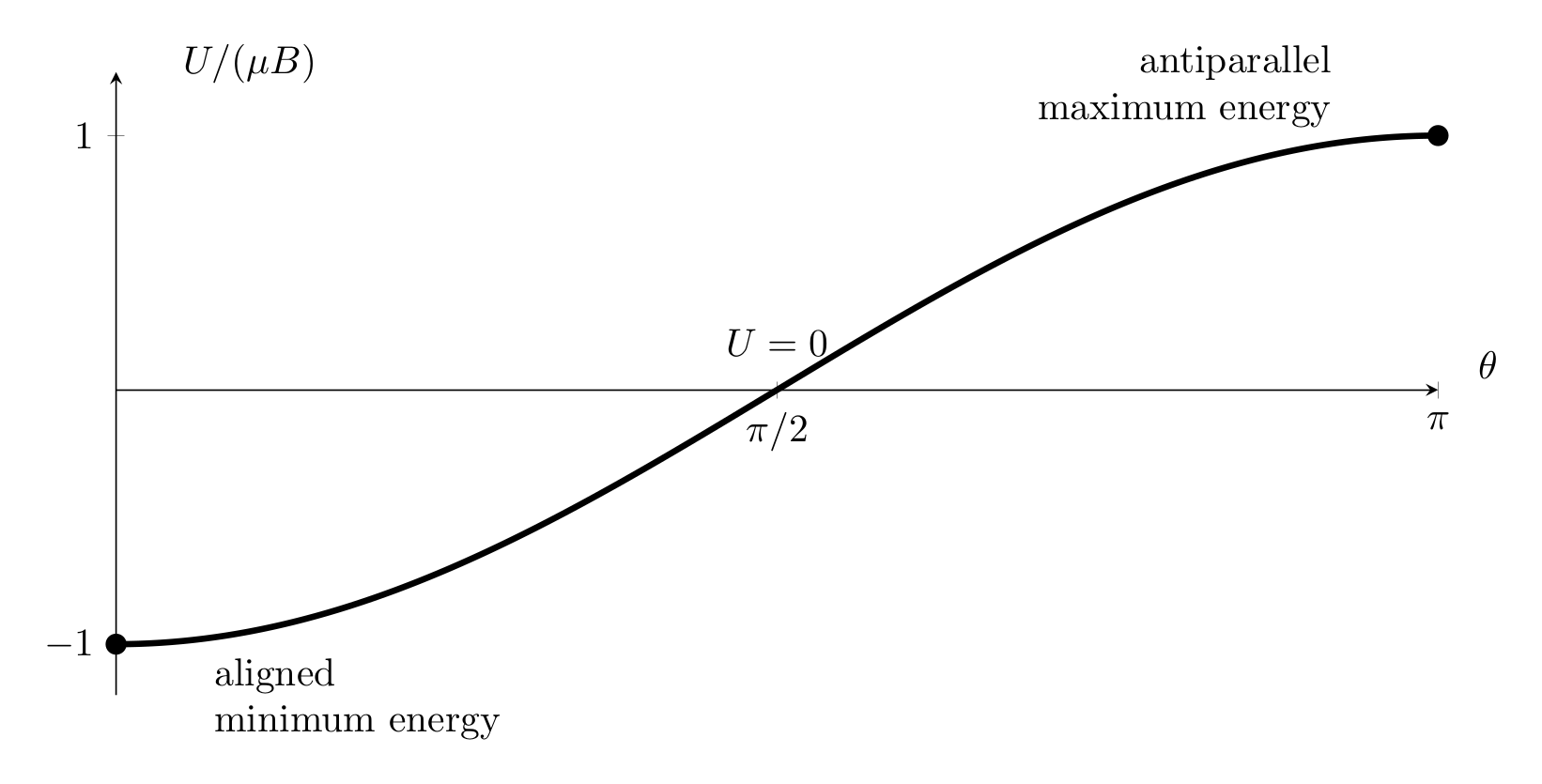
Figure. Normalized magnetic dipole energy U∕(μB) = − cos 𝜃. Alignment is the
minimum-energy orientation.
Exercise 13: when zero net force no longer follows
A closed current loop is placed first in a uniform magnetic field and then in a strongly nonuniform
magnetic field.
For each case, discuss whether the following must be zero:
- net magnetic force;
- magnetic torque.
Explain which step in the uniform-field proof fails when B varies along the loop.
Exercise 14: synthesis - coil force, torque, and energy
A 100-turn planar coil carries
and each turn has area
The coil is placed in a uniform field
with the coil normal at
to the field.
Find:
- the magnetic dipole moment magnitude;
- the net magnetic force on the complete closed loop;
- the torque magnitude;
- the magnetic potential energy at 30∘;
- the energy change if the coil rotates quasistatically to alignment.
Part II: Complete Worked Solutions
Solution 1: magnetic force on a negative moving charge
First evaluate the cross product for a positive charge:
The magnitude is
| FB | = |q|vB | (49)
|
| = (2.0 × 10⁻⁶)(4.0 × 10⁴)(0.15) | (50)
|
| = 1.2 × 10⁻² N. | (51) |
Because the charge is negative, the force direction is opposite to v × B. Therefore,
Solution 2: from electron drift to force on a wire
The current density is
Both q and the x component of vd are negative, so the current density points in +x:
| J | = (8.5 × 1028)(−1.602 × 10⁻¹⁹)[−(2.0 × 10⁻⁴)x] | (54)
|
| = 2.7234 × 10⁶x A/m2. | (55) |
Thus
The conventional current is
| I | = JA | (57)
|
| = (2.7234 × 10⁶)(1.0 × 10⁻⁶) | (58)
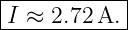
|
| = 2.7234 A. | (59) |
Therefore,
For the wire segment,
Hence
| F | = IL × B | (62)
|
| = (2.7234)(0.20)(0.30)(x ×z) | (63)
|
| = −0.1634y N. | (64) |
Thus
Solution 3: vector force on a straight conductor
Use
The direction is
The magnitude is
| F | = ILB | (68)
|
| = (5.0)(0.40)(0.20) | (69)
|
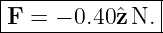
| = 0.40 N. | (70) |
Therefore,
Solution 4: force magnitude for an oblique wire
The magnitude is
Thus
| F | = (3.0)(0.50)(0.40) sin 60∘ | (73)
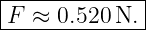
|
| ≈ 0.520 N. | (74) |
Hence
Solution 5: magnetic force density
The force density is
Since
we obtain
| fB | = (1.5 × 10⁶)(0.080)x | (78)
|
| = 1.2 × 10⁵x N/m3. | (79) |
Therefore,
Solution 6: total force from a uniform force density
First,
Because
we obtain
The force is uniform, so
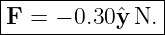
| F | = fBV | (84)
|
| = (−1.0 × 10⁵)(3.0 × 10⁻⁶)y | (85)
|
| = −0.30y N. | (86) |
Thus
Solution 7: curved wire in a uniform field
The endpoint displacement is
Therefore,
| F | = I(r2 − r1) × B | (89)
|
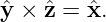
| = 2.5(0.30x + 0.40y) × (0.30z). | (90) |
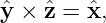
Use
Then
| F | = 0.75[−0.30y + 0.40x] | (92)
|
| = 0.30x − 0.225y N. | (93) |
Hence
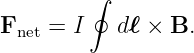
Solution 8: closed loop in a uniform magnetic field
Start from
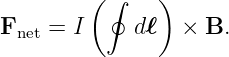
Because B is uniform, it can be moved outside the path integral:
For any closed path,
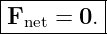
Therefore,
This does not imply zero torque. Equal and opposite forces can act at different points
on the loop and form a couple, producing rotation even though their vector sum is
zero.
Solution 9: torque on a multiturn rectangular loop
The magnetic moment magnitude is
| μ | = NIA | (99)
|
| = 20(1.5)(0.030) | (100)
|
| = 0.90 A m2. | (101) |
The torque magnitude is
| τ | = μB sin 𝜃 | (102)
|
| = (0.90)(0.20) sin 40∘ | (103)
|
| ≈ 0.1157 N m. | (104) |
Thus
Solution 10: magnetic dipole moment
The magnitude is
| μ | = NIA | (106)
|
| = 50(0.25)(6.0 × 10⁻⁴) | (107)
|
| = 7.5 × 10⁻³ A m2. | (108) |
Hence
Viewed from +z, the current is counterclockwise. Curling the right-hand fingers with the current
makes the thumb point in +z. Therefore,
Solution 11: vector torque from a dipole moment
Use
Then
| τ | = (0.040)(0.30)(y ×z) | (112)
|
| = 0.012x N m. | (113) |
Thus
Solution 12: magnetic potential-energy change
The potential energy is
Initially,
| Ui | = −(0.050)(0.40) cos 120∘ | (116)
|
| = +1.0 × 10⁻² J. | (117) |
So
At alignment,
| Uf | = −(0.050)(0.40) cos 0 | (119)
|
| = −2.0 × 10⁻² J. | (120) |
Thus
The change is
| ΔU | = Uf − Ui | (122)
|
| = −0.020 − 0.010 | (123)
|
| = −3.0 × 10⁻² J. | (124) |
Therefore,
The aligned state is lower in potential energy.
Solution 13: when zero net force no longer follows
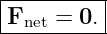
For a closed loop in a uniform magnetic field,
The torque need not be zero. Unless μ is parallel or antiparallel to B, the loop can
have
For a strongly nonuniform field, neither quantity must vanish. Different portions of the loop can
sample different field magnitudes or directions, so the local forces need not cancel completely. The
uniform-field proof fails at the step
because a spatially varying B cannot be taken outside the integral.
Solution 14: synthesis - coil force, torque, and energy
The magnetic moment magnitude is
| μ | = NIA | (129)
|
| = 100(0.40)(5.0 × 10⁻⁴) | (130)
|
| = 2.0 × 10⁻² A m2. | (131) |
Hence
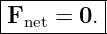
Because the field is uniform and the coil is closed,
The torque magnitude is
| τ | = μB sin 30∘ | (134)
|
| = (0.020)(0.25)(0.5) | (135)
|
| = 2.5 × 10⁻³ N m. | (136) |
Thus
At 30∘,
| U30 | = −μB cos 30∘ | (138)
|
| = −(0.020)(0.25)(0.8660) | (139)
|
| ≈−4.33 × 10⁻³ J. | (140) |
Therefore,
At alignment,
The potential-energy change is
| ΔU | = U0 − U30 | (143)
|
| = −5.00 × 10⁻³ − (−4.33 × 10⁻³) | (144)
|
| ≈−6.70 × 10⁻⁴ J. | (145) |
Thus
The coil lowers its magnetic potential energy as it moves toward alignment.
Common mistakes
- Using electron drift direction in I dℓ. The current-element vector follows
conventional current.
- Dropping the cross product. Magnetic force is perpendicular to both the current
direction and the magnetic field.
- Treating J × B as total force. It is force per unit volume and must be integrated
over volume.
- Assuming zero net force means zero torque. A current loop in a uniform field
can have zero net force and nonzero torque.
- Using A instead of NA for a multiturn coil. The magnetic moment is μ = NIA.
- Measuring 𝜃 from the plane of the loop. In τ = μB sin 𝜃 and U = −μB cos 𝜃, 𝜃
is the angle between the loop normal and B.
- Applying the closed-loop zero-force proof to a nonuniform field. The field
may not be taken outside the path integral when it varies with position.
What EM10E reinforces
The sequence from microscopic to macroscopic magnetic force is
For a continuous current distribution,
For a closed planar coil,
and
These ideas complete the force side of the current-field interaction. EM11 reverses the direction of
reasoning and asks how electric currents generate magnetic fields through the Biot–Savart
law.
References
[1] David J. Griffiths, Introduction to Electrodynamics, 4th ed., Cambridge University
Press, 2017.
[2] Samuel J. Ling, Jeff Sanny, and William Moebs, University Physics, Volume 2,
OpenStax, 2016, chapters on magnetic force, current loops, and sources of magnetic fields.
[3] Edward M. Purcell and David J. Morin, Electricity and Magnetism, 3rd ed.,
Cambridge University Press, 2013.
[4] Richard P. Feynman, Robert B. Leighton, and Matthew Sands, The Feynman Lectures
on Physics, Volume II, Addison-Wesley, 1964, chapters on magnetic force, currents, and
magnetic moments.
[5] Massachusetts Institute of Technology, 8.02 Physics II: Electricity and Magnetism,
MIT OpenCourseWare, materials on Lorentz force, current-carrying conductors, torque,
and magnetic dipoles.

![[parent]](https://images.physicslibrary.org/images/uparrow.png)