Electromagnetic Waves, Antennas, and RF: Magnetic Fields
EM08 introduced electric current and current density: charge in motion. The next step is to study
a new vector field whose most immediate effect is also tied to moving charge: the magnetic
field.
In this article the magnetic field is introduced operationally through the force it exerts on a
moving charged particle. The sources of magnetic fields are postponed to EM10, where
currents will be used to generate magnetic fields through the Biot–Savart law and related
results.
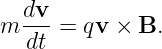
The central magnetic-force law is
Here q is the particle charge, v is its velocity, and B is the magnetic field, often called the
magnetic flux density. The cross product makes magnetic force fundamentally directional: the force
depends not only on the field magnitude but also on the direction of particle motion
[1, 2, 3, 5].
1 The magnetic field as a vector field
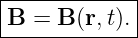
Like the electric field introduced in EM05, the magnetic field is a vector field:
At each point in space and time, B has both magnitude and direction.
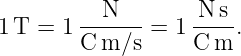
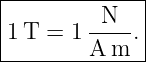
Its SI unit is the tesla:
The unit follows directly from the magnetic-force law. For motion perpendicular to the
field,
so
Because 1 A = 1 C/s, this may also be written as
2 The magnetic part of the Lorentz force
The complete electromagnetic force on a point charge is the Lorentz force
The electric part is
while the magnetic part is
This equation immediately reveals an important difference between electric and magnetic forces. A
stationary charge can experience an electric force, but if
then
A magnetic field therefore does not exert a magnetic force on a stationary point charge.
3 Cross-product geometry
For two vectors v and B, the vector
is perpendicular to both. Its magnitude is
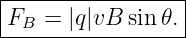
where 𝜃 is the angle between v and B.
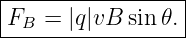
Therefore the magnetic-force magnitude is
For a positive charge, the force direction is the direction of v × B. For a negative charge, the force
direction is reversed.
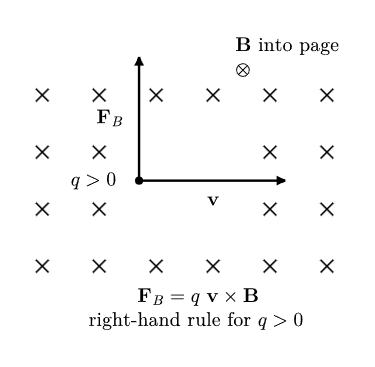
Figure. For a positive charge, FB = qv × B follows the right-hand rule. A negative charge
experiences the opposite force direction.
3.1 Three important angles
If v is parallel to B,
and
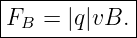
If v is perpendicular to B,
and the magnetic force has its maximum magnitude:
If v is antiparallel to B,
and again
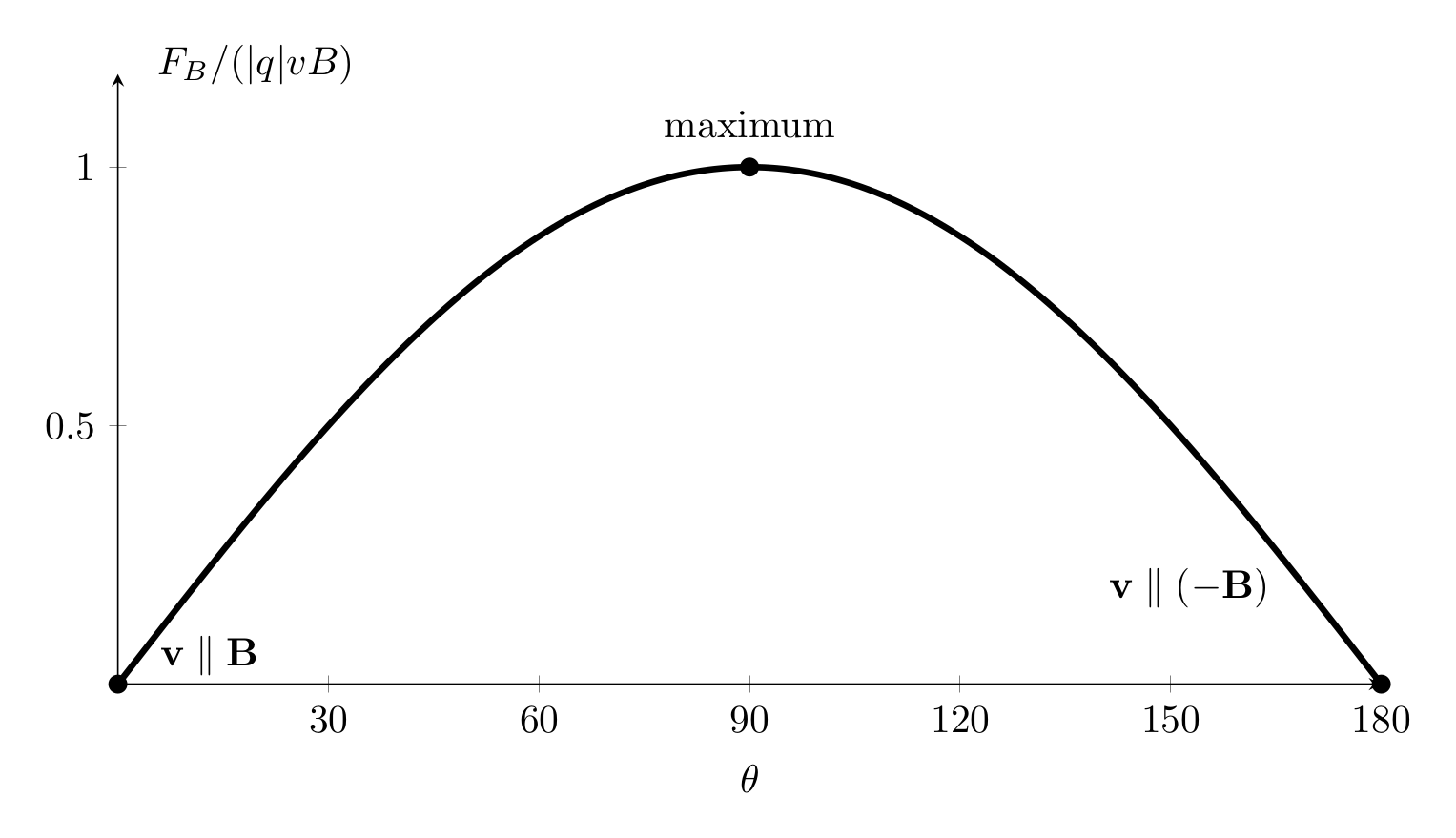
Figure. Normalized magnetic-force magnitude as a function of the angle between velocity
and magnetic field. Only the component of velocity perpendicular to B contributes to the
magnetic force.
4 Only perpendicular velocity contributes
Decompose the velocity into components parallel and perpendicular to the field:
Then
Because v∥ is parallel to B,
Thus
The parallel velocity passes through the magnetic field without being changed by the magnetic
force. The perpendicular velocity is continuously deflected.
5 A magnetic field does no work on a point charge
Instantaneous mechanical power delivered by a force is
For the magnetic force,
| PB | = FB ⋅ v | (26)
|
| = q(v × B) ⋅ v. | (27) |
The vector v × B is perpendicular to v, so their dot product is zero:
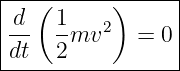
Therefore an ideal magnetic field acting alone does not change the kinetic energy of a point
charge:
in the nonrelativistic case.
The magnetic field can change the direction of velocity, but not its speed. This is why magnetic
forces naturally produce curved particle trajectories.
6 Circular motion for velocity perpendicular to the field
Suppose a charged particle enters a uniform magnetic field with
The magnetic force is always perpendicular to the velocity. Because the speed remains constant
while the direction changes, the force acts as a centripetal force.
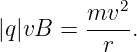
Equating magnetic and centripetal force magnitudes gives
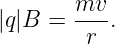
Cancel one factor of v:
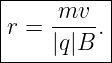
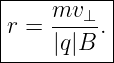
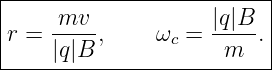
Therefore the orbit radius is
This result is nonrelativistic. It shows that a larger momentum produces a larger orbit radius,
while a stronger magnetic field bends the trajectory more tightly.
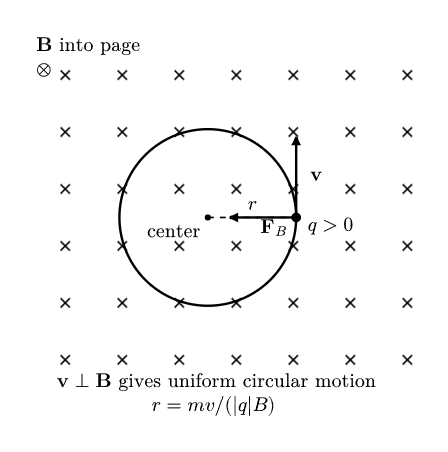
Figure. For v ⊥ B, the magnetic force remains perpendicular to the velocity and points
toward the center of the circular trajectory.
6.1 Cyclotron angular frequency
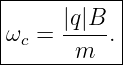
The angular speed for circular motion is
Using
we obtain
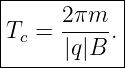
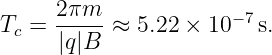
The corresponding period is
In this ideal nonrelativistic model, the cyclotron angular frequency does not depend on
speed.
7 Helical motion when velocity has two components
Now suppose
The perpendicular component produces circular motion, while the parallel component remains
unchanged. The result is a helix around the magnetic-field direction.
The helix radius is
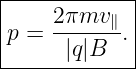
During one cyclotron period, the particle moves a parallel distance
where p is the helix pitch. Therefore
This decomposition is widely useful in plasma physics, charged-particle instrumentation, and space
environments.
8 Magnetic force on a current-carrying conductor
EM08 described electric current as moving charge. Since moving charges experience magnetic
force, a current-carrying Conductor placed in a magnetic field can experience a net
force.
For a short straight conductor segment with vector length L carrying conventional current I in a
uniform magnetic field,
Its magnitude is
The vector L points in the conventional-current direction.
For a differential conductor element,
This result will become especially useful once EM10 develops the magnetic fields generated by
currents themselves.
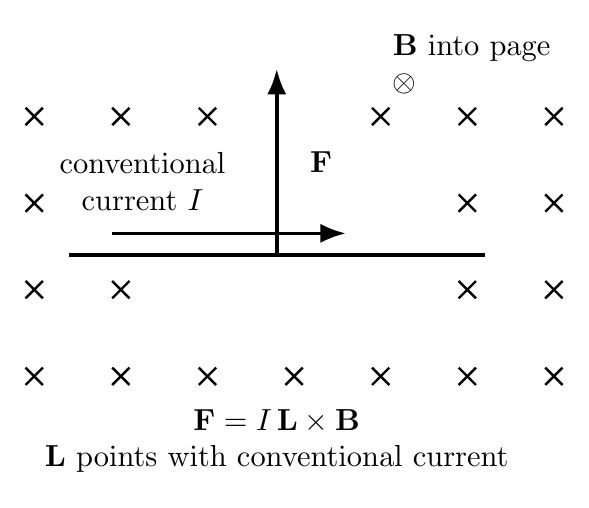
Figure. A straight current element in a magnetic field experiences a force perpendicular to
both the current direction and the magnetic field.
9 A note about B and H
In this article the magnetic field is described using B, measured in tesla. Electromagnetic-wave and
materials discussions also commonly use the magnetic field intensity H, measured in
A/m.
In vacuum they are related by
The distinction becomes more important in material media. The present article keeps the focus on
B because it appears directly in the Lorentz-force law. Later wave articles will return to H when
electromagnetic wave impedance and power flow are developed.
10 Worked Example 1: force on a positive charge
A proton moves with
through a uniform field
For a proton,
The direction is
The magnitude is
| FB | = qvB | (50)
|
| = (1.602 × 10⁻¹⁹)(3.0 × 10⁶)(0.20) | (51)
|
| ≈ 9.61 × 10⁻¹⁴ N. | (52) |
Thus
11 Worked Example 2: the same motion for an electron
Suppose an electron has the same velocity and moves through the same field as in Example
1.
The vector v × B is still directed toward −y, but the electron charge is negative:
Therefore
The positive and negative particles bend in opposite directions.
12 Worked Example 3: force at an oblique angle
A particle has
and the angle between v and B is 30∘.
Then
| FB | = |q|vB sin 𝜃 | (57)
|
| = (2.0 × 10⁻⁶)(400)(0.50) sin 30∘ | (58)
|
| = 2.0 × 10⁻⁴ N. | (59) |
Thus
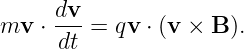
13 Worked Example 4: proving that speed stays constant
For a particle moving only under magnetic force,
Dot both sides with v:
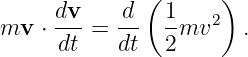
The right side is zero. The left side is
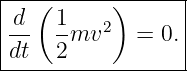
Therefore
The magnetic field changes velocity direction but not speed.
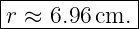
14 Worked Example 5: proton orbit radius
A proton moves perpendicular to a uniform magnetic field with
Using
we find
| r | =  | (67)
|
| = 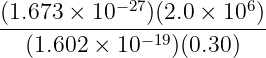 | (68)
|
| ≈ 6.96 × 10⁻² m. | (69) |
Thus
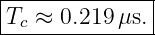
The cyclotron period is
| Tc | =  | (71)
|
| ≈ 2.19 × 10⁻⁷ s. | (72) |
So
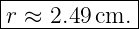
15 Worked Example 6: helical motion
A particle has perpendicular and parallel velocity components
Let
The helix radius is
| r | =  | (76)
|
| = 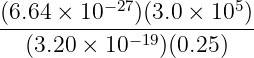 | (77)
|
| ≈ 2.49 × 10⁻² m. | (78) |
Thus
The period is
The pitch is
| p | = v∥Tc | (81)
|
| = (4.0 × 10⁵)(5.22 × 10⁻⁷) | (82)
|
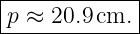
| ≈ 0.209 m. | (83) |
Therefore
16 Worked Example 7: force on a straight current segment
A straight conductor segment has length
and carries
It lies perpendicular to a uniform magnetic field
The force magnitude is
| F | = ILB | (88)
|
| = (3.0)(0.40)(0.25) | (89)
|
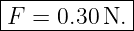
| = 0.30 N. | (90) |
Thus
Its direction is determined by L × B.
17 Common misconceptions
- Magnetic field does not mean magnetic force is always present. A stationary
point charge has zero magnetic force.
- The force is not generally along B. Magnetic force is perpendicular to both v and
B.
- The force is not generally along v. Its perpendicularity to velocity is exactly why
magnetic force does no work on a point charge.
- A negative charge reverses the right-hand-rule force direction.
- Parallel motion is not bent. Only v⊥ contributes to magnetic force.
- A circular orbit does not imply changing speed. The velocity vector changes
direction while its magnitude remains constant.
- B and H are related but are not the same quantity.
18 Why this matters for radio waves and antennas
The present article has introduced the magnetic field through its mechanical effect on moving
charge. That is only one part of the electromagnetic story.
EM08 established that electric current is organized charge motion. EM10 will show that currents
generate magnetic fields. Later, Faraday’s law and Maxwell’s correction to Ampere’s law will show
that changing electric and magnetic fields are coupled.
That sequence eventually leads to electromagnetic waves in which electric and magnetic fields
propagate together. In a simple plane wave the geometry will become
with electromagnetic power flow connected to the vector product of the electric and magnetic
fields.
The magnetic-field foundations developed here therefore become part of the mathematical
language used later for radio waves, antennas, GPS links, and RF power flow.
19 Summary
The magnetic field is a vector field
whose force on a moving point charge is
The force magnitude is
Because magnetic force is perpendicular to velocity,
so a magnetic field acting alone changes velocity direction without changing particle
speed.
For perpendicular motion in a uniform field,
A current-carrying conductor experiences
EM10 next reverses the viewpoint: instead of asking how a magnetic field acts on moving charge, it
asks how moving charge and electric current produce magnetic fields.
References
[1] David J. Griffiths, Introduction to Electrodynamics, 4th ed., Cambridge University
Press, 2017.
[2] Samuel J. Ling, Jeff Sanny, and William Moebs, University Physics, Volume 2,
OpenStax, 2016, chapters on magnetic fields and sources of magnetic fields.
[3] Edward M. Purcell and David J. Morin, Electricity and Magnetism, 3rd ed.,
Cambridge University Press, 2013.
[4] Richard P. Feynman, Robert B. Leighton, and Matthew Sands, The Feynman Lectures
on Physics, Volume II, Addison-Wesley, 1964, chapters on magnetic fields and moving
charges.
[5] Massachusetts Institute of Technology, 8.02 Physics II: Electricity and Magnetism,
MIT OpenCourseWare, materials on magnetic fields, magnetic force, and charged-particle
motion.


![|--------|
[B-] =-T.-](https://images.physicslibrary.org/cache/objects/1225/make4ht/ElectromagneticWavesMagneticFields2x.png)