Electromagnetic Waves, Antennas, and RF: Electric Current and Current Density
EM05–EM07 treated Electric Charge primarily as a static source. The next step is to let charge
move.
Electric current measures how rapidly charge crosses an oriented surface. Current density describes
how that charge flow is distributed in space and in direction. These ideas are essential because
moving charge produces magnetic effects, and time-varying currents are among the physical
sources of electromagnetic radiation and antenna fields [1, 2, 3, 5].
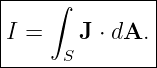
The central distinction is
for current through a chosen surface, whereas
is a vector field defined throughout a region of space.
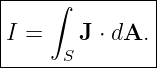
The two are connected by
This equation should look familiar. It has the same geometric structure as the electric-flux integral
introduced in EM06.
1 Electric current as charge flow rate
Suppose an oriented surface is placed across a conducting wire. Let dq be the net charge that
crosses the surface in time dt. The instantaneous current is
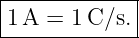
The SI unit of current is the ampere:
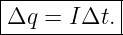
If a constant current I flows for a time interval Δt, the amount of charge transported
is
Current is therefore not an amount of charge. It is a rate of charge transport.
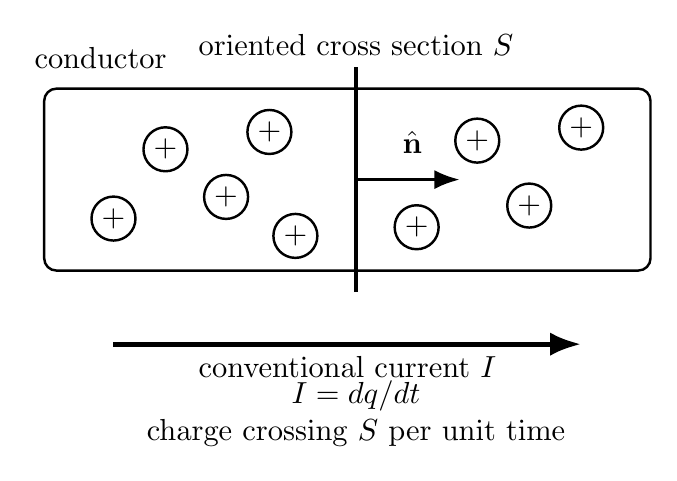
Figure. Electric current measures the net charge crossing an oriented surface per unit
time. The arrow labeled I indicates the conventional-current direction.
2 Conventional current direction
By convention, current direction is defined as the direction in which positive charge would
move.
If positive charge carriers move toward +x, the conventional current points toward
+x.
In an ordinary metal, the mobile carriers are electrons. Because electrons have negative charge,
their drift direction is opposite the conventional-current direction.
This convention predates the discovery of the electron, but it remains standard throughout circuit
theory and Electromagnetism.
2.1 Current is signed
Once a positive surface orientation has been chosen, current can be positive or negative. A net
positive charge flow in the chosen positive direction gives positive current. Reversing the
orientation reverses the sign assigned to the same physical flow.
3 From current to current density
Current tells us the total charge flow through a surface, but not how that flow is distributed across
the surface.
Imagine a wide Conductor. The charge flow might be nearly uniform, or it might be concentrated
near one side. To describe the local flow we introduce the current density
Current density is a vector field. Its direction gives the local conventional-current direction, and its
magnitude gives current per unit area measured perpendicular to the flow.
Its SI unit is
4 Current as flux of current density
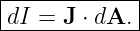
Consider a small oriented surface element
The infinitesimal current through that patch is
Using the dot product,
where 𝜃 is the angle between J and the surface normal.
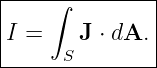
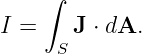
Adding all the surface patches gives
This is the current-density analogue of a flux integral.
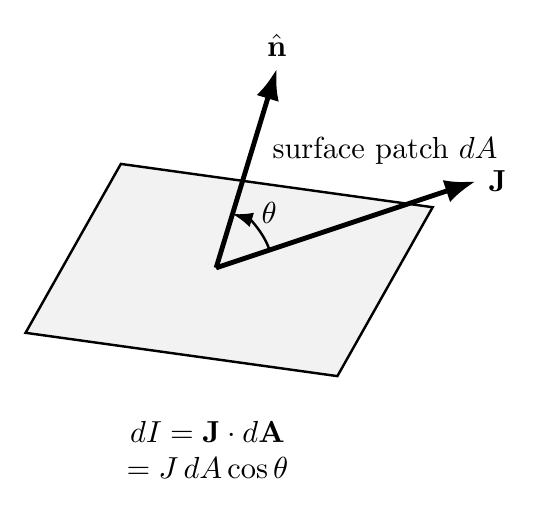
Figure. Only the component of J normal to the surface contributes to current through the
surface. The angle is measured between J and the area normal n.
5 Uniform current density
If J is uniform over a flat area A and perpendicular to the surface, then
Therefore,
| I | = ∫
SJ dA | (14)
|
| = JA. | (15) |
Hence,
and
This familiar formula is a special case of the surface integral. It is not valid when J varies
appreciably across the cross section unless J is interpreted as an average.
6 Current density from moving charge density
Suppose a continuous volume charge density ρ moves with velocity v.
In a short time dt, charge moving normally through a surface sweeps out a volume proportional to
v dt. The amount of charge crossing per unit area per unit time is therefore proportional to
ρv.
The vector relation is
This formula is especially useful when the moving charge can be modeled as a continuous
fluid.
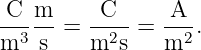
The units confirm the interpretation:
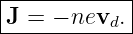
7 Microscopic carrier form: J = nqvd
Suppose there are n mobile charge carriers per unit volume. If each carrier has charge q, the mobile
volume charge density is
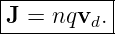
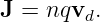
If their average drift velocity is vd, then
For positive carriers, J points in the same direction as vd.
For electrons,
so
Thus the conventional current density points opposite the electron drift velocity.
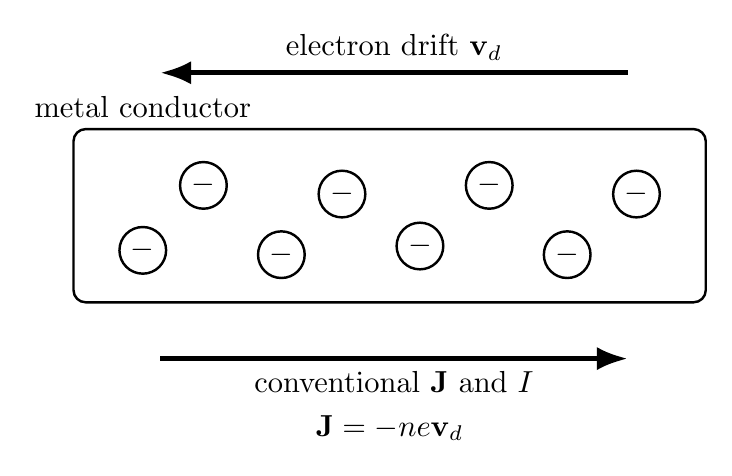
Figure. In a metal, electrons drift opposite to the conventional-current direction because
the mobile carriers have negative charge.
8 Drift velocity is usually slow
The electrical signal in a conductor can propagate rapidly even though the average drift speed of
individual charge carriers is often quite small.
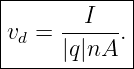
For a wire carrying a uniform current,
in magnitude. Therefore,
Because conductors contain an enormous number of mobile electrons per unit volume, modest
currents generally require only small average drift speeds.
This distinction becomes important later in RF. Electromagnetic disturbances and fields
can propagate through a structure far faster than individual electrons drift along the
conductor.
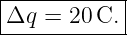
9 Example 1: charge transported by a steady current
A steady current of
flows for
The transported charge is
| Δq | = IΔt | (28)
|
| = (2.5)(8.0) | (29)
|
| = 20 C. | (30) |
Thus,
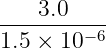
10 Example 2: uniform current density in a wire
A wire carries
through a cross-sectional area
Assuming uniform current density perpendicular to the cross section,
| J | =  | (34)
|
| =  | (35)
|
| = 2.0 × 10⁶ A/m2. | (36) |
Therefore,
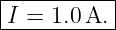
11 Example 3: current through a tilted surface
A uniform current density has magnitude
It crosses a flat area
whose normal makes an angle
with J.
Then
| I | = JA cos 𝜃 | (41)
|
| = (5.0)(0.40) cos 60∘ | (42)
|
| = 1.0 A. | (43) |
So
12 Example 4: electron drift speed
A metallic wire carries
Suppose
and each carrier has charge magnitude
The drift-speed magnitude is
| vd | =  | (48)
|
| =  | (49)
|
| ≈ 7.34 × 10⁻⁵ m/s. | (50) |
Thus,
This is less than one tenth of a millimeter per second.
13 Charge conservation for a fixed volume
Charge cannot simply disappear from a region without crossing its boundary or being balanced by
corresponding charge transport.
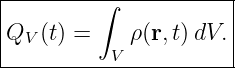
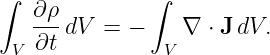
Consider a fixed volume V bounded by a closed surface S. The total charge inside is
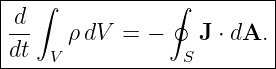
If positive current flows outward through the boundary, the charge remaining inside decreases.
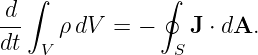
Therefore,
The minus sign is essential: positive outward current corresponds to decreasing enclosed
charge.
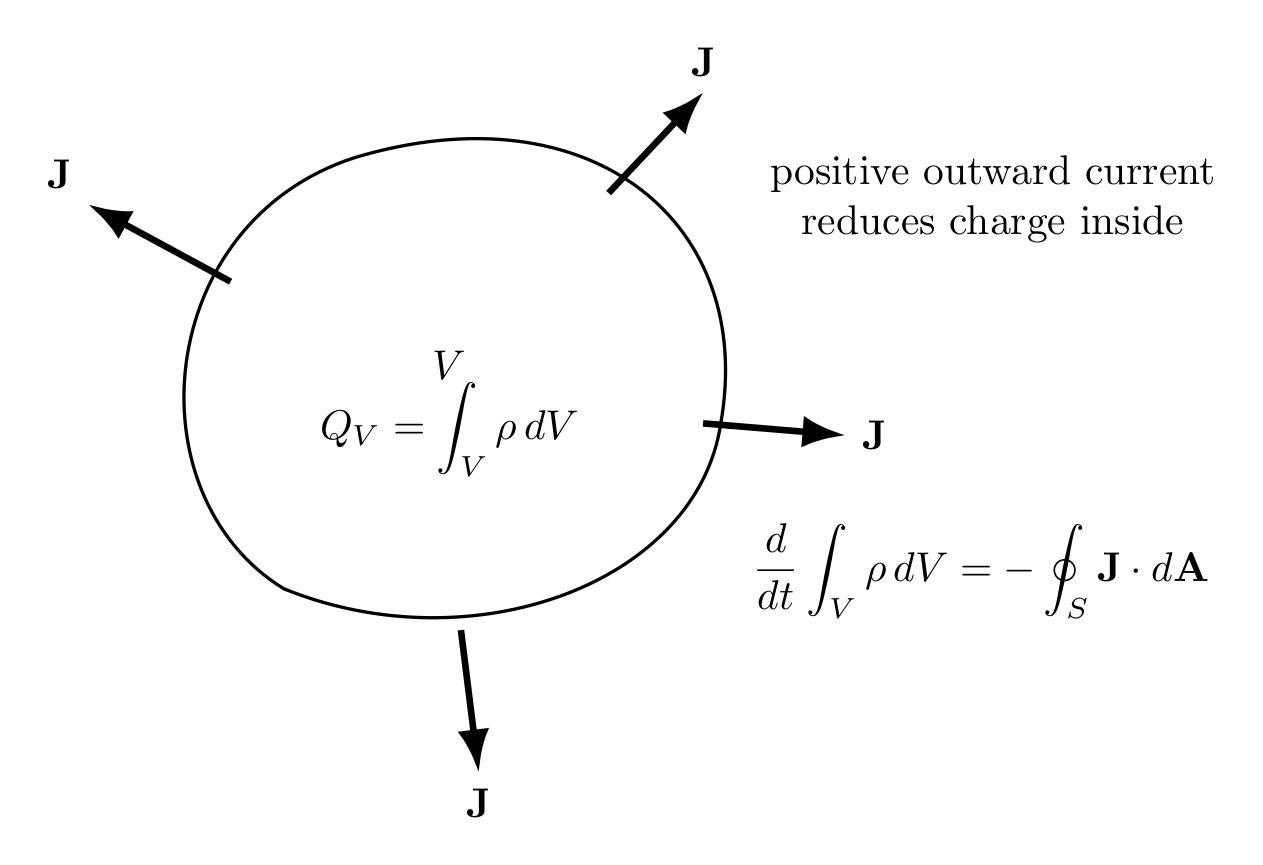
Figure. Charge conservation for a fixed control volume. Net outward current through the
boundary reduces the charge stored inside the volume.
14 From integral conservation to the continuity equation
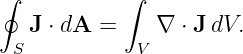
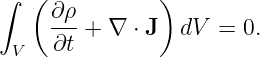
Use the divergence theorem:
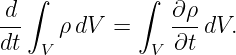
Also, for a fixed volume,
Therefore,
Move everything to one side:
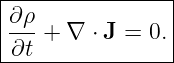
Because this must hold for every sufficiently small volume,
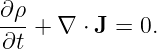
This is the continuity equation for electric charge.
15 Physical meaning of the continuity equation
The continuity equation says
If
more current leaves a tiny region than enters it, so
The local charge density decreases.
If
more current enters than leaves, so charge accumulates locally.
This gives a physical interpretation to the divergence operator introduced in EM03.
16 Steady current
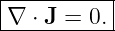
For a truly steady charge-flow pattern,
The continuity equation then gives
A steady current density therefore has no local accumulation or depletion of charge in the region
being modeled.
This does not mean that J must be spatially uniform. It means only that its divergence is
zero.
17 Example 5: current density from moving volume charge
Suppose
moves with velocity
Then
| J | = ρv | (67)
|
| = (4.0 × 10⁻⁶)(3.0)x | (68)
|
| = 1.2 × 10⁻⁵x A/m2. | (69) |
Therefore,
18 Example 6: nonuniform current density through a disk
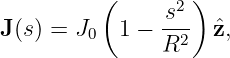
Suppose a circular cross section of radius R carries an axial current density
where s is radial distance from the axis.
For a cross section normal to z,
Thus,
| I | = ∫
02π ∫
0RJ
0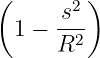 sdsdϕ sdsdϕ | (73)
|
| = 2πJ0![[ 2 4 ]
s- − -s--
2 4R2](https://images.physicslibrary.org/cache/objects/1223/make4ht/ElectromagneticWavesElectricCurrentAndCurrentDensity60x.png) 0R 0R | (74)
|
| = 2πJ0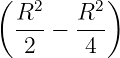 | (75)
|
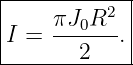
| =  . . | (76) |
Therefore,
This example shows why the general surface integral is needed when current density is not
uniform.
19 Example 7: continuity equation and local charge loss
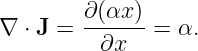
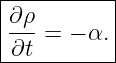
Let
where α is constant.
The divergence is
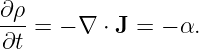
The continuity equation gives
Hence,
The positive divergence means net current leaves a small region, so the local charge density
decreases with time.
20 Current density and the antenna path ahead
Current density is not merely a circuit quantity. It is one of the central source fields of classical
electromagnetism.
Later articles will introduce magnetic fields produced by currents and then Maxwell’s equations. In
those equations, the source term J(r,t) describes electric current density distributed through
space.
For antennas, the important source is generally time-varying current. A wire antenna, for example,
supports a current distribution that varies with position and time. The spatial and
temporal structure of that current determines the electromagnetic fields radiated into
space.
A simplified harmonic current can be written schematically as
The detailed connection between such currents and radiation will be developed only after the
magnetic field, Faraday’s law, and the Maxwell-Ampere equation are established.
21 Current is not the same as current density
These quantities must remain distinct:
Current I is a scalar rate through a selected surface and has units of amperes.
Current density J is a vector field and has units of amperes per square meter.
They are related by
Knowing I alone does not determine the full spatial distribution of J.
22 Common mistakes
- Confusing charge with current. Charge is measured in coulombs; current is charge
per unit time.
- Confusing I with J. Current is a scalar through a chosen surface; current density is
a vector field.
- Ignoring surface orientation. The sign of ∫
J ⋅ dA depends on the chosen normal
direction.
- Using I = JA for a nonuniform J. The general relation is the surface integral.
- Assuming electrons move in the current direction. In metals, electron drift is
opposite conventional current.
- Assuming rapid electrical response means rapid electron drift. Carrier drift
can be slow even while electromagnetic disturbances propagate rapidly.
- Forgetting the minus sign in charge conservation. Net outward current decreases
the charge stored inside a fixed volume.
Summary
The essential results of EM08 are:
- Electric current is the rate of charge flow:
- Current density is a vector field with units A/m2.
- Current through a surface is
- For uniform perpendicular current density,
- Moving continuous charge gives
- For discrete carrier density n,
- Charge conservation gives
- The local continuity equation is
The next lesson, EM09, introduces magnetic fields and the magnetic force on moving charge,
beginning the transition from charge flow to the coupled electric-and-magnetic description required
for electromagnetic waves.
References
[1] David J. Griffiths, Introduction to Electrodynamics, 4th ed., Cambridge University
Press, 2017.
[2] Samuel J. Ling, Jeff Sanny, and William Moebs, University Physics, Volume 2,
OpenStax, 2016, sections on electric current, current density, and charge conservation.
[3] Edward M. Purcell and David J. Morin, Electricity and Magnetism, 3rd ed.,
Cambridge University Press, 2013.
[4] Richard P. Feynman, Robert B. Leighton, and Matthew Sands, The Feynman Lectures
on Physics, Volume II, Addison-Wesley, 1964, chapters on current, charge conservation,
and electromagnetic fields.
[5] Massachusetts Institute of Technology, 8.02 Physics II: Electricity and Magnetism,
MIT OpenCourseWare, materials on current, current density, magnetic fields, and
Maxwell’s equations.
[6] John D. Jackson, Classical Electrodynamics, 3rd ed., Wiley, 1999, sections on charge
conservation and current density.





![|----------2-|
-[J-] =-A/m--.-](https://images.physicslibrary.org/cache/objects/1223/make4ht/ElectromagneticWavesElectricCurrentAndCurrentDensity7x.png)