|
|
|
|||||||
WM20 obtained the instantaneous power
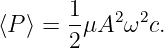
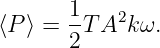
and the cycle average
The same lesson also established
and
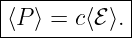
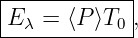
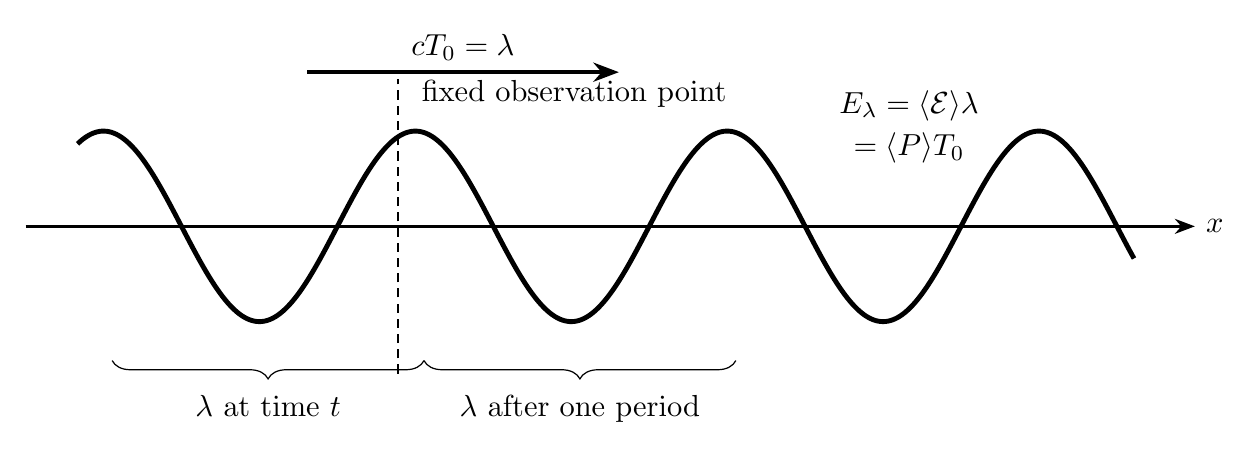
For a steady sinusoidal traveling wave, the energy in one wavelength satisfies
because one wavelength passes a fixed point in one period [1, 2, 3].
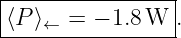
How to use this problem setAttempt all exercises in Part I before consulting Part II. Keep the following distinctions explicit:
Part I: Exercises
Exercise 1: Derive the one-half factorStarting from
show that
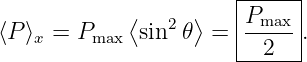
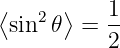
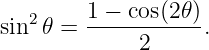
over one complete cycle, and hence derive
Use
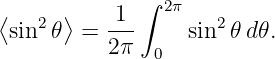
The following figure gives a geometric interpretation of the same average.
Exercise 2: Average and peak power from string dataA right-moving sinusoidal wave has
on a string with
Find:
Exercise 3: Use the TA2kω formA right-moving sinusoidal wave has
and the string tension is
Find the average power and the peak instantaneous power.
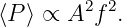
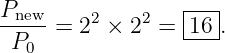
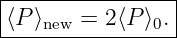
Exercise 4: Square-law scalingFor a fixed string, a sinusoidal wave initially carries average power P0. The amplitude changes from A0 to 1.40A0 and the frequency changes from f0 to 0.75f0.
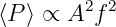
Use the figure below as a reminder of the square-law dependence.
Figure. At fixed string properties, average power is quadratic in both amplitude and frequency.
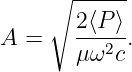
Exercise 5: Required amplitudeA string has
A sinusoidal wave of frequency
must carry an average power of
Find the required displacement amplitude A.
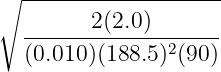
Exercise 6: Infer frequency from measured average powerA traveling sinusoidal wave has
and carries average power
Find its ordinary frequency f.
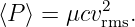
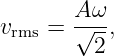
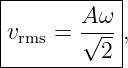
Exercise 7: RMS transverse velocityAt a fixed point on a sinusoidal traveling wave, the RMS transverse material velocity is
The string has
Exercise 8: Average energy density and energy per wavelengthA sinusoidal traveling wave has
Find:
Figure. One wavelength moves a distance λ = cT0 in one period, so the energy in one wavelength crosses a fixed point in one period.
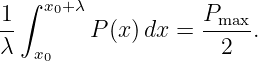
Exercise 9: Spatial average versus temporal averageAt a fixed time, the power of a right-moving sinusoidal wave is
Show directly that averaging over one wavelength gives
Explain why this is equal to the time average over one period.
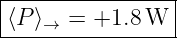
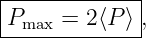
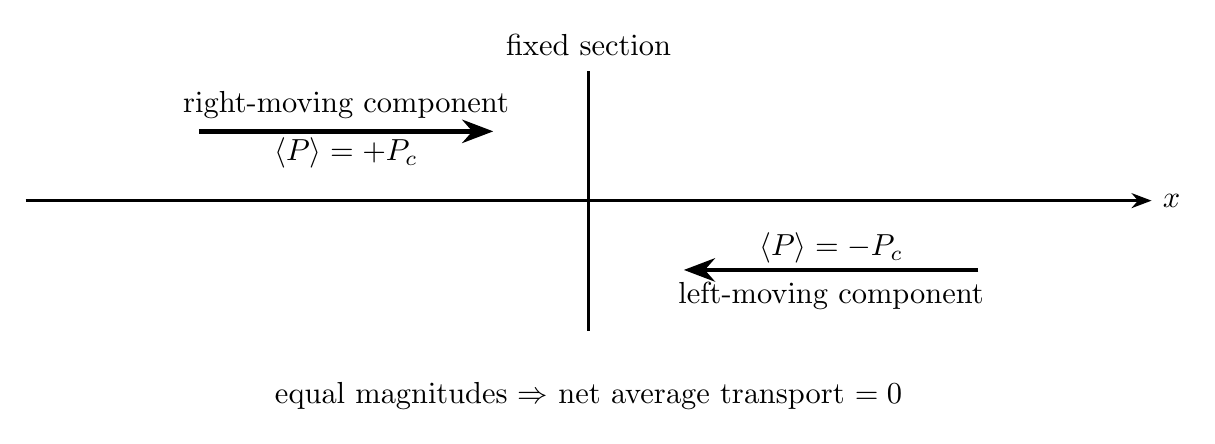
Exercise 10: Signed average powerTwo otherwise identical sinusoidal waves have the same A, f, μ, and c. One travels right and the other travels left. The magnitude of the average power carried by each is
Using the WM19 sign convention:
Figure. Equal right- and left-moving sinusoidal waves carry equal-magnitude average powers with opposite signs.
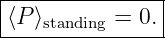
Exercise 11: Perfect standing waveA Standing Wave is formed from two equal sinusoidal waves traveling in opposite directions. Each component separately carries average power magnitude
Exercise 12: Changing the tension changes the mediumA sinusoidal wave is maintained at fixed displacement amplitude A and fixed ordinary frequency f on a string whose linear density μ is unchanged. The tension is increased from T0 to 4T0.
Exercise 13: Diagnose conceptual statementsFor each statement, decide whether it is correct. If it is incorrect, rewrite it accurately.
Exercise 14: Full synthesisA right-moving sinusoidal wave travels on a string with
and has
Find:
Then verify numerically that
Part II: Complete Worked Solutions
Solution 1: Derive the one-half factorAt fixed x, define
Then
Over one complete period, the phase changes by 2π, so
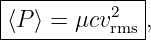
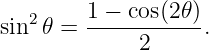
Use
Therefore
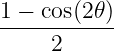
Since
the average is
Solution 2: Average and peak power from string dataGiven
first compute
The angular frequency is
Now
For a sinusoidal traveling wave,
so
Solution 3: Use the TA2kω formConvert the amplitude:
Then
Therefore
Solution 4: Square-law scalingFor fixed string properties,
Hence
Thus the power increases by about 10.3%. If both amplitude and frequency double,
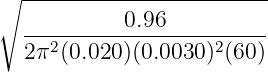
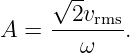
Solution 5: Required amplitudeUse
Solve for A:
The angular frequency is
Therefore
Thus
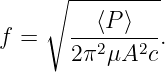
Solution 6: Infer frequency from measured average powerStart from
Solve for f:
Substitute
Then
Solution 7: RMS transverse velocityUse
Thus
For part (b),
so
With
we obtain
Therefore
Solution 8: Average energy density and energy per wavelengthUse
Hence
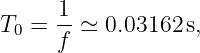
The period is
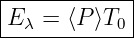
The energy in one wavelength is
The energy crossing a point in one period is
The two values agree, as they must.
Solution 9: Spatial average versus temporal averageThe spatial average is
Let
Over one wavelength,
so the phase spans one complete cycle. Therefore
The temporal average is identical because at a fixed position the phase also spans exactly 2π during one period. Both averages therefore sample one complete phase cycle.
Solution 10: Signed average powerUnder the WM19 sign convention, rightward energy flow is positive and leftward flow is negative. Thus
and
If both equal components are present,
Solution 11: Perfect standing wave
Solution 12: Changing the tension changes the mediumThe wave speed is
If
then
At fixed A, f, and μ,
Therefore doubling c doubles the average power:
The simple statement
assumes the medium properties remain fixed. Here the tension changes, so the propagation speed also changes and must be included.
Solution 13: Diagnose conceptual statements
Solution 14: Full synthesisGiven
first find the wave speed:
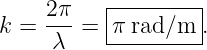
The Wavenumber is
The frequency is
The angular frequency is
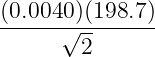
The RMS transverse velocity is
The average energy density is
The average power is
The peak instantaneous power is
The energy in one wavelength is
Finally,
so
Thus
is verified numerically.
Common mistakes
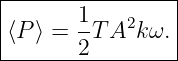
What WM20E1 reinforcesThese exercises reinforce the central WM20 result
They also connect average power to RMS velocity, average energy density, signed propagation direction, and energy transport over one wavelength and one period. These ideas prepare directly for later discussions of intensity, flux, impedance, and reflection/transmission.
References
References
[1] A. P. French, Vibrations and Waves, M.I.T. Introductory Physics Series, W. W. Norton & Company, 1971. [2] Frank S. Crawford, Jr., Waves, Berkeley Physics Course, Volume 3, McGraw-Hill, 1968. [3] William Moebs, Samuel J. Ling, and Jeff Sanny, University Physics, Volume 1, OpenStax, 2016, Section 16.4, “Energy and Power of a Wave.” [4] Howard Georgi, The Physics of Waves, Prentice Hall, 1993. [5] Massachusetts Institute of Technology, 8.03SC Physics III: Vibrations and Waves, MIT OpenCourseWare, Fall 2016. [6] Richard P. Feynman, Robert B. Leighton, and Matthew Sands, The Feynman Lectures on Physics, Volume I, Chapter 47, “Sound. The Wave Equation.” "example of Wave Mechanics: Average Power of a Sinusoidal Wave" is owned by bloftin.
This object's parent. Cross-references: impedance, flux, Wavenumber, units, potential energy, position, Standing Wave, WM19, velocity, displacement, frequency, amplitude, tension, angular frequency, speed, phase, magnitude, Power, period, energy, instantaneous power, average power, mechanics, WM20 This is version 1 of example of Wave Mechanics: Average Power of a Sinusoidal Wave, born on 2026-09-12. Object id is 1188, canonical name is ExampleOfWaveMechanicsAveragePowerOfASinusoidalWave. Accessed 229 times total. Classification:
|
|
|
|
Pending Errata and AddendaNone.
|
DiscussionNo messages.
|
Interact |
![[parent]](https://images.physicslibrary.org/images/uparrow.png)





























![[π ]](https://images.physicslibrary.org/cache/objects/1188/make4ht/ExampleOfWaveMechanicsAveragePowerOfASinusoidalWave39x.png)







 (0
(0



 (72)(0