The idea that matter is composed of tiny particles called atoms is at least 25 centuries old.
It took until the twentieth century, however, for scientists to invent instruments that
permitted them to probe inside an atom and find that it is not, as had been thought,
hard and indivisible. Instead, the atom is a complex structure composed of still smaller
particles.
Probing the Atom
The first of these smaller particles was discovered by British physicist James (J. J.)
Thomson in 1897. Named the electron, this particle is negatively charged. (It is the flow of
these particles that produces currents of electricity, whether in lightning bolts or in
the wires leading to your lamp.) Because an atom in its normal state is electrically
neutral, each electron in an atom must be balanced by the same amount of positive
charge.
The next step was to determine where in the atom the positive and negative charges are located.
In 1911, British physicist Ernest Rutherford devised an experiment that provided part of
the answer to this question. He bombarded an extremely thin piece of gold foil, only
about 400 atoms thick, with a beam of alpha particles (Figure 5.14). Alpha particles
(α particles) are helium atoms that have lost their electrons and thus are positively
charged.
Most of these particles passed though the gold foil just as if it and the atoms in it were nearly
empty space. About 1 in 8000 of the alpha particles, however, completely reversed direction and
bounced backward from the foil. Rutherford wrote, “It was quite the most incredible event that
has ever happened to me in my life. It was almost as incredible as if you fired a 15-inch shell at a
piece of tissue paper and it came back and hit you.”
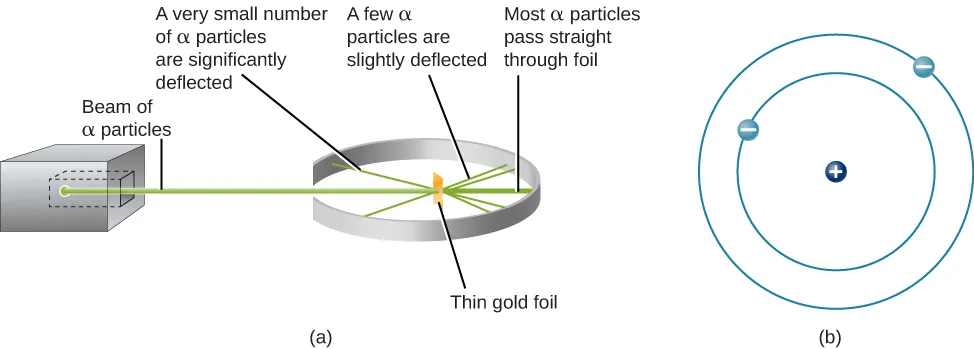
Figure 5.14 Rutherford’s Experiment. (a) When Rutherford allowed α particles from a radioactive
source to strike a target of gold foil, he found that, although most of them went straight through,
some rebounded back in the direction from which they came. (b) From this experiment, he
concluded that the atom must be constructed like a miniature solar system, with the positive
charge concentrated in the nucleus and the negative charge orbiting in the large volume around the
nucleus. Note that this drawing is not to scale; the electron orbits are much larger relative to the
size of the nucleus.
The only way to account for the particles that reversed direction when they hit the gold foil was to
assume that nearly all of the mass, as well as all of the positive charge in each individual gold
atom, is concentrated in a tiny center or nucleus. When a positively charged alpha particle strikes
a nucleus, it reverses direction, much as a cue ball reverses direction when it strikes another billiard
ball.
Rutherford’s model placed the other type of charge—the negative electrons—in orbit around this
nucleus.
Rutherford’s model required that the electrons be in motion. Positive and negative charges attract
each other, so stationary electrons would fall into the positive nucleus. Also, because both the
electrons and the nucleus are extremely small, most of the atom is empty, which is why nearly all
of Rutherford’s particles were able to pass right through the gold foil without colliding with
anything.
Rutherford’s model was a very successful explanation of the experiments he conducted, although
eventually scientists would discover that even the nucleus itself has structure.
The Atomic Nucleus
The simplest possible atom (and the most common one in the Sun and stars) is hydrogen. The
nucleus of ordinary hydrogen contains a single proton. Moving around this proton is a single
electron. The mass of an electron is nearly 2000 times smaller than the mass of a proton; the
electron carries an amount of charge exactly equal to that of the proton but opposite in sign
(Figure 5.15). Opposite charges attract each other, so it is an electromagnetic force that holds the
proton and electron together, just as gravity is the force that keeps planets in orbit around the
Sun.
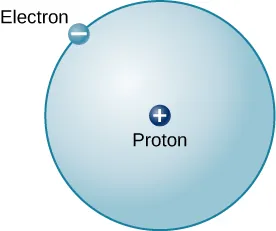
Figure 5.15 Hydrogen Atom. This is a schematic diagram of a hydrogen atom in its
lowest energy state, also called the ground state. The proton and electron have equal
but opposite charges, which exert an electromagnetic force that binds the hydrogen
atom together. In the illustration, the size of the particles is exaggerated so that you
can see them; they are not to scale. They are also shown much closer than they would
actually be as it would take more than an entire page to show their actual distance to
scale.
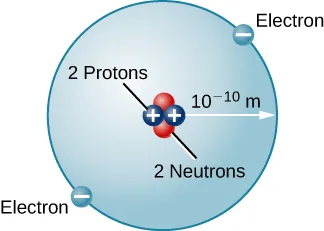
There are many other types of atoms in nature. Helium, for example, is the second-most abundant
element in the Sun. Helium has two protons in its nucleus instead of the single proton that
characterizes hydrogen. In addition, the helium nucleus contains two neutrons, particles with a
mass comparable to that of the proton but with no electric charge. Moving around this
nucleus are two electrons, so the total net charge of the helium atom is also zero (Figure
5.16).
Figure 5.16 Helium Atom. Here we see a schematic diagram of a helium atom in its lowest energy
state. Two protons are present in the nucleus of all helium atoms. In the most common variety of
helium, the nucleus also contains two neutrons, which have nearly the same mass as the proton but
carry no charge. Two electrons orbit the nucleus.
From this description of hydrogen and helium, perhaps you have guessed the pattern for building
up all the elements (different types of atoms) that we find in the universe. The type of element is
determined by the number of protons in the nucleus of the atom. For example, any atom with six
protons is the element carbon, with eight protons is oxygen, with 26 is iron, and with 92 is
uranium.
On Earth, a typical atom has the same number of electrons as protons, and these electrons follow
complex orbital patterns around the nucleus. Deep inside stars, however, it is so hot that the
electrons get loose from the nucleus and (as we shall see) lead separate yet productive
lives.
The ratio of neutrons to protons increases as the number of protons increases, but each element is
unique. The number of neutrons is not necessarily the same for all atoms of a given element. For
example, most hydrogen atoms contain no neutrons at all. There are, however, hydrogen atoms
that contain one proton and one neutron, and others that contain one proton and two
neutrons.
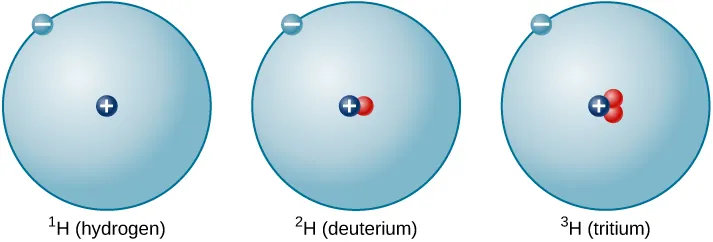
The various types of hydrogen nuclei with different numbers of neutrons are called isotopes of
hydrogen (Figure 5.17), and all other elements have isotopes as well. You can think of isotopes as
siblings in the same element “family”—closely related but with different characteristics and
behaviors.
Figure 5.17 Isotopes of Hydrogen. A single proton in the nucleus defines the atom to be hydrogen,
but there may be zero, one, or two neutrons. The most common isotope of hydrogen is the one
with only a single proton and no neutrons.
Link to Learning
To explore the structure of atoms, go to the PhET Build an Atom website
(https://openstax.org/l/30atombld) where you can add protons, neutrons, or electrons to a model
and the name of the element you have created will appear. You can also see the net charge, the
mass number, whether it is stable or unstable, and whether it is an ion or a neutral
atom.
The Bohr Atom
Rutherford’s model for atoms has one serious problem. Maxwell’s theory of electromagnetic
radiation says that when electrons change either speed or the direction of motion, they must emit
energy. Orbiting electrons constantly change their direction of motion, so they should emit a
constant stream of energy. Applying Maxwell’s theory to Rutherford’s model, all electrons should
spiral into the nucleus of the atom as they lose energy, and this collapse should happen very
quickly—in about 10−16 seconds.
It was Danish physicist Niels Bohr (1885–1962) who solved the mystery of how electrons remain in
orbit. He was trying to develop a model of the atom that would also explain certain regularities
observed in the spectrum of hydrogen. He suggested that the spectrum of hydrogen
can be understood if we assume that orbits of only certain sizes are possible for the
electron.
Bohr further assumed that as long as the electron moves in only one of these allowed
orbits, it radiates no energy: its energy would change only if it moved from one orbit to
another.
This suggestion, in the words of science historian Abraham Pais, was “one of the most audacious
hypotheses ever introduced in physics.” If something equivalent were at work in the everyday
world, you might find that, as you went for a walk after astronomy class, nature permitted you to
walk two steps per minute, five steps per minute, and 12 steps per minute, but no speeds in
between. No matter how you tried to move your legs, only certain walking speeds would be
permitted.
To make things more bizarre, it would take no effort to walk at any one of the allowed speeds, but
it would be difficult to change from one speed to another. Luckily, no such rules apply at the level
of human behavior. But at the microscopic level of the atom, experiment after experiment has
confirmed the validity of Bohr’s strange idea. Bohr’s suggestions became one of the foundations of
the new (and much more sophisticated) model of the subatomic world called quantum
mechanics.
In Bohr’s model, if the electron moves from one orbit to another closer to the atomic nucleus, it
must give up some energy in the form of electromagnetic radiation. If the electron goes from an
inner orbit to one farther from the nucleus, however, it requires some additional energy. One way
to obtain the necessary energy is to absorb electromagnetic radiation that may be streaming past
the atom from an outside source.
A key feature of Bohr’s model is that each of the permitted electron orbits around a given atom
has a certain energy value; we therefore can think of each orbit as an energy level. To move from
one orbit to another (which will have its own specific energy value) requires a change in
the electron’s energy—a change determined by the difference between the two energy
values.
If the electron goes to a lower level, the energy difference will be given off; if the electron goes to a
higher level, the energy difference must be obtained from somewhere else. Each jump (or
transition) to a different level has a fixed and definite energy change associated with
it.
A crude analogy for this situation might be life in a tower of luxury apartments where the rent is
determined by the quality of the view. Such a building has certain, definite numbered levels
or floors on which apartments are located. No one can live on floor 5.37 or 22.5. In
addition, the rent gets higher as you go up to higher floors. If you want to exchange an
apartment on the twentieth floor for one on the second floor, you will not owe as much
rent.
However, if you want to move from the third floor to the twenty-fifth floor, your rent will increase.
In an atom, too, the “cheapest” place for an electron to live is the lowest possible level, and energy
is required to move to a higher level.
Here we have one of the situations where it is easier to think of electromagnetic radiation as
particles (photons) rather than as waves. As electrons move from one level to another, they give off
or absorb little packets of energy. When an electron moves to a higher level, it absorbs a photon of
just the right energy (provided one is available). When it moves to a lower level, it emits a
photon with the exact amount of energy it no longer needs in its “lower-cost living
situation.”
The photon and wave perspectives must be equivalent: Light is light, no matter how we look at
it. Thus, each photon carries a certain amount of energy that is proportional to the
frequency (f) of the wave it represents. The value of its energy (E) is given by the
formula
where the constant of proportionality, h, is called Planck’s constant.
The constant is named for Max Planck, the German physicist who was one of the originators of the
quantum theory (Figure 5.18). If metric units are used (that is, if energy is measured in joules and
frequency in hertz), then Planck’s constant has the value h = 6.626 × 10⁻³⁴ joule-seconds (J-s).
Higher-energy photons correspond to higher-frequency waves (which have a shorter wavelength);
lower-energy photons are waves of lower frequency.
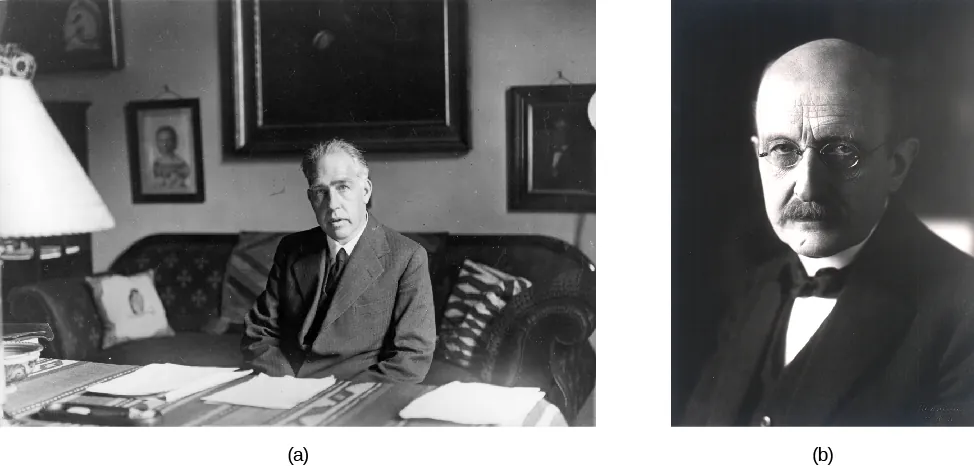
Figure 5.18 Niels Bohr (1885–1962) and Max Planck (1858–1947). (a) Bohr, shown at his desk in
this 1935 photograph, and (b) Planck helped us understand the energy behavior of
photons.
To take a specific example, consider a calcium atom inside the Sun’s atmosphere in which an
electron jumps from a lower level to a higher level. To do this, it needs about 5 × 10⁻¹⁹ joules of
energy, which it can conveniently obtain by absorbing a passing photon of that energy coming from
deeper inside the Sun.
This photon is equivalent to a wave of light whose frequency is about 7.5 × 10¹⁴ hertz and whose
wavelength is about 3.9 × 10⁻⁷ meters (393 nanometers), in the deep violet part of the visible
light spectrum. Although it may seem strange at first to switch from picturing light
as a photon (or energy packet) to picturing it as a wave, such switching has become
second nature to astronomers and can be a handy tool for doing calculations about
spectra.
Bibliography
This article is a derivative work of the Creative Commons source in [1].
[1] Andrew Fraknoi, David Morrison, and Sidney Wolff, “5.4 The Structure of the Atom,” in
Astronomy 2e. Houston, Texas: OpenStax, 2022. Licensed CC BY 4.0 in the original
2022 release (https://creativecommons.org/licenses/by/4.0/). Changes: converted to
LaTeX for PhysicsLibrary and Example 5.5 separated into a standalone entry. Access for
free at https://openstax.org/books/astronomy-2e/pages/1-introduction. Section source:
https://openstax.org/books/astronomy-2e/pages/5-4-the-structure-of-the-atom.