In classical mechanics, the term “variational principle” is used to describe a texhnique wheteby the
dynamics of a system may be deduced by extremization of a suitable function.
More specifically, suppose that the instantaneous configuration of a system may be described by a
point in a geometric space M. Let us use the term possible history of the system to denote a
mapping from an interval [a,b] (representing time) into this space M. For many systems of interest
to physicists, it is possible to find a real-valued function S on the set of possible histories such that
a possible history represents the actual time evolution of the system if and only if it a critical
point of the functional S. For historical reasons, such a functional is often known as
the action for the system, but it should be noted that, at the level of generality we
are considering, this functional need not resemble the action of a particle or system of
particles.
It is important to note that it is only required that a possible history be a critical point
(maximum, minimum, or saddle point) of the action functional. In popular usage, one still
hears phrases sush a “minimizing the action” or “ the principle of least action”. These
date back to the eighteenth century when the notion of action was first introduced.
At that time it was thought that only minima were to be used, but later on it was
realized that other types of extremal points (i.e. saddle points and maxima) need to be
admitted as well. Nevertheless, the old terminology still lingers, so one needs to be
careful.
Another possibility is that one has a constrained system. In this case, one does not consider all
paths as possible histories, but only those which satisfy the constraints. Examples of possible
constraints include: demanding that the motion of the particle lie on a certain subspace,
demanding that a ball or a wheel be in rolling contact with the ground, demanding that energy be
conserved. In the case of a constrained system, one looks for critical points of the action as
restricted to paths which satisfy the constraint. It should be noted that these extrema will not
necessarily be extrema of the unconstrained action. It is often possible to implement constraints by
means of Lagrange multipliers.
1 Example
To illustrate this notion of variational principle, we may consider the example of a particle on a
line moving under the influence of a force derived from a potential V . In this case M may be taken
to be the line and the action may be taken as follows:
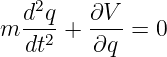
To find the extrema of this functional, we may compute the Euler-Lagrange equations to obtain
the following:
Note that this is the usual equation of motion of a point particle.
It is easy enough to generalize this to the case of a particle moving in three dimensions as
follows:
It should be mentioned that the form of the action is typically similar to that of these two
examples. That is to say, the action is typically the integral of a function of the path and a certain
number of its derivatives:
The function L appearing here is known as the Lagrangian of the system.

![∫ b( ( )2 )
S [q(⋅)] = m- dq- − V (q(t)) dt
a 2 dt](https://images.physicslibrary.org/cache/objects/55/make4ht/Action0x.png)
![∫ ( ( ) )
b m- d⃗q- 2
S [⃗q(⋅)] = 2 dt − V (⃗qt) dt
a](https://images.physicslibrary.org/cache/objects/55/make4ht/Action2x.png)
![( )
∫ b df dnf
S[f] = L f,---,...,--n-
a dt dt](https://images.physicslibrary.org/cache/objects/55/make4ht/Action3x.png)