0.1 Hilbert spaces, Von Neumann algebras and Quantum Groups
John von Neumann introduced a mathematical foundation for Quantum mechanics in the form of
W∗-algebras of (quantum) bounded operators in a (quantum:= presumed separable, i.e. with a
countable basis) Hilbert space HS. Recently, such von Neumann algebras, W∗ and/or (more
generally) C*-algebras are, for example, employed to define locally compact quantum groups
CQGlc by equipping such algebras with a co-associative multiplication and also with
associated, both left– and right– Haar measures, defined by two semi-finite Normal Weights
[1].
0.1.1 Remark on Jordan-Banach-von Neumann (JBW) algebras, JBWA
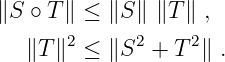
A Jordan–Banach algebra (a JB–algebra for short) is both a real Jordan algebra and a Banach
space, where for all S,T ∈ 𝔄ℝ, we have
A JLB–algebra is a JB–algebra 𝔄ℝ together with a Poisson bracket for which it becomes a
Jordan–Lie algebra JL for some ℏ2 ≥ 0 . Such JLB–algebras often constitute the real part of
several widely studied complex associative algebras. For the purpose of quantization, there are
fundamental relations between 𝔄sa, JLB and Poisson algebras.
Definition 0.1. A JB–algebra which is monotone complete and admits a separating set of
normal sets is called a JBW-algebra.
These appeared in the work of von Neumann who developed an orthomodular lattice theory of
projections on ℒ(H) on which to study quantum logic. BW-algebras have the following property:
whereas 𝔄sa is a J(L)B–algebra, the self-adjoint part of a von Neumann algebra is a
JBW–algebra.
References
[1] Leonid Vainerman. 2003. “Locally Compact Quantum Groups and Groupoids”:
Proceedings of the Meeting of Theoretical Physicists and Mathematicians, Strasbourg,
February 21-23, 2002., Walter de Gruyter Gmbh & Co: Berlin.
[2] Von Neumann and the Foundations of Quantum Theory.
[3] Böhm, A., 1966, Rigged Hilbert Space and Mathematical Description of Physical
Systems, Physica A, 236: 485-549.
[4] Böhm, A. and Gadella, M., 1989, Dirac Kets, Gamow Vectors and Gel’fand Triplets,
New York: Springer-Verlag.
[5] Dixmier, J., 1981, Von Neumann Algebras, Amsterdam: North-Holland Publishing
Company. [First published in French in 1957: Les Algèbres d’Opérateurs dans l’Espace
Hilbertien, Paris: Gauthier-Villars.]
[6] Gelfand, I. and Neumark, M., 1943, On the Imbedding of Normed Rings into the
Ring of Operators in Hilbert Space, Recueil Mathématique [Matematicheskii Sbornik]
Nouvelle Série, 12 [54]: 197-213. [Reprinted in C*-algebras: 1943-1993, in the series
Contemporary Mathematics, 167, Providence, R.I. : American Mathematical Society,
1994.]
[7] Grothendieck, A., 1955, Produits Tensoriels Topologiques et Espaces Nucléaires,
Memoirs of the American Mathematical Society, 16: 1-140.
[8] Horuzhy, S. S., 1990, Introduction to Algebraic Quantum Field Theory, Dordrecht:
Kluwer Academic Publishers.
[9] J. von Neumann.,1955, Mathematical Foundations of Quantum Mechanics.,
Princeton, NJ: Princeton University Press. [First published in German in 1932:
Mathematische Grundlagen der Quantenmechanik, Berlin: Springer.]
[10] J. von Neumann, 1937, Quantum Mechanics of Infinite Systems, first published in
(Rédei and Stöltzner 2001, 249-268). [A mimeographed version of a lecture given at
Pauli’s seminar held at the Institute for Advanced Study in 1937, John von Neumann
Archive, Library of Congress, Washington, D.C.]