The theory of matter waves leads unambiguously to the wave equation of a free particle (in
non-relativistic approximation). Indeed, the wave Ψ(r,t) is a superposition:
of monochromatic plane waves e![[i(p⋅r−Et)∕ℏ]](https://images.physicslibrary.org/cache/objects/595/make4ht/WaveEquationOfAFreeParticle1x.png) whose frequency E∕ℏ is connected with the wave
vector p∕ℏ by the relation connecting momentum and energy for a particle of mass
m
whose frequency E∕ℏ is connected with the wave
vector p∕ℏ by the relation connecting momentum and energy for a particle of mass
m
Taking the partial derivatives of the two sides of equation (1), we omit questions of
convergence since mathematical rigor is of no concern to us in this argument, one obtains
successively:
According to relation (2), the expressions under the integral signs of equations (2) and (5) are
proportional; therefore the integrals themselves differ by the same proportionality factor.
Consequently
This is the Schrödinger equation for a free particle; it satisfies conditions (A) and (B);
from the very manner in which it was obtained it also satisfies the requirements of the
correspondence principle. Indeed the formal analogy with Clasical mechanics is actually
realized: equation (6) is in a sense the quantum-mechanical translation of the classical
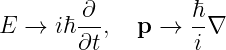
equation (2), the energy and momentum being represented in this quantum language
by differential operators acting on the wave function according to the correspondence
rule
Thus the quantity p2 = p
x2 + p
y2 + p
z2 is represented by the operator
Just like relation (2) from which it originated, equation (6) obviously does not satisfy the principle
of relativity. On the other hand, the de Broglie theory does not suffer from this limitation. To
obtain a relativistic equation of the free particle, one may try to repeat the preceding
argument, replacing relation (2) by a relation between energy and momentum in conformity
with the theory of relativity. The correct relation E =  is most suitable
because of the presence of the square root. To avoid that difficulty, one can use the
relation
is most suitable
because of the presence of the square root. To avoid that difficulty, one can use the
relation
from which one deduces the equation
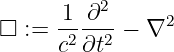
which may also be written
making use of the D’Alembertian operator
One again finds the same formal correspondence between equations (8) and (9), as the one which
exists between equations (2) and (6).
Equation (9), the so-called Klein-Gordon equation, plays an important role in Relativistic
quantum theory. As it does not satisfy criterion (B), it cannot be adopted as wave equation
without a physical reinterpretation of the wave Ψ. Actually, the fact that a wave can
represent the dynamical state of one and only one particle is fully justified only in the
non-relativistic limit, i.e. when the law of conservation of the number of particles is
satisfied.
0.1 References
[1] Messiah, Albert. ”Quantum Mechanics: volume I.” Amsterdam, North-Holland Pub. Co.; New
York, Interscience Publishers, 1961-62.
This entry is a derivative of the Public domain work [1].










![[ ]
( mc-)2
□ + ℏ Ψ(r,t) = 0](https://images.physicslibrary.org/cache/objects/595/make4ht/WaveEquationOfAFreeParticle12x.png)