Physics Library
 An open source physics library
Encyclopedia | Forums | Docs | Random  

Reynolds' transport theorem

(Theorem)

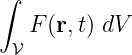
Let F(r,t) represent the amount of some physical property of a continuous material medium per unit volume. The total amount of this property present in a finite region 𝒱 of the material is obtained through the volume integral.

∫
   F (r,t) dV
 𝒱

If this property is being transported by the action of the flow of the material with a velocity u(r,t), then Reynolds’ transport theorem states that the rate of change of the total amount of F within the material volume is equal to the volume integral of the instantaneous changes of F occuring within the volume, plus the surface integral of the rate at which F is being transported through the surface 𝒮 (bounding 𝒱) to and from the surrounding region.

d  ∫              ∫  ∂F        ∫
--   F (r,t) dV =    ----dV  +    F u ⋅ n dS
dt  𝒱               𝒱 ∂t        𝒮

Here, n is a unit vector indicating the Normal direction of the surface (oriented to point out of the volume).


"Reynolds' transport theorem" is owned by PhysBrain.
(view preamble)
View style:

Cross-references: Normal, unit vector, surface integral, velocity, volume integral, volume, unit

This is version 4 of Reynolds' transport theorem, born on 2006-07-05, modified 2007-07-08.
Object id is 193, canonical name is ReynoldsTransportTheorem.
Accessed 4588 times total.

Classification:
Physics Classification: 51.10.+y (Kinetic and transport theory of gases )
 47.10.+g (General theory )

Pending Errata and Addenda

None.

View all 2

Discussion

No messages.

Interact