GRE Physics Companion: Newton’s Laws of Motion
This companion focuses on fast recognition of which Newton-law idea a short problem is testing.
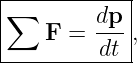
The core relations are
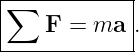
and, for constant mass,
Newton’s third law is
1 Fast triage
If the net force is zero, think constant velocity.
If a nonzero net force is given, use the vector form of Newton’s second law.
If the question asks about forces two bodies exert on one another, think Newton’s third law and
remember that the forces act on different bodies.
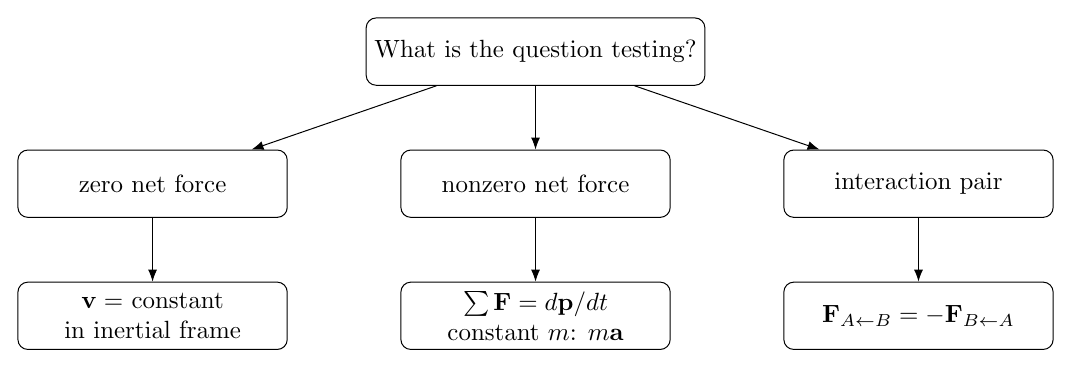
Figure 1. GRE-speed triage for Newton’s laws. First identify whether the question is about zero
net force, a nonzero force sum, or a force pair from one interaction.
2 Common traps
Zero net force does not mean zero velocity. It means zero acceleration and therefore constant
velocity.
The net force is the vector sum of all forces on the chosen object.
A Newton-third-law pair acts on two different bodies. The pair therefore does not cancel in the
force sum for just one body.
Equal interaction forces do not imply equal accelerations if the two masses differ.
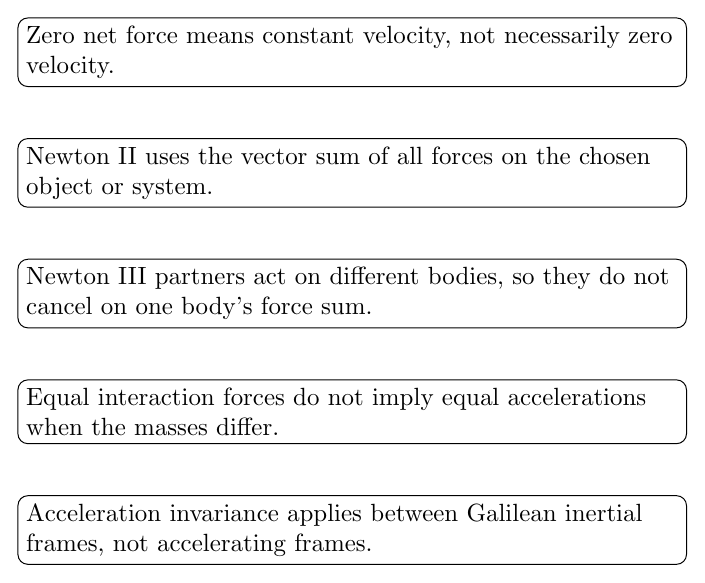
Figure 2. Frequent Newton-law test traps. The most important distinction is between forces
balancing on one body and an action-reaction pair distributed across two bodies.
3 Worked GRE example 1: force scaling
A net force F gives a particle of mass m acceleration a. The same net force is then applied to a
particle of mass 4m. What is the new acceleration?
From
the original acceleration is
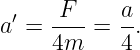
For mass 4m,
Thus the acceleration is reduced by a factor of four.
4 Worked GRE example 2: collision forces
A small CAR collides with a heavy truck. During the collision, which vehicle exerts the larger force
on the other?
Newton’s third law gives
Therefore the force magnitudes are equal. The smaller-mass vehicle can nevertheless have the
larger acceleration because
5 GRE-speed questions
- A particle moves east at constant 12 m/s. Its net force is (A) east (B) west (C) zero
(D) impossible to determine.
- A 2 kg particle experiences a net force of 10 N east. Its acceleration is (A) 2 (B) 5 (C)
10 (D) 20 m/s2 east.
- A particle has momentum px = 4t2 kg m/s. The net force at t = 3 s is (A) 8 (B) 12
(C) 24 (D) 36 N in the +x direction.
- A book rests motionless on a table. The net force on the book is (A) upward (B)
downward (C) zero (D) equal to its mass.
- A car exerts a 5000 N force on a truck during a collision. The truck exerts on the car
(A) less than 5000 N (B) exactly 5000 N in the opposite direction (C) more than 5000
N (D) zero force.
- Two objects experience the same net-force magnitude. Object A has twice the mass of
object B. The ratio aA∕aB is (A) 1∕4 (B) 1∕2 (C) 1 (D) 2.
- Two equal-and-opposite forces act on different interacting bodies. They (A) always
cancel in either body’s individual force equation (B) form a Newton-third-law pair (C)
imply both bodies have equal acceleration (D) imply both bodies are at rest.
- Frame B moves at constant velocity relative to inertial frame G. If a particle has
acceleration a in G, its acceleration in B is (A) zero (B) −a (C) a (D) dependent on
the relative velocity.
6 Answers and rationales
- C. Constant velocity in an inertial frame requires zero net force.
- B. a = F∕m = 10∕2 = 5 m/s2.
- C. Fx = dpx∕dt = 8t, so at t = 3 s the force is 24 N.
- C. Rest with no acceleration means the forces on the book balance.
- B. Newton-third-law interaction forces have equal magnitude and opposite direction.
- B. At the same force, acceleration is inversely proportional to mass.
- B. Third-law forces act on different bodies and therefore do not cancel in one body’s
equation.
- C. Constant-relative-velocity Galilean frames measure the same acceleration.
References
[1] PhysicsLibrary, M02-01, Newton’s Laws of Motion.
[2] S. J. Ling, J. Sanny, and W. Moebs, University Physics, Volume 1, archived 2016
revision, OpenStax/BCcampus, CC BY 4.0.

![[parent]](https://images.physicslibrary.org/images/uparrow.png)