1 Groupoid representations
Whereas group representations of quantum unitary operators are extensively employed in standard
quantum mechanics, the applications of groupoid representations are still under development. For
example, a description of stochastic quantum mechanics in curved spacetime (Drechsler and
Tuckey, 1996) involving a Hilbert bundle is possible in terms of groupoid representations which can
indeed be defined on such a Hilbert bundle (X ∗ℋ,π), but cannot be expressed as the
simpler group representations on a Hilbert space ℋ. On the other hand, as in the case of
group representations, unitary groupoid representations induce associated C*-algebra
representations. In the next subsection we recall some of the basic results concerning groupoid
representations and their associated groupoid *-algebra representations. For further
details and recent results in the mathematical theory of groupoid representations one has
also available the succint monograph by Buneci (2003) and references cited therein
(www.utgjiu.ro/math/mbuneci/preprint.html).
Let us consider first the relationships between these mainly algebraic concepts and their extended
quantum symmetries, also including relevant computation examples. Let us consider first several
further extensions of symmetry and algebraic topology in the context of Local Quantum Physics/
quantum field theory, symmetry breaking, quantum chromodynamics and the development of novel
supersymmetry theories of quantum gravity. In this respect one can also take spacetime
‘inhomogeneity’ as a criterion for the comparisons between physical, partial or local, symmetries:
on the one hand, the example of paracrystals reveals Thermodynamic disorder (entropy) within its
own spacetime framework, whereas in spacetime itself, whatever the selected model, the
inhomogeneity arises through (super) gravitational effects. More specifically, in the former
case one has the technique of the generalized Fourier–Stieltjes transform (along with
convolution and Haar measure), and in view of the latter, we may compare the resulting
‘broken’/paracrystal–type symmetry with that of the supersymmetry predictions for weak
gravitational fields (e.g., ‘ghost’ particles) along with the broken supersymmetry in
the presence of intense gravitational fields. Another significant extension of quantum
symmetries may result from the superoperator algebra/algebroids of Prigogine’s quantum
superoperators which are defined only for irreversible, infinite-dimensional systems (Prigogine,
1980).
1.1 Definition of extended quantum groupoid and algebroid symmetries
Quantum groups → Representations →weak Hopf algebras → quantum groupoids and
algebroids Our intention here is to view the latter scheme in terms of weak Hopf C*–algebroid–
and/or other– extended symmetries, which we propose to do, for example, by incorporating the
concepts of rigged Hilbert spaces and sectional functions for a small category. We note, however,
that an alternative approach to quantum ‘groupoids’ has already been reported (Maltsiniotis,
1992), (perhaps also related to noncommutative geometry); this was later expressed in terms of
deformation-quantization: the Hopf algebroid deformation of the universal enveloping
algebras of Lie algebroids (Xu, 1997) as the classical limit of a quantum ‘groupoid’; this
also parallels the introduction of quantum ‘groups’ as the deformation-quantization
of Lie bialgebras. Furthermore, such a Hopf algebroid approach (Lu, 1996) leads to
categories of Hopf algebroid modules (Xu, 1997) which are monoidal, whereas the links
between Hopf algebroids and monoidal bicategories were investigated by Day and Street
(1997).
As defined under the following heading on groupoids, let (Glc,τ) be a locally compact groupoid
endowed with a (left) Haar system, and let A = C∗(G
lc,τ) be the convolution C∗–algebra (we
append A with 1 if necessary, so that A is unital). Then consider such a groupoid representation
Λ : (Glc,τ)→{ℋx,σx}x∈X that respects a compatible measure σx on ℋx (cf Buneci, 2003). On taking
a state ρ on A, we assume a parametrization
Furthermore, each ℋx is considered as a rigged Hilbert space Bohm and Gadella (1989), that is, one
also has the following nested inclusions:
in the usual manner, where Φx is a dense subspace of ℋx with the appropriate locally convex
topology, and Φx× is the space of continuous antilinear functionals of Φ . For each x ∈ X,
we require Φx to be invariant under Λ and Im Λ|Φx is a continuous representation
of Glc on Φx . With these conditions, representations of (proper) quantum groupoids
that are derived for weak C*–Hopf algebras (or algebroids) modeled on rigged Hilbert
spaces could be suitable generalizations in the framework of a hamiltonian generated
semigroup of time evolution of a quantum system via integration of Schrödinger’s equation
ιℏ = Hψ as studied in the case of Lie groups (Wickramasekara and Bohm, 2006). The
adoption of the rigged Hilbert spaces is also based on how the latter are recognized as
reconciling the Dirac and von Neumann approaches to quantum theories (Bohm and Gadella,
1989).
= Hψ as studied in the case of Lie groups (Wickramasekara and Bohm, 2006). The
adoption of the rigged Hilbert spaces is also based on how the latter are recognized as
reconciling the Dirac and von Neumann approaches to quantum theories (Bohm and Gadella,
1989).
Next, let G be a locally compact Hausdorff groupoid and X a locally compact Hausdorff space. (G
will be called a locally compact groupoid, or lc- groupoid for short). In order to achieve a small
C*–category we follow a suggestion of A. Seda (private communication) by using a general
principle in the context of Banach bundles (Seda, 1976, 982)). Let q = (q1,q2) : G→X × X be a
continuous, open and surjective map. For each z = (x,y) ∈ X × X, consider the fibre
Gz = G(x,y) = q−1(z), and set

equipped with a uniform norm ∥ ∥z . Then we set 𝒜 = ⋃
z𝒜z . We form a Banach
bundle p : 𝒜→X × X as follows. Firstly, the projection is defined via the typical fibre
p−1(z) = 𝒜
z = 𝒜(x,y) . Let Cc(G) denote the continuous complex valued functions on G with
compact support. We obtain a sectional function ψ : X × X→𝒜 defined via restriction as
ψ(z) = ψ|Gz = ψ|G(x,y) . Commencing from the vector space γ = {ψ : ψ ∈ Cc(G)}, the set
{ψ(z) : ψ ∈ γ} is dense in 𝒜z . For each ψ ∈ γ, the function ∥ψ(z)∥z is continuous on X, and each
ψ is a continuous section of p : 𝒜→X × X . These facts follow from Seda (1982, theorem 1).
Furthermore, under the convolution product f ∗ g, the space Cc(G) forms an associative algebra
over ℂ (cf. Seda, 1982, Theorem 3).
1.2 Groupoids
Recall that a groupoid G is, loosely speaking, a small category with inverses over its set of objects
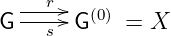
X = Ob(G) . One often writes Gxy for the set of morphisms in G from x to y . A topological
groupoid consists of a space G, a distinguished subspace G(0) = Ob(G) ⊂ G, called the space of
objects of G, together with maps
called the range and source maps respectively, together with a law of composition
such that the following hold :
- s(γ1 ∘ γ2) = r(γ2) , r(γ1 ∘ γ2) = r(γ1) , for all (γ1,γ2) ∈ G(2) .
- s(x) = r(x) = x , for all x ∈ G(0) .
- γ ∘ s(γ) = γ , r(γ) ∘ γ = γ , for all γ ∈ G .
- (γ1 ∘ γ2) ∘ γ3 = γ1 ∘ (γ2 ∘ γ3) .
- Each γ has a two–sided inverse γ−1 with γγ−1 = r(γ) , γ−1γ = s(γ) .
Furthermore, only for topological groupoids the inverse map needs be continuous. It is usual to call
G(0) = Ob(G) the set of objects of G . For u ∈ Ob(G), the set of arrows u→u forms a group G
u, called
the isotropy group of G at u. Thus, as is well kown, a topological groupoid is just a groupoid
internal to the category of topological spaces and continuous maps. The notion of internal groupoid
has proved significant in a number of fields, since groupoids generalise bundles of groups, group
actions, and equivalence relations. For a further study of groupoids we refer the reader to Brown
(2006).
Several examples of groupoids are:
- (a) locally compact groups, transformation groups, and any group in general (e.g. [59]
- (b) equivalence relations
- (c) tangent bundles
- (d) the tangent groupoid (e.g. [4])
- (e) holonomy groupoids for foliations (e.g. [4])
- (f) Poisson groupoids (e.g. [81])
- (g) graph groupoids (e.g. [47, 64]).
As a simple example of a groupoid, consider (b) above. Thus, let R be an equivalence
relationhttps://physicslibrary.org/encyclopedia/Bijective.html on a set X. Then R is a groupoid
under the following operations: (x,y)(y,z) = (x,z), (x,y)−1 = (y,x). Here, G0 = X, (the diagonal
of X × X ) and r((x,y)) = x,s((x,y)) = y.
Thus, R2 =  . When R = X ×X, R is called a trivial groupoid. A
special case of a trivial groupoid is
. When R = X ×X, R is called a trivial groupoid. A
special case of a trivial groupoid is
. (So every i is equivalent to every j). Identify (i,j) ∈ Rn with the matrix unit eij. Then the
groupoid Rn is just matrix multiplication except that we only multiply eij,ekl when k = j, and
(eij)−1 = e
ji. We do not really lose anything by restricting the multiplication, since the pairs
eij,ekl excluded from groupoid multiplication just give the 0 product in normal algebra
anyway.
Definition 1.1. For a groupoid Glc to be a locally compact groupoid means that Glc is
required to be a (second countable) locally compact Hausdorff space, and the product and
also inversion maps are required to be continuous. Each Glcu as well as the unit space G
lc0 is
closed in Glc.
Remark 1.1. What replaces the left Haar measure on Glc is a system of measures λu
(u ∈ Glc0), where λu is a positive regular Borel measure on G
lcu with dense support. In
addition, the λu ’s are required to vary continuously (when integrated against f ∈ C
c(Glc))
and to form an invariant family in the sense that for each x, the map y xy is a measure
preserving homeomorphism from Glcs(x) onto G
lcr(x). Such a system
xy is a measure
preserving homeomorphism from Glcs(x) onto G
lcr(x). Such a system  is called a left
Haar system for the locally compact groupoid Glc.
is called a left
Haar system for the locally compact groupoid Glc.
This is defined more precisely next.
1.3 Haar systems for locally compact topological groupoids
Let
be a locally compact, locally trivial topological groupoid with its transposition into transitive
(connected) components. Recall that for x ∈ X, the costar of x denoted CO∗(x) is defined as the
closed set ⋃
{G(y,x) : y ∈ G}, whereby
is a principal G(x0,y0)–bundle relative to fixed base points (x0,y0) . Assuming all relevant sets are
locally compact, then following Seda (1976), a (left) Haar system on G denoted (G,τ) (for later
purposes), is defined to comprise of i) a measure κ on G, ii) a measure μ on X and iii) a
measure μx on CO∗(x) such that for every Baire set E of G, the following hold on setting
Ex = E ∩ CO∗(x) :
- x
 μx(Ex) is measurable.
- κ(E) = ∫
xμx(Ex) dμx .
- μz(tEx) = μx(Ex), for all t ∈ G(x,z) and x,z ∈ G .
The presence of a left Haar system on Glc has important topological implications: it requires that
the range map r : Glc → Glc0 is open. For such a G
lc with a left Haar system, the vector space
Cc(Glc) is a convolution *–algebra, where for f,g ∈ Cc(Glc):
with f ∗ (x) = f(x−1).
One has C∗(G
lc) to be the enveloping C*–algebra of Cc(Glc) (and also representations
are required to be continuous in the inductive limit topology). Equivalently, it is the
completion of πuniv(Cc(Glc)) where πuniv is the universal representation of Glc. For example, if
Glc = Rn, then C∗(G
lc) is just the finite dimensional algebra Cc(Glc) = Mn, the span of the
eij′s.
There exists (cf. [7]) a measurable Hilbert bundle (Glc0,ℋ,μ) with ℋ =  and a
G-representation L on ℋ. Then, for every pair ξ,η of square integrable sections of ℋ, it is required
that the function x
and a
G-representation L on ℋ. Then, for every pair ξ,η of square integrable sections of ℋ, it is required
that the function x (L(x)ξ(s(x)),η(r(x))) be ν–measurable. The representation Φ of Cc(Glc) is
then given by:
(L(x)ξ(s(x)),η(r(x))) be ν–measurable. The representation Φ of Cc(Glc) is
then given by:
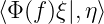 = ∫
f(x)(L(x)ξ(s(x)),η(r(x)))dν0(x).
= ∫
f(x)(L(x)ξ(s(x)),η(r(x)))dν0(x).
The triple (μ,ℋ,L) is called a measurable Glc–Hilbert bundle.
References
[1] E. M. Alfsen and F. W. Schultz: Geometry of State Spaces of Operator Algebras,
Birkhäuser, Boston–Basel–Berlin (2003).
[2] I. C. Baianu : Categories, Functors and Automata Theory: A Novel Approach to
Quantum Automata through Algebraic–Topological Quantum Computations., Proceed.
4th Intl. Congress LMPS, (August-Sept. 1971).
[3] I. C. Baianu, J. F. Glazebrook and R. Brown.: A Non–Abelian, Categorical Ontology
of Spacetimes and Quantum Gravity., Axiomathes 17,(3-4): 353-408(2007).
[4] I.C.Baianu, R. Brown J.F. Glazebrook, and G. Georgescu, Towards Quantum
Non–Abelian Algebraic Topology. in preparation, (2008).
[5] F.A. Bais, B. J. Schroers and J. K. Slingerland: Broken quantum symmetry and
confinement phases in planar physics, Phys. Rev. Lett. 89 No. 18 (1–4): 181–201 (2002).
[6] J.W. Barrett.: Geometrical measurements in three-dimensional quantum gravity.
Proceedings of the Tenth Oporto Meeting on Geometry, Topology and Physics (2001).
Intl. J. Modern Phys. A 18 , October, suppl., 97–113 (2003).
[7] M. R. Buneci.: Groupoid Representations, (orig. title “Reprezentari de Grupoizi”),
Ed. Mirton: Timishoara (2003).
[8] M. Chaician and A. Demichev: Introduction to Quantum Groups, World Scientific
(1996).
[9] Coleman and De Luccia: Gravitational effects on and of vacuum decay., Phys. Rev.
D 21: 3305 (1980).
[10] L. Crane and I.B. Frenkel. Four-dimensional topological quantum field theory, Hopf
categories, and the canonical bases. Topology and physics. J. Math. Phys. 35 (no. 10):
5136–5154 (1994).
[11] W. Drechsler and P. A. Tuckey: On quantum and parallel transport in a
Hilbert bundle over spacetime., Classical and Quantum Gravity, 13:611-632 (1996). doi:
10.1088/0264–9381/13/4/004
[12] V. G. Drinfel’d: Quantum groups, In Proc. Intl. Congress of Mathematicians,
Berkeley 1986, (ed. A. Gleason), Berkeley, 798-820 (1987).
[13] G. J. Ellis: Higher dimensional crossed modules of algebras, J. of Pure Appl. Algebra
52 (1988), 277-282.
[14] P.. I. Etingof and A. N. Varchenko, Solutions of the Quantum Dynamical
Yang-Baxter Equation and Dynamical Quantum Groups, Comm.Math.Phys., 196:
591-640 (1998).
[15] P. I. Etingof and A. N. Varchenko: Exchange dynamical quantum groups, Commun.
Math. Phys. 205 (1): 19-52 (1999)
[16] P. I. Etingof and O. Schiffmann: Lectures on the dynamical Yang–Baxter equations,
in Quantum Groups and Lie Theory (Durham, 1999), pp. 89-129, Cambridge University
Press, Cambridge, 2001.
[17] B. Fauser: A treatise on quantum Clifford Algebras. Konstanz, Habilitationsschrift.
arXiv.math.QA/0202059 (2002).
[18] B. Fauser: Grade Free product Formulae from Grassman–Hopf Gebras. Ch. 18
in R. Ablamowicz, Ed., Clifford Algebras: Applications to Mathematics, Physics and
Engineering, Birkhäuser: Boston, Basel and Berlin, (2004).
[19] J. M. G. Fell.: The Dual Spaces of C*–Algebras., Transactions of the American
Mathematical Society, 94: 365–403 (1960).
[20] F.M. Fernandez and E. A. Castro.: (Lie) Algebraic Methods in Quantum Chemistry
and Physics., Boca Raton: CRC Press, Inc (1996).
[21] R. P. Feynman: Space–Time Approach to Non–Relativistic Quantum Mechanics,
Reviews of Modern Physics, 20: 367–387 (1948). [It is also reprinted in (Schwinger 1958).]
[22] A. Fröhlich: Non–Abelian Homological Algebra. I. Derived functors and satellites.,
Proc. London Math. Soc., 11(3): 239–252 (1961).
[23] R. Gilmore: Lie Groups, Lie Algebras and Some of Their Applications., Dover Publs.,
Inc.: Mineola and New York, 2005.
[24] P. Hahn: Haar measure for measure groupoids., Trans. Amer. Math. Soc. 242:
1–33(1978).
[25] P. Hahn: The regular representations of measure groupoids., Trans. Amer. Math.
Soc. 242:34–72(1978).
[26] R. Heynman and S. Lifschitz. 1958. Lie Groups and Lie Algebras., New York and
London: Nelson Press.
[27] C. Heunen, N. P. Landsman, B. Spitters.: A topos for algebraic quantum theory,
(2008) arXiv : 0709.4364v2[quant −−ph].