
|
|
|
|||||||
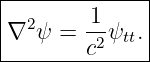
A plane wave satisfies
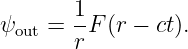
while an outgoing spherically symmetric wave has amplitude proportional to
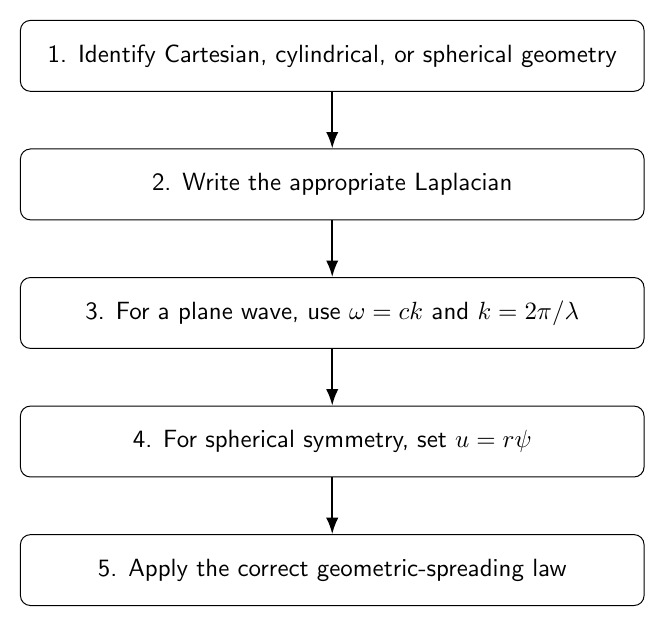
Figure 1. A compact strategy: identify the spatial geometry, write the correct Laplacian, test plane-wave dispersion when appropriate, and use geometric spreading only after identifying the wavefront dimension.
1 High-value GRE facts
Part I: Original GRE-style problems
Problem 1: three-dimensional wave equationWhich equation is the scalar wave equation in Cartesian three dimensions?
Problem 2: wave-vector magnitudeFor
the magnitude of the wave vector is
Problem 3: wavelengthFor the wave vector in Problem 2, the wavelength is closest to
Problem 4: wavefront orientationFor a plane wave, surfaces of constant phase are
Problem 5: spherical amplitudeAn outgoing spherical-wave amplitude is A at radius r. At radius 2r, the ideal amplitude is
Problem 6: spherical intensityIf spherical-wave intensity is I at radius r, then at radius 2r it is
Problem 7: radial substitutionThe substitution that converts the three-dimensional spherically symmetric wave equation into a one-dimensional wave equation is
Problem 8: outgoing spherical solutionWhich form represents an outgoing spherically symmetric solution?
Problem 9: cylindrical intensityFor an ideal cylindrical wave in the far field, intensity scales approximately as
Problem 10: travel timeA spherical acoustic pulse travels 1000 m in air at 343 m∕s. The travel time is closest to
Problem 11: harmonic spatial equationSubstituting
into the wave equation gives
Problem 12: geometric spreadingWhich statement is correct in a lossless medium?
Part II: Complete worked solutions
Solution 1In Cartesian three dimensions,
Thus
Answer: (B).
Solution 2
Answer: (D).
Solution 3
Answer: (C).
Solution 4Constant phase means
at fixed time. These are planes perpendicular to
Answer: (B).
Solution 5Spherical-wave amplitude scales as
Therefore doubling radius halves the amplitude. Answer: (D).
Solution 6Spherical intensity scales as
Therefore doubling radius reduces intensity by a factor of four. Answer: (E).
Solution 7The exact radial reduction uses
Answer: (B).
Solution 8The outgoing solution depends on retarded radial coordinate
and includes the spherical spreading factor:
Answer: (C).
Solution 9Power per unit source length spreads over a circumference proportional to
Thus
Answer: (B).
Solution 10
Answer: (C).
Solution 11With
the spatial equation is
Answer: (B).
Solution 12Lossless propagation can still show geometric spreading. For a spherical wave,
because the same power crosses increasing spherical area. Answer: (B).
2 GRE checklist
References
References
[1] PhysicsLibrary, M06-11, Acoustic Waves, Sound Intensity, and Acoustic Impedance. [2] PhysicsLibrary, M06-10, Fourier Analysis, Wave Packets, and Dispersion. [3] A. P. French, Vibrations and Waves, W. W. Norton, 1971. [4] G. B. Arfken, H. J. Weber, and F. E. Harris, Mathematical Methods for Physicists, 7th ed., Academic Press, 2013. "GRE Physics Companion: Wave Equations in Two and Three Dimensions and Spherical Waves" is owned by bloftin.
This object's parent. Cross-references: Normal, vector, spherical wave, unit, Power, speed, wave amplitudes, wave vector, magnitude, phase, dimension, wavefront, geometric spreading, Laplacian, amplitude, plane wave, wave equation, scalar This is version 1 of GRE Physics Companion: Wave Equations in Two and Three Dimensions and Spherical Waves, born on 2026-10-24. Object id is 1534, canonical name is GREPhysicsCompanionWaveEquationsInTwoAndThreeDimensionsAndSphericalWaves. Accessed 8 times total. Classification:
|
|
|
|
Pending Errata and AddendaNone.
|
DiscussionNo messages.
|
Interact |



















 amplitude only as the far-field scaling.