GRE Physics Companion: Tangential-Normal Particle Kinematics
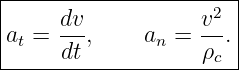
This companion focuses on fast recognition of path-coordinate acceleration. The most useful
relation is
with
1 Fast triage
If the problem asks how fast the particle’s speed is changing, use at.
If the problem gives a curved path and asks about the inward acceleration, use an.
If speed is given as a function of arc length,
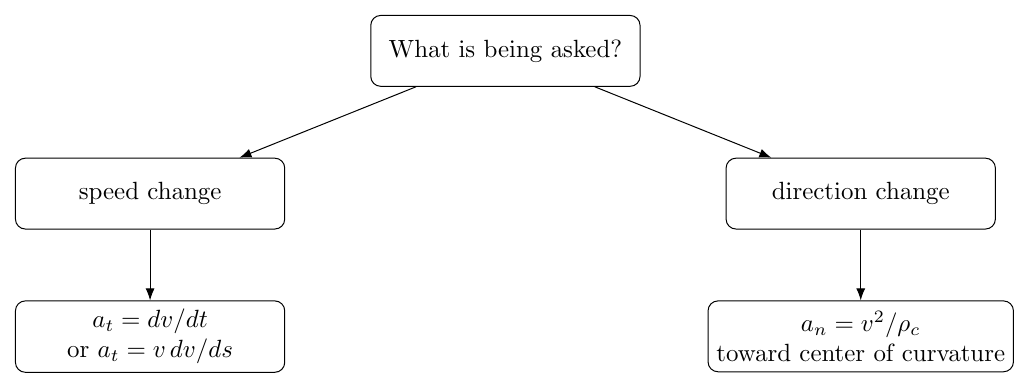
Figure 1. GRE-speed triage for tangential-normal kinematics. Separate speed change from
direction change before calculating the acceleration magnitude.
2 Common traps
A particle can have at = 0 and still have nonzero acceleration if the path is curved.
The normal component always points toward the local center of curvature.
At fixed curvature radius,
At fixed speed,
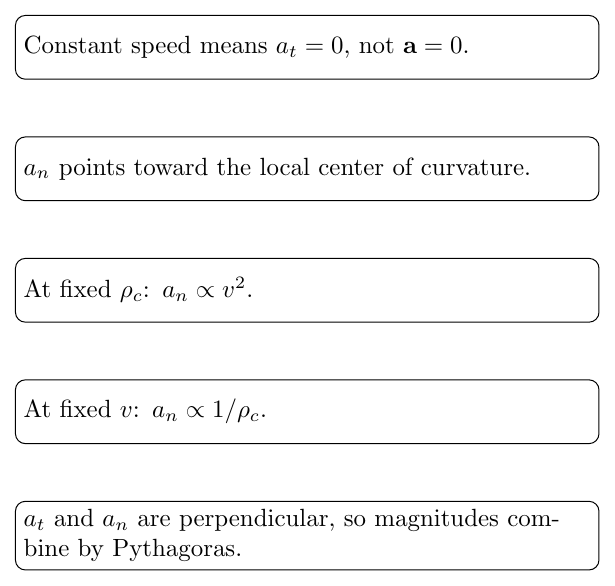
Figure 2. Common path-coordinate traps: zero tangential acceleration does not imply zero total
acceleration, and normal acceleration scales as v2∕ρc.
3 Worked GRE example 1: constant-speed curve
A particle travels at 15 m/s around a path whose local radius of curvature is 45 m. Its speed is
instantaneously constant.
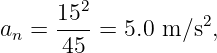
Since
and
we have
directed toward the local center of curvature.
4 Worked GRE example 2: scaling
A particle moves along the same path, so ρc is unchanged. Its speed increases from v to
3v.
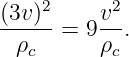
Because
the new normal acceleration is
Thus the normal acceleration increases by a factor of 9.
5 GRE-speed questions
- A particle moves at constant speed along a curved path. Which component must be
zero? (A) an (B) at (C) total acceleration (D) curvature.
- At fixed radius of curvature, doubling speed changes an by a factor of (A) 1∕2 (B) 2
(C) 4 (D) 8.
- At fixed speed, doubling ρc changes an by a factor of (A) 1∕2 (B) 1 (C) 2 (D) 4.
- A particle has at = 3 m/s2 and a
n = 4 m/s2. Its total acceleration magnitude is (A) 1
(B) 5 (C) 7 (D) 12 m/s2.
6 Answers and rationales
- B. Constant speed means dv∕dt = 0, so at = 0; curvature can still produce an.
- C. The normal component depends on v2.
- A. The normal component is inversely proportional to radius of curvature.
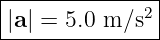
- B. The components are perpendicular, so |a| =
 = 5 m/s2.
References
[1] PhysicsLibrary, M01-12, Tangential-Normal Particle Kinematics.
[2] PhysicsLibrary, M01-08, Uniform Circular Motion.

![[parent]](https://images.physicslibrary.org/images/uparrow.png)