1 Problem Statement
Consider an example of Kepler’s Second Law, the Law of Equal Areas, which states: A
line joining a planet to the Sun sweeps out equal areas in equal intervals of time. This law
reflects a planet’s faster motion near the Sun (perihelion) and slower motion farther away
(aphelion).
Earth orbits the Sun in an ellipse with semi-major axis
and eccentricity
The orbital period is
Calculate the area swept out by Earth’s radius vector in a 10-day interval when Earth
is:
- at perihelion (closest to the Sun);
- at aphelion (farthest from the Sun).
Then verify Kepler’s Second Law by comparing the two areas. Assume the Sun is at one
focus of the ellipse.
2 Solution
2.1 Step 1: Kepler’s Second Law
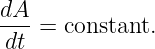
Kepler’s Second Law states that the areal velocity is constant:
Therefore, equal time intervals must correspond to equal swept areas, regardless of where
the planet is in its orbit.
2.2 Step 2: Orbital Parameters
The focal distance is
Hence,
and
The semi-minor axis is
Thus,
2.3 Step 3: Total Orbital Area
The area enclosed by the ellipse is
Substituting the values above,
The constant areal velocity is therefore
2.4 Step 4: Area Swept in 10 Days
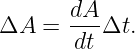
For any 10-day interval,
Therefore,
This value applies both near perihelion and near aphelion.
2.5 Step 5: Angular-Momentum Check
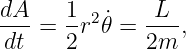
Areal velocity is related to angular momentum by
which is constant for motion under a central force.
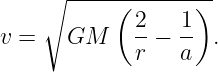
The orbital speed can also be estimated from the vis-viva equation,
Using
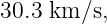
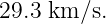
one obtains approximately
at perihelion and
at aphelion.
The larger speed at perihelion compensates for the smaller orbital radius, while the smaller
speed at aphelion compensates for the larger radius, so the areal velocity remains
constant.
2.6 Step 6: Compare Areas
The areas are equal, as required by Kepler’s Second Law.
2.7 Step 7: Real-World Interpretation
Near perihelion Earth moves at roughly
while near aphelion it moves at roughly
Despite this change in orbital speed, equal time intervals correspond to equal swept
areas.
3 Answer Summary
- Perihelion area in 10 days: approximately 1.925 × 10¹⁵ km2.
- Aphelion area in 10 days: approximately 1.925 × 10¹⁵ km2.
- Verification: equal areas are swept in equal times, as Kepler’s Second Law
requires.
This example was originally generated by Grok, an AI developed by xAI, on February 28,
2025.
References
References
[1] C. D. Murray and S. F. Dermott, Solar System Dynamics. Cambridge
University Press (1999).
[2] P. K. Seidelmann (ed.), Explanatory Supplement to the Astronomical
Almanac. University Science Books (1992).
[3] K. R. Lang, The Cambridge Guide to the Solar System, 2nd ed. Cambridge
University Press (2011).
[4] NASA JPL, “Planetary Fact Sheet,” Solar System Dynamics (2025).
[5] J. Kepler, Harmonices Mundi (1619); English translation by E. J. Aiton et
al., American Philosophical Society (1997).

![[parent]](https://images.physicslibrary.org/images/uparrow.png)