
|
|
|
|||||||
The SI unit of P is the watt, denoted W, where one watt equals one joule per second.
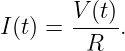
2 Ohm’s Law and Resistive LoadConsider a simple series circuit consisting of a voltage source V (t) and a resistor R. For a purely resistive load, the current and voltage are in phase and Ohm’s law applies at every instant:
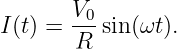
We will assume that the source voltage is sinusoidal with angular frequency ω and amplitude V 0, so that
Substituting into Ohm’s law gives the instantaneous current:
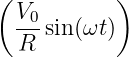
3 Instantaneous Power in a ResistorUsing the definitions above, the instantaneous power delivered to the resistor is
This equation shows that the instantaneous power oscillates at twice the fundamental frequency. The power is always nonnegative for a resistive load, consistent with the fact that a resistor only consumes energy; it does not return energy to the source.
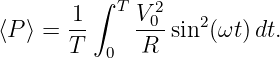
4 Average PowerThe average power ⟨P⟩ over one full cycle is obtained by integrating P(t) with respect to time over the period T = 2π∕ω and dividing by the period:
Substituting P(t) yields
Using the trigonometric identity sin 2(𝜃) =
The cosine term averages to zero over a full cycle, leaving one half of the peak squared voltage divided by the resistance.
5 Root Mean Square ValuesIt is common to express average power in terms of root mean square (rms) values. Define the rms voltage V rms and rms current Irms as
Using these definitions, the average power becomes
which is the standard form used in circuit analysis for a purely resistive load.
6 Interpretation and UnitsIn our example, the voltage and current are in phase, so the average power represents real energy delivered to the resistor each second. The average power in watts equals the rate of conversion of electrical energy into heat in the resistor.
7 ConclusionWe computed the instantaneous and average electrical power delivered to a resistive element in response to a sinusoidal source. The average power is one half the peak voltage squared divided by the resistance and may be expressed as the product of rms voltage and rms current. These results are standard in electrical engineering and physics and provide a basis for more complex analysis of circuits with time-varying sources.
References
"example of electrical power" is owned by bloftin. This object's parent. Cross-references: heat, square, resistance, identity, Ohm's law, energy, power This is version 2 of example of electrical power, born on 2026-02-13, modified 2026-09-05. Object id is 1030, canonical name is ExampleOfElectricalPower. Accessed 1097 times total. Classification:
|
|
|
|
|
|
|
![[parent]](https://images.physicslibrary.org/images/uparrow.png)


 sin
sin 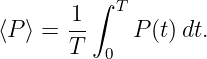

 , we find





 =
= 
