
|
|
|
|||||||
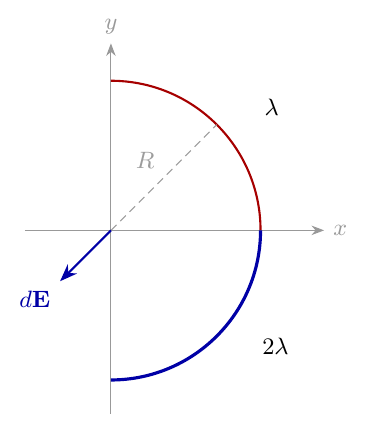
The upper integrals of cos ϕ, sin ϕ are both 1. The lower integrals are 1,−1. Thus
Its magnitude is Check. Both arcs lie to the right of the center, so the horizontal components point left. The more strongly charged lower arc supplies the larger positive vertical contribution.
3 Practice variationSet the lower density to −λ. Solution. The horizontal components cancel and the vertical components add downward, giving E = −2keλy∕R.
4 Keep the signed integration limitsThe arc-length charge element is dq = λiRdϕ when angle increases along a segment, where R is the common radius. From source (R cos ϕ,R sin ϕ) to the center the displacement has both signs reversed. The primitives of cos ϕ and sin ϕ are sin ϕ and − cos ϕ. Explicit evaluation gives
Thus a positive lower density produces a positive vertical contribution. Reversing the sign of density reverses its entire vector contribution, not the sign of only one component.
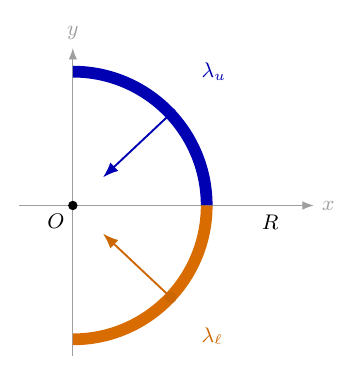
5 Worked example 2: arbitrary symmetric anglesLet the arcs extend to ±α, with 0 < α ≤ π, and keep uniform but possibly distinct densities on the upper and lower segments. Now the cosine integrals are both sin α. The sine integrals are ±(1 − cos α). Therefore
At α = π and equal densities, this is a full uniform ring and both components vanish. For small α, the vertical factor is α2∕2 + O(α4) and the horizontal factor is α + O(α3).
Figure 2. Opposing radial contributions of two right-hand quarter arcs. Unequal upper and lower densities leave a vertical field component.
6 Worked example 3: a continuous semicircle with a density gradientLet the right semicircle span −π∕2 ≤ ϕ ≤ π∕2 and carry
With source location r′ = R(cos ϕx + sin ϕy) and observer at the center, R = −r′. The field integral is
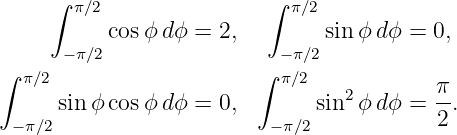
The relevant definite integrals are
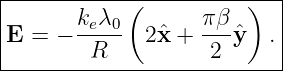
Hence
The vertical component arises entirely from the odd part of the charge density, and its sign reverses with the gradient parameter. The horizontal component is unaffected because the odd contribution is multiplied by the even cosine function and integrates to zero over symmetric limits.
7 Worked example 4: potential vanishes but the field does notSet λu = +λ for 0 ≤ ϕ ≤ π∕2 and λℓ = −λ for −π∕2 ≤ ϕ ≤ 0. At the origin all charge elements are distance R away, so
However, in the original two-arc field formula the horizontal terms cancel while the vertical terms add:
This is a concrete example of why zero electric potential does not imply zero Electric Field. The potential has a nonzero gradient even though its value is zero at the origin.
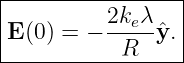
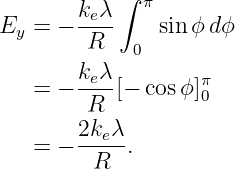
8 Worked example 5: a circular arc located above the observation pointTake a uniformly charged upper semicircle, 0 ≤ ϕ ≤ π, with λ > 0. The horizontal components cancel about the y axis. The y component is
All positive charges lie above the center, so a downward field is expected. If a negative semicircle is substituted, the entire field reverses. If the two halves of a full ring have equal positive density, the fields cancel at the center.
9 ExercisesExercise 1. Keep equal positive densities and α = π∕2. Determine the field direction and magnitude. Solution. The second bracket vanishes because of reflection symmetry. The first is 2λ, giving 2keλ∕R along −x. Exercise 2. Find the potential at the center for λℓ = −λu. Solution. Both arcs have the same length Rα and all their elements are a distance R from the center. The signed charges cancel, so the potential is zero with the reference at infinity. The vector field generally survives.
10 Further exercises and complete solutions
References
References
"Example of Electric Field of Two Charged Quarter Arcs" is owned by bloftin.
This object's parent. Cross-references: vector field, positive charges, Electric Field, electric potential, formula, function, parameter, gradient, charge density, displacement, charge, magnitude, vector This is version 1 of Example of Electric Field of Two Charged Quarter Arcs, born on 2026-11-27. Object id is 1613, canonical name is ExampleOfElectricFieldOfTwoChargedQuarterArcs. Accessed 9 times total. Classification:
|
|
|
|
Pending Errata and AddendaNone.
|
DiscussionNo messages.
|
Interact |









 =
