|
Proper Euler Angles are Euler angle coordinates in which the first and third rotation axis labels are the same and the middle axis is different.
For an intrinsic sequence,
the defining conditions are
 |
(1) |
The first and third labels are the same, but the corresponding physical axes are generally not the same direction because the middle rotation changes the orientation of the intermediate frame.
Proper Euler angles are especially common in classical rigid body mechanics, spacecraft attitude descriptions, orbital orientation, and historical treatments of Euler's rotation coordinates.
The flagship proper Euler sequence in this PhysicsLibrary series is intrinsic - - .
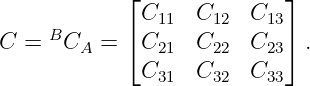
PhysicsLibrary uses passive coordinate transformations.
For a fixed physical vector,
 |
(2) |
For intrinsic - - ,
 |
(3) |
For a proper Euler sequence, , so
 |
(4) |
The rightmost matrix acts first on a coordinate column.
There are three choices for the repeated first and third axis.
Once that outer axis is chosen, there are two possible choices for the different middle axis.
Therefore
 |
(5) |
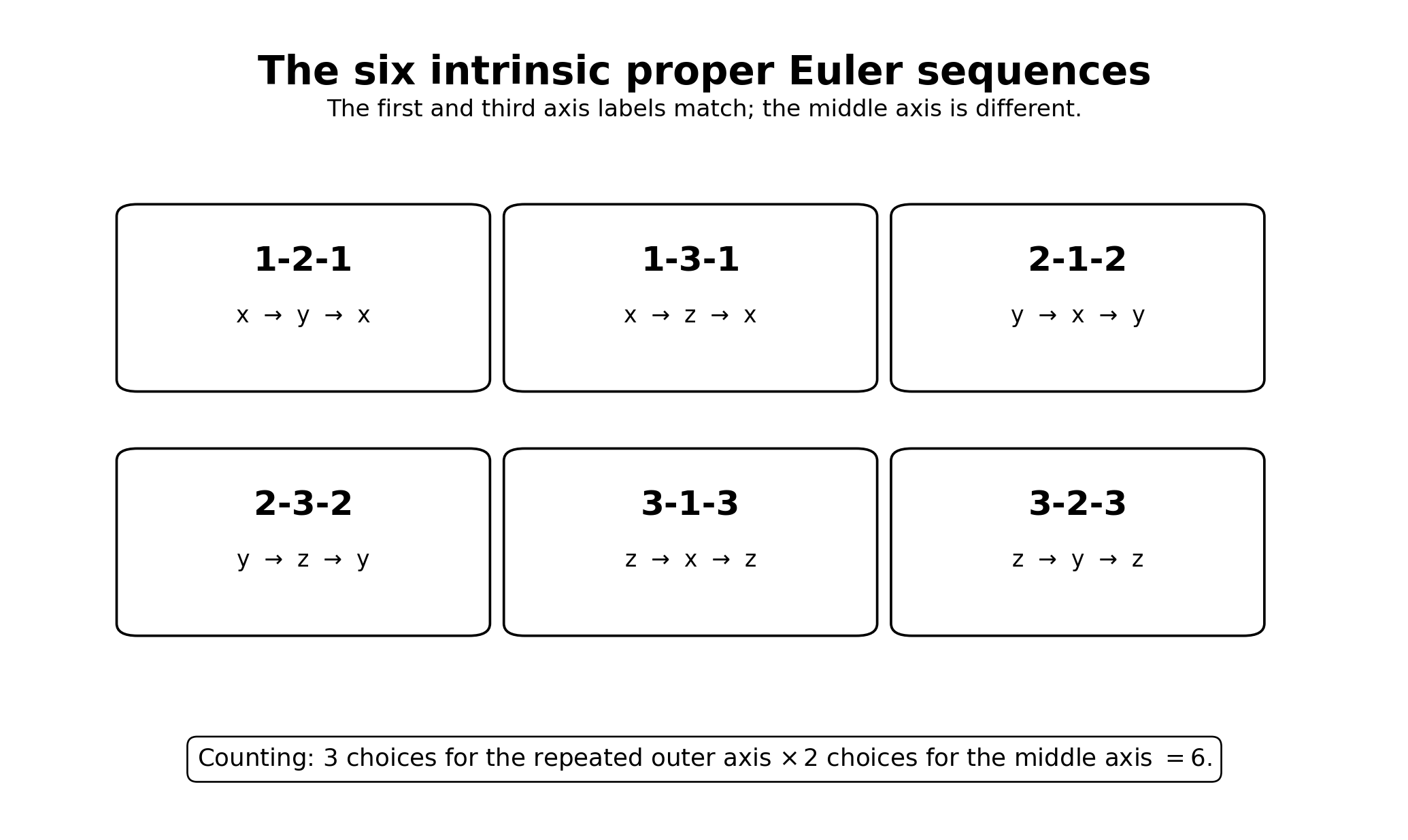
The six intrinsic proper Euler sequences are
 |
(6) |
Figure. The six standard intrinsic proper Euler sequences. The first and third axis labels match, while the middle axis is different.
Applying the universal intrinsic composition rule gives:
| Sequence |
Passive intrinsic product |
- - |
 |
- - |
 |
- - |
 |
- - |
 |
- - |
 |
- - |
 |
These six products are generated by the same frame-chain rule used for every Euler sequence.
Consider intrinsic - - .
The first rotation is about axis of the initial frame .
The second rotation is about axis of the new intermediate frame.
That middle rotation generally changes the direction of axis of the current frame.
The final rotation is therefore about axis of the newest intermediate frame, not generally about the original physical axis.
Thus the first and third rotations cannot usually be combined.
The repeated label indicates the same coordinate-axis number in two different intermediate frames.
The two Euler families differ in the third axis choice.
For Tait Bryan sequences,
are all different.
For proper Euler sequences,
This distinction controls the middle-angle singularity.
Tait Bryan sequences are singular when
Proper Euler sequences are singular when
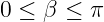
A common proper Euler principal branch is
 |
(7) |
 |
(8) |
and
 |
(9) |
On this branch,
 |
(10) |
Every proper Euler sequence becomes singular when
 |
(11) |
On the standard principal branch,
 |
(12) |
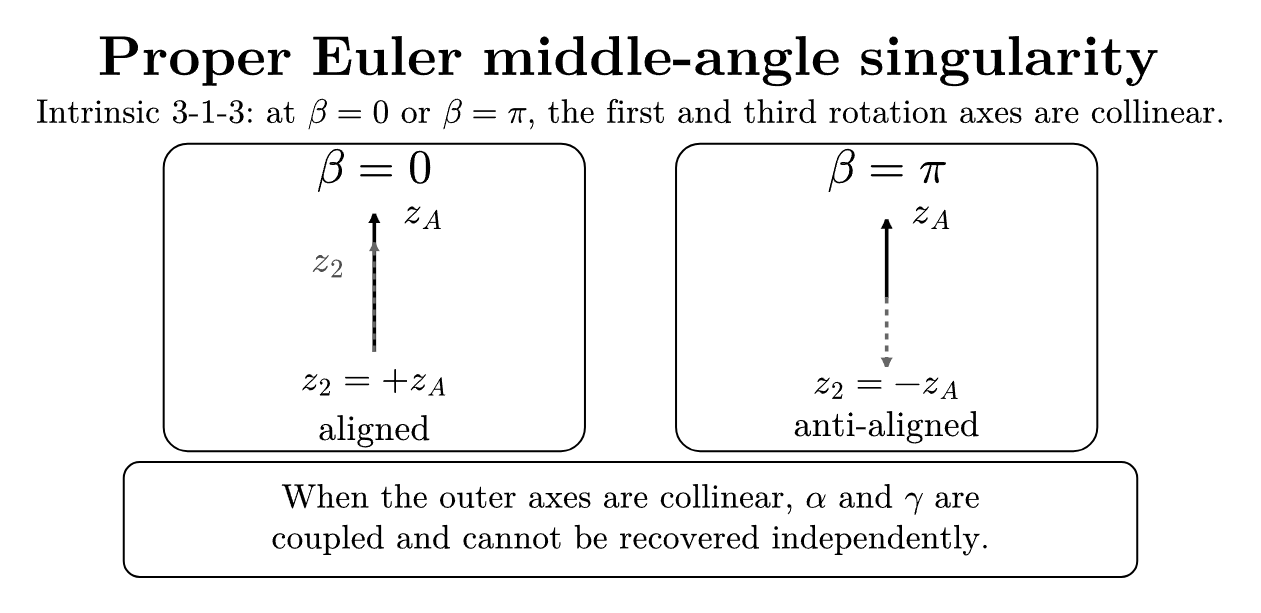
At those values, the first and third physical rotation axes become collinear.
Figure. For intrinsic  -  -  , the third rotation axis  is aligned with  at  and anti-aligned with  at  . The same mechanism occurs in every proper Euler sequence after relabeling the axes.
The physical orientation remains well defined.
Only the Euler coordinate chart loses local uniqueness.
At
the middle rotation is the identity.
For intrinsic - - ,
 |
(13) |
Rotations about the same axis add:
 |
(14) |
Therefore only the sum
 |
(15) |
is observable from the final orientation.
The two outer angles are not independently identifiable.
At
the middle rotation reverses the repeated outer axis.
The first and third physical axes are anti-aligned.
Consequently one difference combination of the outer angles remains observable, while the two angles cannot be recovered independently.
The exact sign of the coupled difference depends on the specific proper Euler sequence and the chosen angle conventions.
The important geometric fact is that the outer axes are again collinear.
For intrinsic - - ,
 |
(16) |
Define
and similarly for and .
Multiplication gives
 |
(17) |
Let
On the nonsingular principal branch,

 |
(18) |

 |
(19) |
and

 |
(20) |
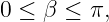
These equations require
 |
(21) |
Near or , software should use a declared singular-case policy instead of attempting to recover two independently meaningless outer angles.
For any proper Euler sequence,

intrinsic - - extrinsic - - |
(22) |
The digit string is unchanged because proper Euler sequences are palindromes.
The angle association is still reversed.
For intrinsic - - ,
intrinsic - - extrinsic - - |
(23) |
This is a common source of convention mistakes because the axis labels alone do not reveal whether the construction is intrinsic or extrinsic.
For a positive frame rotation about axis ,
 |
(24) |
A generic intrinsic proper Euler sequence has quaternion product

 |
(25) |
For intrinsic - - ,
 |
(26) |
The DCM and quaternion represent the same passive map:

 |
(27) |
Take

 |
(28) |
Then

 |
(29) |
gives approximately

 |
(30) |
The matrix is orthogonal and has determinant to numerical precision.
The inverse formulas recover the principal triple

Away from the singularity, a proper Euler orientation has alternate representations.
One useful equivalent triple is

 |
(31) |
with the outer angles wrapped by integer multiples of as needed.
The principal condition
selects one standard representative.
A proper Euler triple
is a nonlinear coordinate description of orientation.
In general,

 |
(32) |
is not the exact finite relative orientation between two attitudes.
The correct finite relative attitude should be computed using DCM or quaternion composition.
Proper Euler sequences appear naturally when an orientation has a meaningful preferred axis before and after a nutation-like middle rotation.
Examples include:
- classical rigid body dynamics;
- symmetric tops;
- spacecraft and orbital-frame descriptions;
- precession, nutation, and spin decompositions;
- historical formulations of rotational mechanics.
The - - sequence is especially common in classical mechanics.
A quaternion or DCM is generally preferable for internal propagation when:
- the motion may approach
or ;
- repeated finite composition is central;
- angular velocity directly drives the attitude state;
- global numerical regularity is important;
- an estimator or optimizer must remain well conditioned across a wide orientation range.
Proper Euler coordinates remain useful for interpretation and reporting even when the internal state uses another attitude representation.
- Assuming the first and third rotations of a proper Euler sequence are about the same physical axis for every
.
- Forgetting that the repeated outer axis belongs to different intermediate frames.
- Using the Tait Bryan singularity condition
instead of the proper Euler condition
.
- Assuming intrinsic and extrinsic
- - are automatically the same because the sequence digits form a palindrome.
- Forgetting that the angle association reverses between equivalent intrinsic and extrinsic descriptions.
- Using a
- - extraction formula on a - - DCM.
- Interpreting the coordinate singularity as a physical singularity.
A proper Euler implementation should pass the following checks.
- Zero angles give the identity matrix.
- Single-angle reductions reproduce the appropriate passive elementary matrices.
- The DCM is orthogonal:
- The determinant is
- The reverse map is the transpose.
- DCM-to-Euler round trips recover the selected principal branch away from
.
- The DCM agrees with the passive quaternion product.
The six proper Euler sequences are
 |
(33) |
For intrinsic - - ,
 |
(34) |
Their universal middle-angle singularity is
 |
(35) |
On the common principal branch,

 |
(36) |
For the flagship intrinsic - - sequence,
 |
(37) |
Proper Euler angles provide compact and historically important local coordinates for rigid body orientation, but they remain singular coordinate charts rather than global vector representations.
The next article, Euler angles: Euler 321 yaw pitch roll, develops the most widely used Tait Bryan sequence in full engineering detail.
Goldstein, Poole, and Safko provide the classical mechanics context in which proper Euler angles are especially common.
Henderson gives the classic NASA engineering tabulation of all twelve Euler sequences.
Diebel provides a unified comparison of Euler angles, DCMs, quaternions, and rotation vectors.
Landau and Lifshitz provide another standard classical mechanics treatment of rigid body orientation.
- 1
- H. Goldstein, C. Poole, and J. Safko, Classical Mechanics, 3rd ed., Addison Wesley, 2002. Publisher search
- 2
- D. M. Henderson, Euler Angles, Quaternions, and Transformation Matrices: Working Relationships, JSC-12960, NASA Johnson Space Center, 1977. NASA Technical Reports Server
- 3
- J. Diebel, “Representing Attitude: Euler Angles, Unit Quaternions, and Rotation Vectors,” Stanford University, 2006. Online PDF
- 4
- L. D. Landau and E. M. Lifshitz, Mechanics, 3rd ed., Pergamon Press, 1976. Publisher search
Unless otherwise noted, this PhysicsLibrary entry is intended for release under the Creative Commons Attribution ShareAlike 4.0 International license.
|