
|
|
|
|||||||
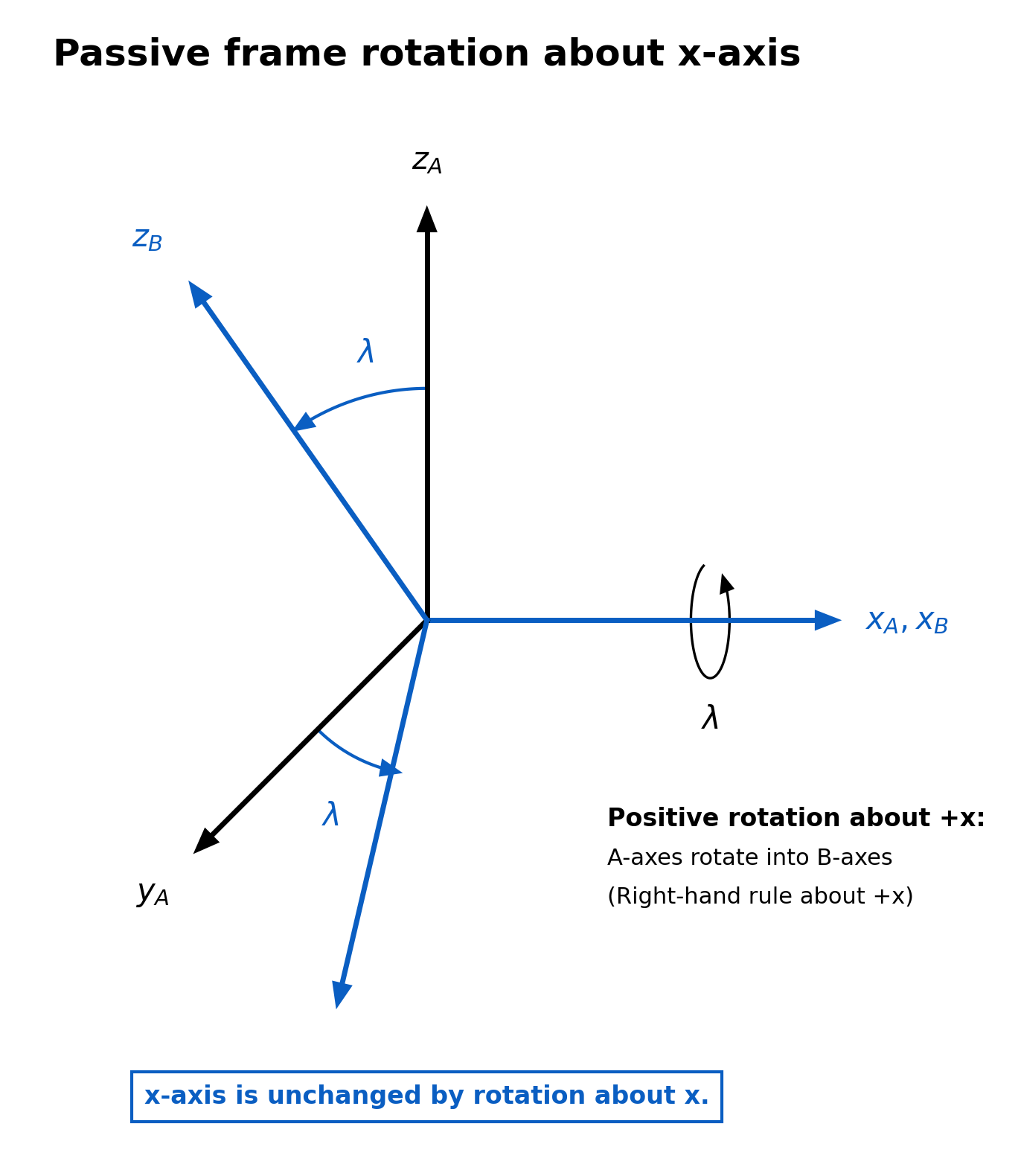
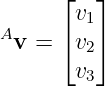
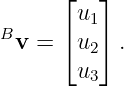
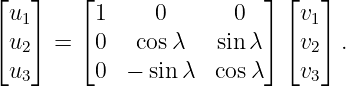
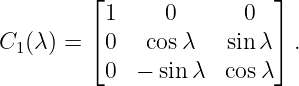
If a fixed physical vector has initial coordinates 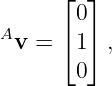 then
This sign pattern agrees with the passive interpretation: the vector did not move, but the coordinate axes did.
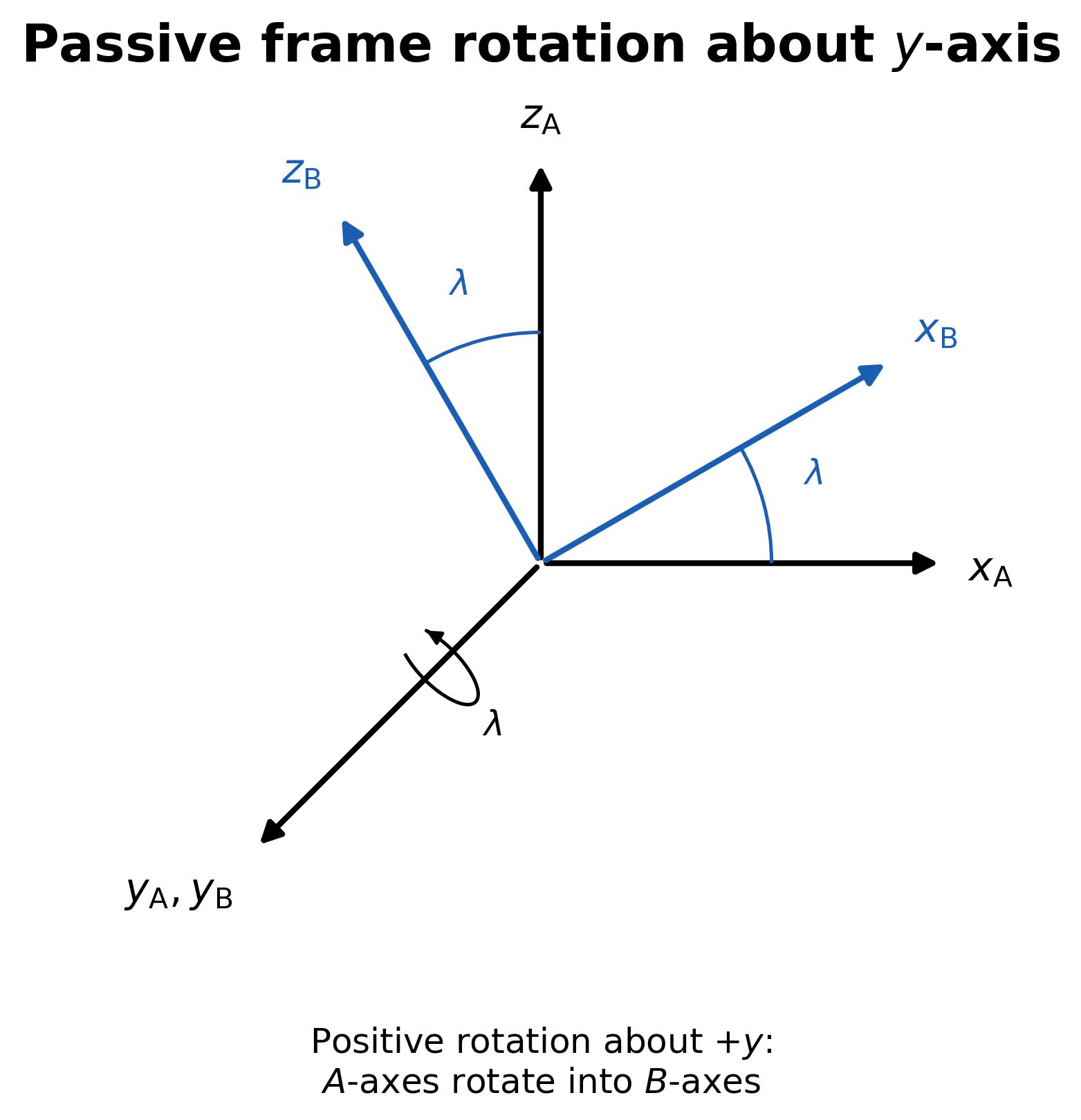
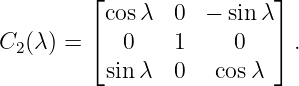
5 Derivation of the rotation about axis 2Now let frame B be obtained from frame A by a positive frame rotation through angle λ about axis 2, the y axis. The y axis is unchanged, while the x and z axes rotate in the xz plane.
Figure. Passive frame rotation about axis 2. The y axis is common to both frames, while the x and z axes of frame B result from a positive frame rotation through angle λ about +y. The marked angle λ is drawn between corresponding old and new axes. Again write
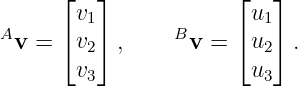 Because the second axis is unchanged,
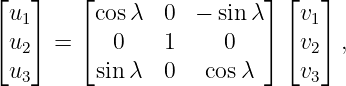
The xz coordinates transform as
Hence
so
A
|
 | (17) |
If
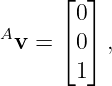
then
 | (18) |
Finally let frame B be obtained from frame A by a positive frame rotation through angle λ about axis 3, the z axis.
The z axis is unchanged, while the x and y axes rotate in the xy plane.
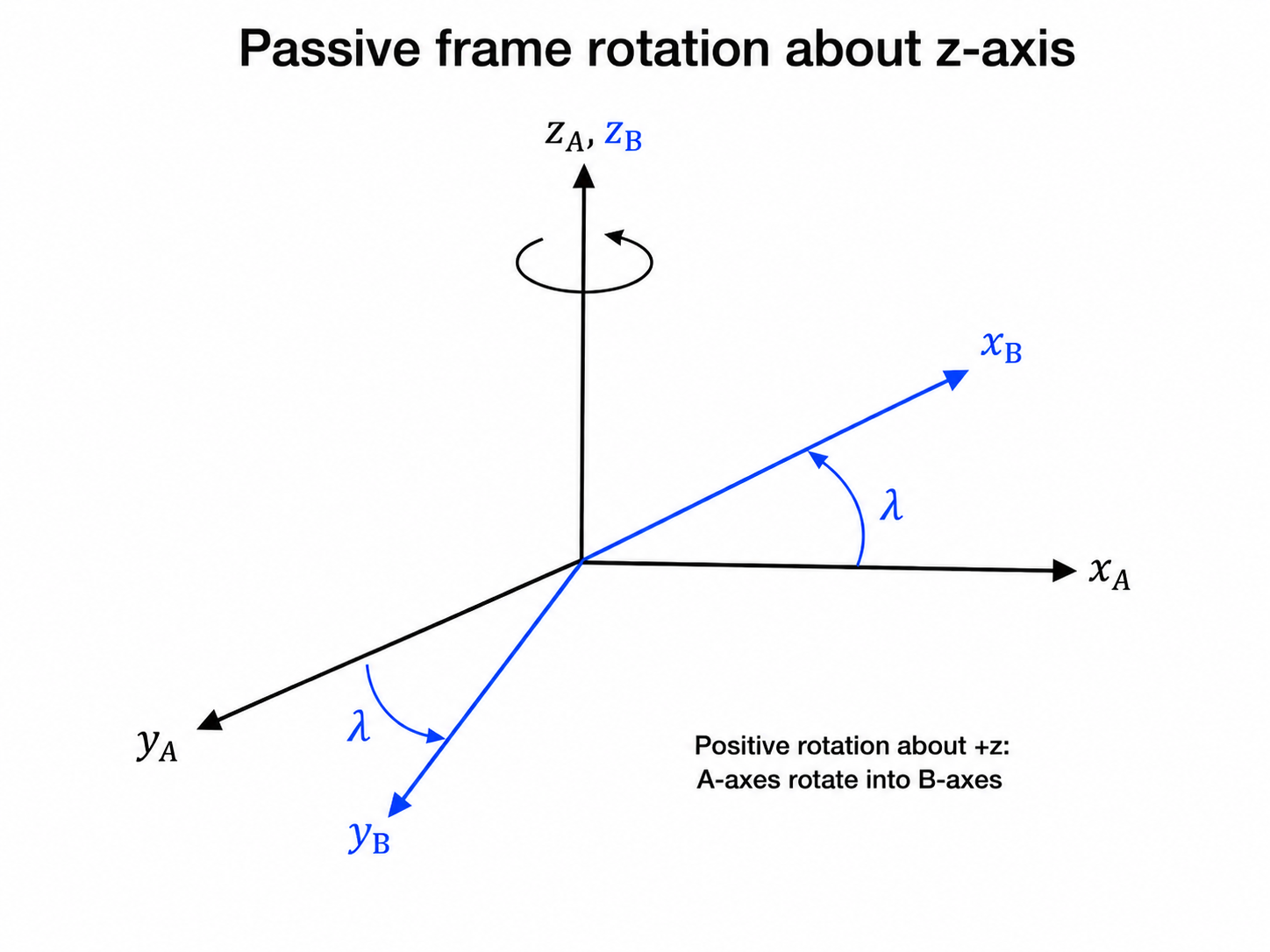
Figure. Passive frame rotation about axis 3. The z axis is common to both frames, while the x and y axes of frame B are produced by a positive frame rotation through angle λ about +z. The angle marker is drawn between the old and new x axes to emphasize the sign convention.
With the same notation,
 | (19) |
and the xy coordinates transform as
 | (20) |
 | (21) |
Therefore
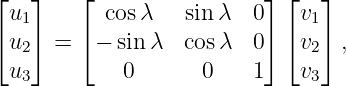 | (22) |
so
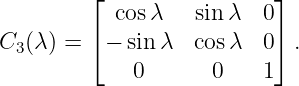 | (23) |
 diagnostic for
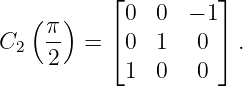
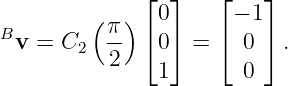
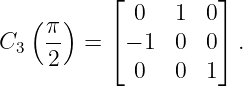
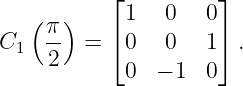
At λ = π∕2,
 | (24) |
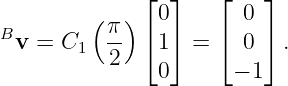
If
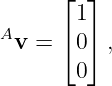
then
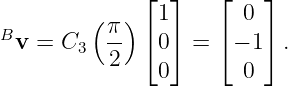 | (25) |
This example is often the quickest sign check for the passive convention.
Each elementary matrix is an orthogonal matrix with determinant +1.
For each i = 1, 2, 3,
 | (26) |
 | (27) |
and therefore
 | (28) |
Because changing the sign of the angle reverses the frame rotation,
 | (29) |
This identity is one of the most useful algebraic checks in Euler angle work.
The passive coordinate transformation and the active vector rotation for the same positive geometric angle are transposes of one another.
If Ri(λ) denotes the active rotation matrix, then
 | (30) |
Thus many sign disagreements found in textbooks are actually differences between active and passive conventions.
The geometry is the same; the map interpretation is different.
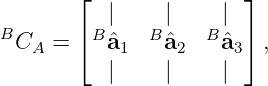
For a passive direction cosine matrix,
 | (31) |
so the columns are the coordinates of the basis vectors of frame A expressed in frame B.
Equivalently, the entries may be written as direction cosines
 | (32) |
Therefore the rows are the components of the basis vectors of frame B measured along the axes of frame A.
Both viewpoints are valid and useful.
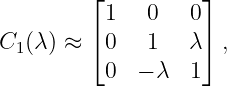
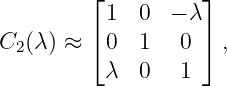
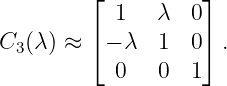
For small |λ|,

Therefore
 | (33) |
 | (34) |
and
 | (35) |
These first-order forms are useful in error analysis and linearized attitude models, but they should not be mistaken for exact finite rotation matrices.
Because a generic intrinsic sequence is

every Euler matrix is formed by multiplying the elementary matrices in the appropriate order.
For example, the PhysicsLibrary passive intrinsic 3-2-1 yaw pitch roll map is
 | (36) |
The rightmost factor acts first on a coordinate column.
Thus the first step is a positive frame rotation about axis 3 through yaw ψ, the second step is a positive frame rotation about the current axis 2 through pitch 𝜃, and the third step is a positive frame rotation about the current axis 1 through roll ϕ.
Any derived Euler matrix should agree with the elementary matrices under appropriate specializations.
Useful tests include:

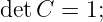

These checks are simple enough to do by hand and strong enough to catch most sign, order, and convention mistakes.
The three elementary passive coordinate transformations are
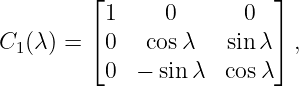 | (37) |
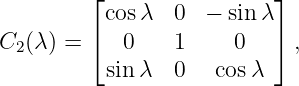 | (38) |
and
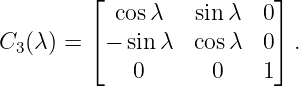 | (39) |
They are orthogonal, proper, and related to their active counterparts by transpose.
Every intrinsic Euler angle matrix in the PhysicsLibrary convention is built from these elementary factors according to
 | (40) |
Understanding these three matrices is therefore the key first step toward understanding every later Euler sequence formula.
The next companion article, Elementary axis rotations and passive rotation matrices: examples, exercises, and solutions, will reinforce these results with direct computations and verification checks.
Henderson is a classic engineering source for Euler angle transformations, quaternions, and direction cosine matrices.
Moore develops passive coordinate transformations and orientation of reference frames in a modern open text.
Diebel gives a compact comparative overview of Euler angles, rotation matrices, quaternions, and rotation vectors.
[1] D. M. Henderson, Euler Angles, Quaternions, and Transformation Matrices: Working Relationships, JSC-12960, NASA Johnson Space Center, 1977. NASA Technical Reports Server
[2] J. K. Moore, Learn Multibody Dynamics, chapter “Orientation of Reference Frames,” 2026 edition. Licensed CC BY 4.0. Orientation of Reference Frames
[3] J. Diebel, “Representing Attitude: Euler Angles, Unit Quaternions, and Rotation Vectors,” Stanford University, 2006. Online PDF
Unless otherwise noted, this PhysicsLibrary entry is intended for release under the Creative Commons Attribution ShareAlike 4.0 International license.
| Also defines: | Euler angle sequence |
| Keywords: | Euler angles, passive rotation matrix, direction cosine, matrix, elementary rotations, coordinate transformation, intrinsic rotation |
|
| Physics Classification: | 02.40.Yy (Geometric mechanics ) |
| 45.40.-f (Dynamics and kinematics of rigid bodies) | |
| 02.10.Ud (Linear algebra) |
None.
No messages.









 diagnostic for



 diagnostic for