Euler Angles: 3-2-1 Yaw Pitch Roll
The intrinsic 3-2-1 Euler sequence is the most common Tait Bryan orientation parameterization in
aerospace engineering and navigation.
It is usually called yaw pitch roll.
In the PhysicsLibrary convention, the three chronological frame rotations are:
- yaw through ψ about axis 3 of the initial frame;
- pitch through 𝜃 about axis 2 of the first intermediate frame;
- roll through ϕ about axis 1 of the second intermediate frame.
The resulting passive coordinate transformation is
This article develops the geometry, matrix, inverse extraction formulas, aerospace sign
interpretation, singularity, quaternion equivalent, and angular-velocity relationship for this
sequence.
The separate Euler 321 sequence entry remains the compact sequence reference. EA07 is the
deeper engineering treatment.
1 Frame and sign convention
Let A be a reference frame and B the final body frame.
PhysicsLibrary uses the passive coordinate map
The physical vector does not change.
Only its coordinate representation changes.
The positive frame rotation itself follows the right hand rule.
For aerospace work, a common specialization is:
- frame A: local navigation North-East-Down coordinates;
- frame B: aircraft body Forward-Right-Down coordinates.
These are both right handed frames.
The FAA describes aircraft roll about the longitudinal axis, pitch about the lateral axis, and yaw
about the vertical axis. In the common body-axis notation these correspond to axes 1, 2, and 3,
respectively.
2 Intrinsic 3-2-1 frame construction
Define
After yaw, call the intermediate frame A1.
After pitch, call the next intermediate frame A2.
After roll,
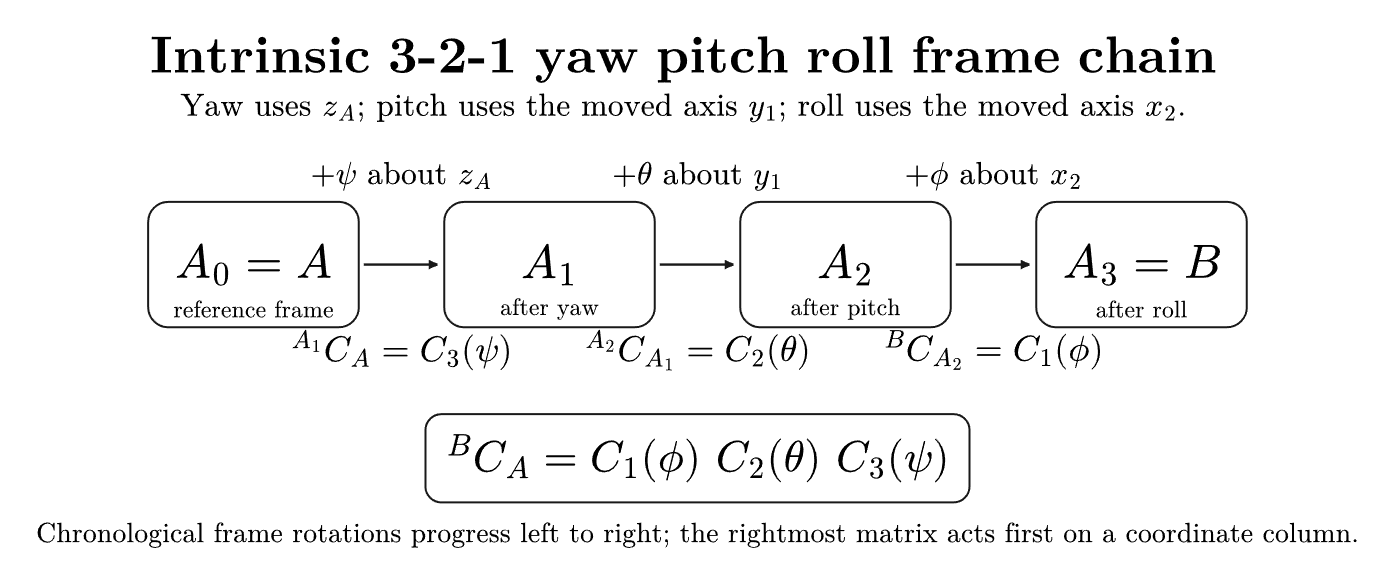
Figure. Intrinsic 3-2-1 frame chain. Yaw is about zA, pitch is about the moved axis y1, and
roll is about the moved axis x2.
The three passive coordinate maps are
and
Matching adjacent frame labels gives
hence
The rightmost matrix acts first on a coordinate column.
3 Positive yaw, pitch, and roll
For a conventional aircraft body frame,
Positive frame rotations obey the right hand rule.
Therefore:
- positive yaw rotates the current x axis toward the current y axis;
- positive pitch rotates the current x axis toward the negative current z direction, which
is nose up in Forward-Right-Down coordinates;
- positive roll rotates the current y axis toward the current z axis, which is right wing
down.
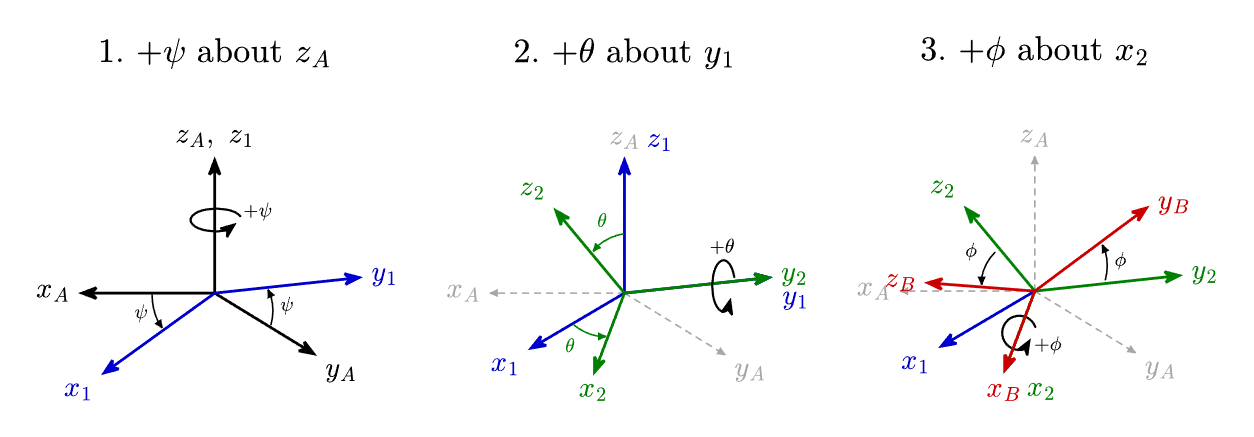
Figure. Positive yaw, pitch, and roll directions for the conventional Forward-Right-Down
aircraft body-axis interpretation. Each rotation is intrinsic, so the axis used at each step
belongs to the current intermediate frame.
4 Elementary passive matrices
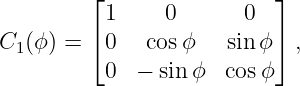
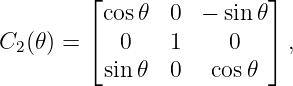
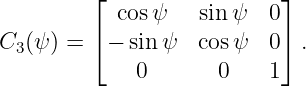
The three required passive frame rotations are
and
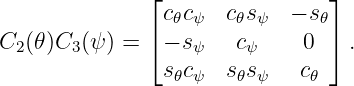
5 Derivation of the full 3-2-1 DCM
Define
with analogous notation for 𝜃 and ψ.
First multiply pitch and yaw:
Premultiplying by C1(ϕ) gives
This is the canonical PhysicsLibrary passive intrinsic 3-2-1 DCM.
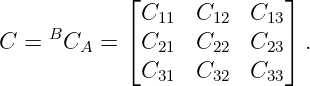
6 What the rows and columns mean
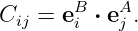
For
the matrix elements satisfy
Thus row i contains the body basis vector eiB expressed in frame A coordinates.
Column j contains the reference basis vector ejA expressed in frame B coordinates.
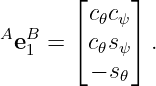
For example, the first row is
This row is the body forward axis expressed in the reference frame.
7 Yaw and pitch from the body forward axis
Suppose frame A is North-East-Down and frame B is Forward-Right-Down.
The body forward direction expressed in navigation coordinates is
When
yaw is the heading of the horizontal projection:
The Down component is
Thus positive pitch gives a negative Down component, corresponding to nose up.
Roll does not change the forward-axis direction because the final roll is about that axis.
8 Principal angle ranges
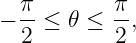
A common principal branch is
and
On this branch,
9 Inverse extraction from the DCM
Let
Away from the singularity,
and
The two-argument function atan2 is essential because it preserves the correct quadrant.
10 Equivalent atan2 form for pitch
Away from singularity,
For a proper DCM,
On the principal branch this reduces to cos 𝜃.
11 The 3-2-1 singularity
The sequence becomes singular when
Thus
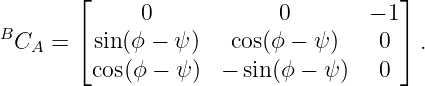
At these configurations, the first rotation axis zA and the third rotation axis x2 become
collinear.
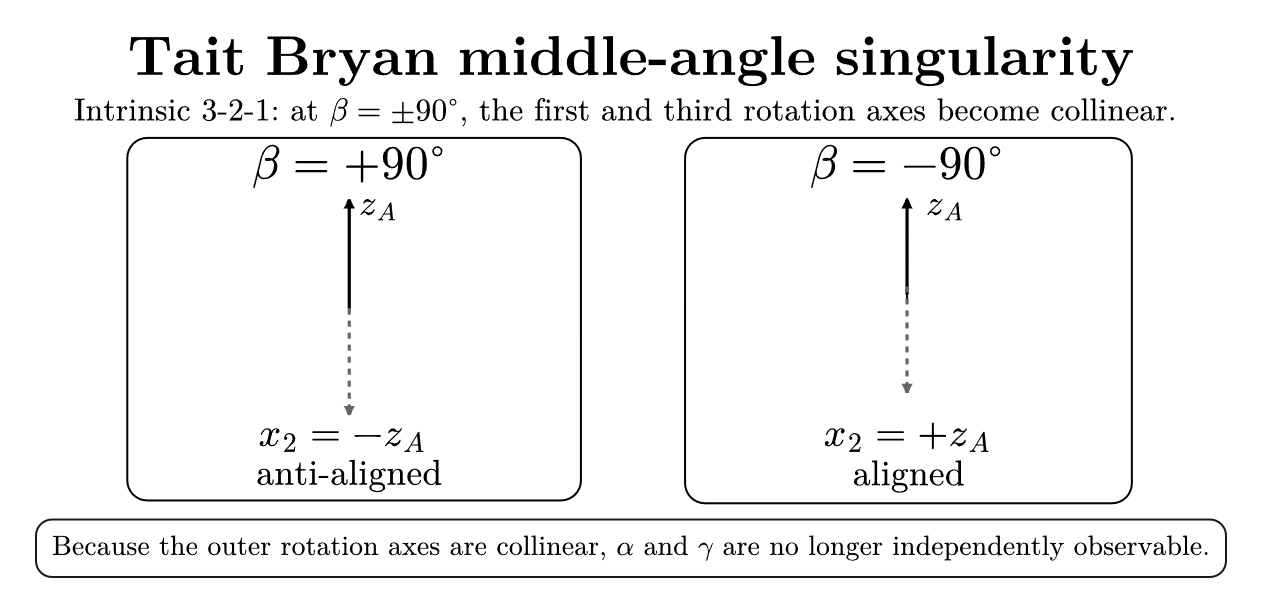
Figure. Intrinsic 3-2-1 singularity. At 𝜃 = +90∘, x
2 is anti-aligned with zA; at 𝜃 = −90∘, it
is aligned with zA.
The physical orientation remains completely valid.
Only the yaw pitch roll coordinate chart becomes singular.
12 Exact outer-angle coupling at positive ninety degrees
Set
Then
Only
appears.
Yaw and roll are therefore not independently recoverable.
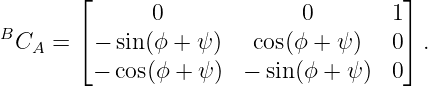
13 Exact outer-angle coupling at negative ninety degrees
Set
Then
Only
appears.
14 A practical singular-case convention
Software must choose a convention when
falls below a selected numerical threshold.
One possible policy is to set
at singularity and assign the entire observable outer-angle combination to yaw.
At positive ninety degrees,
With ϕ = 0,
At negative ninety degrees,
With ϕ = 0,
Another implementation may hold yaw fixed and assign the coupled rotation to roll.
The requirement is not one unique policy; the requirement is an explicit, consistent
policy.
15 Equivalent extrinsic description
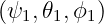
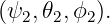
Intrinsic 3-2-1 with chronological angles (ψ,𝜃,ϕ) is equivalent to extrinsic 1-2-3 with chronological
angles (ϕ,𝜃,ψ):
16 Active versus passive 3-2-1 matrices
The PhysicsLibrary matrix is passive:
The corresponding active rotation matrix is its transpose:
Therefore an apparently transposed 3-2-1 matrix in another reference may be correct under an
active-vector convention.
17 Passive quaternion equivalent
For a positive passive frame rotation about axis i,
Therefore
Let
with analogous definitions for 𝜃 and ψ.
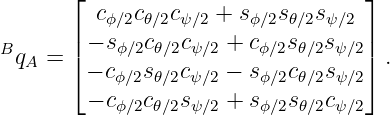
Under Hamilton multiplication and scalar-first storage,
The quaternion and DCM satisfy
18 Angular velocity and Euler angle rates
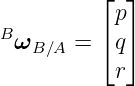
Let
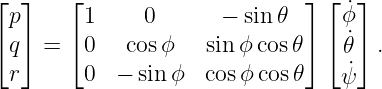
be the angular velocity of frame B relative to frame A, expressed in body coordinates.
For intrinsic 3-2-1,
Thus body angular velocity components are not equal to Euler Angle rates except in special
cases.
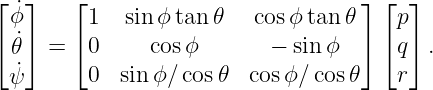
Away from the singularity,
The inverse rate map becomes singular at the same cos 𝜃 = 0 condition.
Euler Angles and angular velocity develops this relationship in detail later in the series.
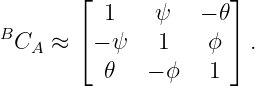
19 Small-angle approximation
For small yaw, pitch, and roll,
Then
If
then
This is a local linearization only.
Finite yaw pitch roll angles are not a rotation vector.
20 Numerical example
Take
Then
gives
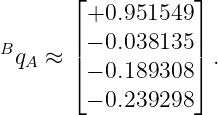
The corresponding passive quaternion is approximately
The DCM satisfies
and
to numerical precision.
Applying the inverse extraction formulas recovers
21 Relative attitude should not be found by angle subtraction
Suppose two body attitudes are represented by
and
The exact relative attitude is not generally
Instead form the two DCMs,
and compute
Quaternion composition gives the equivalent exact result.
22 Use in navigation and flight dynamics
The intrinsic 3-2-1 sequence is attractive because its coordinates have direct interpretation over
Normal aircraft operating attitudes.
When A is a local navigation frame and B is the body frame:
- yaw describes heading-like orientation about the local vertical;
- pitch describes nose-up or nose-down tilt;
- roll describes bank about the forward axis.
Practical inertial navigation and flight-control software often propagates a quaternion or DCM
internally and converts to yaw pitch roll for displays, interfaces, limits, initialization, or selected
control logic.
23 Convention traps in the literature
A source that says “yaw pitch roll” or “3-2-1” has not yet fully specified its convention.
Determine at least:
- intrinsic or extrinsic axes;
- active or passive transformation;
- coordinate-map direction;
- column-vector or row-vector convention;
- positive-angle convention;
- whether 3-2-1 describes chronological rotations or written matrix-factor order;
- reference-frame axis directions, such as North-East-Down versus East-North-Up;
- body-axis convention, such as Forward-Right-Down.
Many apparent sign disagreements disappear when these choices are aligned.
24 Verification battery
A correct PhysicsLibrary 3-2-1 implementation should satisfy:
- zero angles give the identity;
- 𝜃 = ϕ = 0 gives C3(ψ);
- ψ = ϕ = 0 gives C2(𝜃);
- ψ = 𝜃 = 0 gives C1(ϕ);
- CCT = I;
- det C = 1;
- the reverse map is the transpose;
- DCM-to-Euler round trips recover the principal branch away from cos 𝜃 = 0;
- the DCM agrees with the passive quaternion product;
- the Euler-rate inverse becomes singular at the same cos 𝜃 = 0 condition.
25 Summary
The PhysicsLibrary intrinsic 3-2-1 yaw pitch roll convention is
Its passive coordinate map is
Away from singularity,
and
The singularity occurs at
where yaw and roll become coupled.
The equivalent passive quaternion is
The 3-2-1 sequence is therefore an extremely useful local engineering coordinate system, while a
quaternion or DCM is usually preferable for global attitude propagation.
The next article, Euler angles: 3-1-3 proper Euler sequence, develops the flagship proper Euler
sequence in comparable detail.
26 References and further reading
Henderson provides the classic NASA engineering development of Euler angles, quaternions,
transformation matrices, and the twelve sequence relationships.
The FAA Pilot’s Handbook of Aeronautical Knowledge describes aircraft roll, pitch, and yaw
about the longitudinal, lateral, and vertical axes.
Diebel gives a unified attitude-representation treatment useful for comparing Euler, DCM,
quaternion, and rotation-vector conventions.
SciPy’s rotation documentation provides a modern software reference for intrinsic and extrinsic
Euler sequence notation.
References
[1] D. M. Henderson, Euler Angles, Quaternions, and Transformation Matrices: Working
Relationships, JSC-12960, NASA Johnson Space Center, 1977. NASA Technical Reports
Server
[2] Federal Aviation Administration, Pilot’s Handbook of Aeronautical Knowledge,
FAA-H-8083-25C, 2023. FAA Pilot’s Handbook of Aeronautical Knowledge
[3] J. Diebel, “Representing Attitude: Euler Angles, Unit Quaternions, and Rotation
Vectors,” Stanford University, 2006. Online PDF
[4] SciPy Developers, “Rotation.from_euler,” SciPy documentation. SciPy Euler rotation
documentation
License
Unless otherwise noted, this PhysicsLibrary entry is intended for release under the Creative
Commons Attribution ShareAlike 4.0 International license.














![AeB = [c c c s − s ] .
1 𝜃 ψ 𝜃 ψ 𝜃](https://images.physicslibrary.org/cache/objects/1131/make4ht/EulerAngles321YawPitchRoll18x.png)






























![BCA ≈ I − [𝜖×].](https://images.physicslibrary.org/cache/objects/1131/make4ht/EulerAngles321YawPitchRoll61x.png)