Electromagnetic Waves, Antennas, and RF: Gauss’s Law - Exercises and Complete Worked
Solutions
This companion article provides self-study exercises for EM07, Gauss’s Law. All exercises are
stated first. Complete worked solutions follow in Part II.
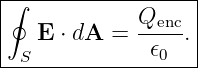
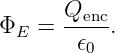
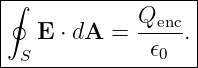
The central law is
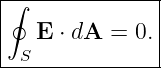
The most important methodological distinction is
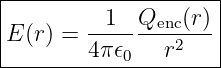
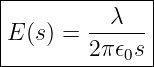
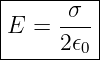
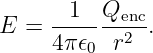
For symmetric charge distributions, useful results from EM07 are
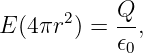
for spherical symmetry,
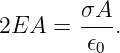
for an ideal infinite line charge, and
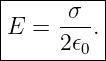
for an ideal infinite uniformly charged sheet.
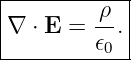
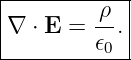
The differential form is
These are the same definitions and conventions used in EM07 [1, 2, 3, 5].
How to use this problem set
Attempt every exercise in Part I before reading Part II. For each Gaussian-surface problem,
explicitly answer these questions before writing the flux integral:
- What symmetry does the physical charge distribution possess?
- What direction must E point because of that symmetry?
- On what parts of the Gaussian surface is E constant?
- On what parts is E ⋅ dA zero?
- What charge is actually enclosed?
Choosing a convenient surface does not create symmetry that the charge distribution does not
have.
Part I: Exercises
Exercise 1: net enclosed charge and total flux
A closed Gaussian surface encloses three point charges:
Find:
- the net enclosed charge;
- the total electric flux through the closed surface.
Use
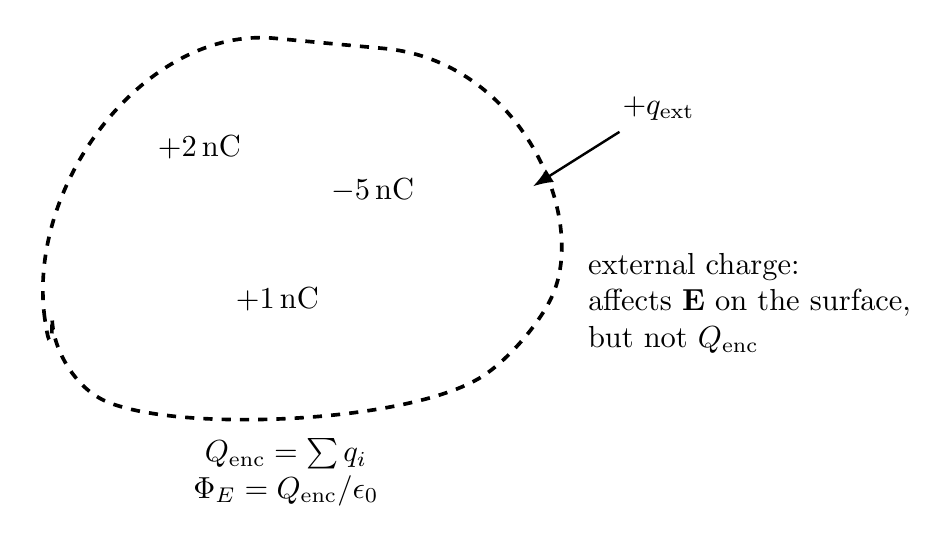
Figure. Gauss’s law depends on the algebraic sum of charge enclosed by the closed
surface. External charge may alter the field on the surface but does not appear in Qenc.
Exercise 2: off-center charge inside an arbitrary closed surface
A point charge q = +4.0 nC lies inside an irregular closed surface but is not at its geometric
center.
- Find the total electric flux through the surface.
- Can the field magnitude be assumed constant on the surface?
- Can the flux integral be replaced by EA for this arbitrary surface? Explain.
Exercise 3: external charge and zero enclosed charge
A closed box contains no charge. A positive point charge lies outside the box and produces a
nonzero Electric Field throughout much of the box.
What is the net electric flux through the entire closed box? Does your answer imply that the
electric field is zero on the box?
Exercise 4: field outside a uniformly charged sphere
A spherically symmetric insulating sphere of radius
contains total charge
Find the electric-field magnitude at
State the field direction.
Exercise 5: field inside a uniformly charged solid sphere
The same sphere as in Exercise 4 has charge uniformly distributed throughout its volume. Find the
electric-field magnitude at
Show explicitly how the enclosed charge is determined.
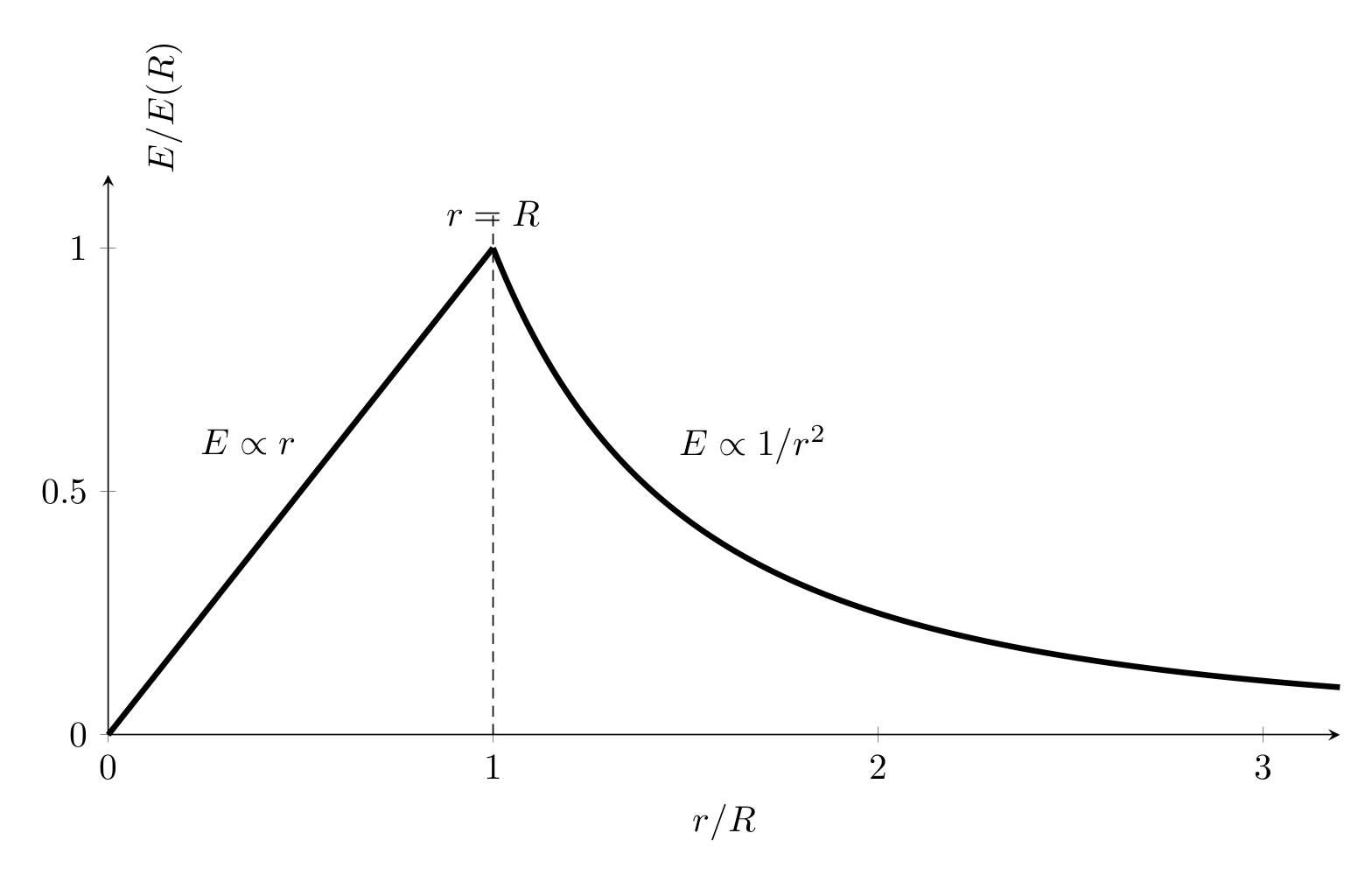
Figure. For a uniformly charged solid sphere, E increases linearly inside the sphere and
decreases as 1∕r2 outside. The two expressions meet continuously at r = R.
Exercise 6: derive the field of an infinite line charge
An ideal infinite line carries uniform linear charge density λ > 0 along the z axis.
Using a coaxial cylindrical Gaussian surface of radius s and length L:
- identify which parts of the cylinder contribute flux;
- determine the enclosed charge;
- derive E(s).
Exercise 7: numerical infinite line-charge field
For
find the electric-field magnitude at
Use the result derived in Exercise 6.
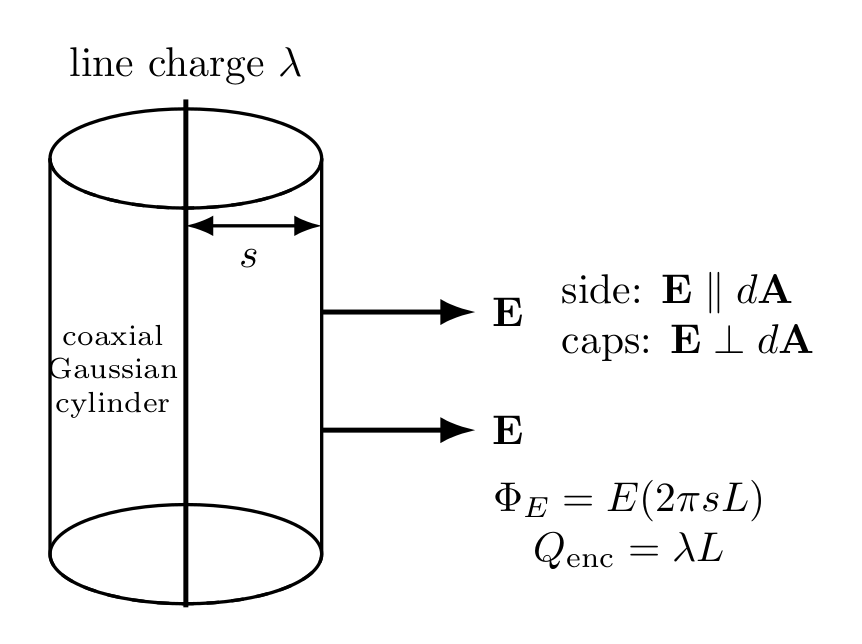
Figure. For cylindrical symmetry, the flux passes through the curved side of a coaxial
Gaussian cylinder; the end-cap flux is zero.
Exercise 8: field of an infinite charged sheet
An ideal infinite sheet carries positive surface charge density σ.
Using a pillbox Gaussian surface that straddles the sheet, derive
Explain why the curved side of the pillbox contributes no flux.
Exercise 9: two oppositely charged infinite sheets
Two parallel infinite sheets carry surface charge densities
Using superposition and the single-sheet result, find the field magnitude:
- between the sheets;
- outside the pair.
State the direction of the field between the sheets.
Exercise 10: choose the useful Gaussian surface
For each idealized charge distribution below, identify the most useful Gaussian surface and explain
why it matches the field symmetry:
- a point charge at the origin;
- an infinite straight line charge;
- an infinite uniformly charged plane;
- two unequal point charges separated by a finite distance.
For part (d), state whether Gauss’s law remains valid and whether it is likely to solve directly for
E.
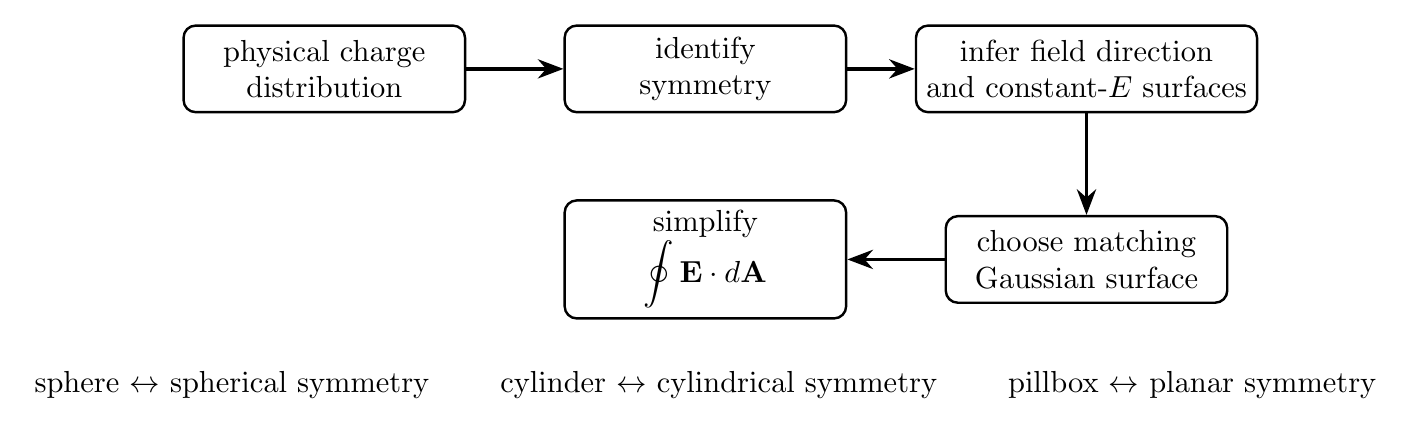
Figure. Useful Gaussian surfaces follow from physical symmetry. A surface is chosen to
exploit a known field geometry; the surface itself does not create that geometry.
Exercise 11: uniform external field through a closed box
A rectangular box has two opposite faces of area
normal to a uniform field
Find the flux through:
- the right face;
- the left face;
- the other four faces;
- the complete closed box.
What enclosed charge is implied?
Exercise 12: infer charge density from divergence
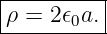
In a region of space,
where a is a constant.
Find:
- ∇⋅ E;
- the corresponding volume charge density ρ using differential Gauss law.
Exercise 13: verify integral and differential Gauss law for a simple field
Consider
where a is constant. For a sphere of radius R centered at the origin:
- use the differential form of Gauss’s law to find ρ;
- find the total enclosed charge from ρ;
- compute the flux directly from the spherical surface;
- verify that the two sides of Gauss’s law agree.
Exercise 14: Gauss-law synthesis
For each statement, decide whether it is correct. If incorrect, rewrite it accurately.
- “Gauss’s law is valid only for symmetric charge distributions.”
- “If a closed surface has zero net flux, the electric field must be zero everywhere on it.”
- “Any charge outside a Gaussian surface contributes nothing to the electric field on that
surface.”
- “A spherical Gaussian surface always allows the replacement ∮
E ⋅ dA = E(4πr2).”
- “In a charge-free region, ∇⋅ E = 0.”
- “The integral and differential forms of Gauss’s law describe the same physical law.”
Part II: Complete Worked Solutions
Solution 1: net enclosed charge and total flux
The enclosed charge is the algebraic sum:
| Qenc | = q1 + q2 + q3 | (21)
|
| = (2.0 − 5.0 + 1.0) nC | (22)
|
| = −2.0 nC. | (23) |
Thus
Gauss’s law gives
Therefore,
| ΦE | = 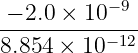 | (26)
|
| ≈−2.26 × 10² N m2∕C. | (27) |
Hence
The negative sign means the net signed flux is inward.
Solution 2: off-center charge inside an arbitrary closed surface
Gauss’s law depends only on enclosed charge:
Thus
| ΦE | = 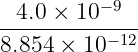 | (30)
|
| ≈ 4.52 × 10² N m2∕C. | (31) |
Therefore,
The field magnitude cannot generally be assumed constant on the irregular surface. The field also
need not be everywhere normal to the surface. Therefore the total flux is known, but the integral
cannot generally be replaced by EA.
Solution 3: external charge and zero enclosed charge
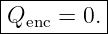
The box encloses no charge:
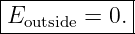
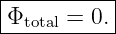
Therefore,
This does not imply E = 0. The external charge can produce a nonzero field on the surface. Field
entering the box contributes negative flux and field leaving contributes positive flux; the signed
contributions cancel over the complete closed surface.
Solution 4: field outside a uniformly charged sphere
Because the charge distribution is spherically symmetric, choose a spherical Gaussian surface of
radius r = 0.25 m. Since r > R, the Gaussian surface encloses the full charge:
Therefore,
so
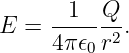
Using
we obtain
| E | = (8.99 × 10⁹)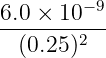 | (39)
|
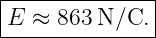
| ≈ 8.63 × 10² N/C. | (40) |
Hence
Because Q > 0, the field points radially outward.
Solution 5: field inside a uniformly charged solid sphere
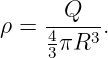
Uniform volume charge density means
The Gaussian sphere of radius r < R encloses only the fraction of charge proportional to its
volume:
| Qenc | = ρ | (43)
|
| = Q . . | (44) |
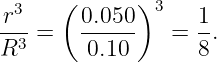
With r = 0.050 m and R = 0.10 m,
Thus
Gauss’s law gives
Therefore,
| E | = (8.99 × 10⁹)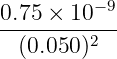 | (48)
|
| ≈ 2.70 × 10³ N/C. | (49) |
Hence
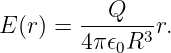
Equivalently, the inside-sphere formula is
Solution 6: derive the field of an infinite line charge
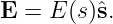
Cylindrical symmetry forces the electric field to point radially away from the line and to depend
only on perpendicular distance s:
Choose a coaxial cylinder of radius s and length L.
On the curved side, the field is parallel to the outward area normal, so
The curved area is
On the end caps, dA points along ±z while E points radially sideways, so
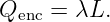
The enclosed charge is
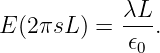
Thus Gauss’s law becomes
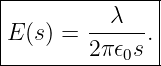
Canceling L gives
For λ > 0, the field points radially outward.
Solution 7: numerical infinite line-charge field
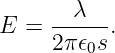
Use
Substituting,
| E | = 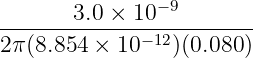 | (60)
|
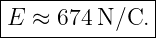
| ≈ 6.74 × 10² N/C. | (61) |
Therefore,
For positive λ, the field points radially away from the line.
Solution 8: field of an infinite charged sheet
Planar symmetry requires the field to be perpendicular to the sheet and to have the same
magnitude on both sides.
Choose a pillbox with two flat caps of area A. On the curved side, the field is tangent to the
surface, so
Each flat cap contributes
Therefore the total flux is
The enclosed charge is
Gauss’s law gives
Canceling A yields
For σ > 0, the field points away from the sheet on both sides.
Solution 9: two oppositely charged infinite sheets
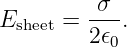
A single sheet produces magnitude
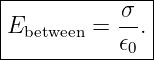
Between the +σ and −σ sheets, both fields point from the positive sheet toward the negative
sheet, so they add:
| Ebetween | =  + +  | (70)
|
| =  . . | (71) |
Thus
Outside the pair, the two fields point in opposite directions with equal magnitudes,
so
Solution 10: choose the useful Gaussian surface
- A point charge at the origin has spherical symmetry. Use a sphere centered on the
charge.
- An infinite straight line charge has cylindrical symmetry. Use a coaxial cylinder.
- An infinite uniformly charged plane has planar symmetry. Use a pillbox whose flat
faces are parallel to the plane.
- Two unequal separated point charges generally possess insufficient symmetry for a
simple Gaussian surface to make E constant over the useful parts of the surface. Gauss’s
law remains exactly valid, but it does not usually solve directly for E.
The key logic is
Solution 11: uniform external field through a closed box
The field is
For the right face, the outward normal is +x, so
Thus
For the left face, the outward normal is −x, so
The other four faces have normals perpendicular to E, so
for each of them.
The complete flux is
Therefore,
Gauss’s law then gives
Solution 12: infer charge density from divergence
The field is
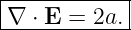
Its divergence is
| ∇⋅ E | =  + +  + +  | (84)
|
| = a + 2a − a | (85)
|
| = 2a. | (86) |
Hence
Differential Gauss law gives
so
Solution 13: verify integral and differential Gauss law for a simple field
The field is
Its divergence is
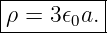
Therefore differential Gauss law gives
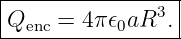
For a sphere of radius R, the enclosed charge is
| Qenc | = ρ | (93)
|
| = (3𝜖0a) | (94)
|
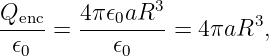
| = 4π𝜖0aR3. | (95) |
Thus
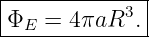
On the spherical surface, E = aRr, so the field is radial and constant in magnitude. The flux
is
| ΦE | = E(4πR2) | (97)
|
| = (aR)(4πR2) | (98)
|
| = 4πaR3. | (99) |
Therefore,
The right-hand side of Gauss’s law is
which matches the direct flux calculation exactly.
Solution 14: Gauss-law synthesis
- Incorrect. Gauss’s law is valid for every closed surface and every charge distribution.
Symmetry is needed only to simplify the integral enough to solve easily for the field.
- Incorrect. Zero net flux does not imply zero field. Positive and negative flux
contributions may cancel over the closed surface.
- Incorrect. External charges can contribute strongly to the electric field on the surface;
they contribute zero net flux through the complete closed surface.
- Incorrect. The replacement ∮
E⋅dA = E(4πr2) requires spherical field symmetry with
constant E and radial alignment over the sphere.
- Correct. If ρ = 0, differential Gauss law gives
- Correct. The divergence theorem connects the integral and differential forms, so they
represent the same physical law at global and local levels.
Common mistakes
- Using total charge in the problem instead of the charge enclosed by the chosen Gaussian
surface.
- Assuming Gauss’s law itself requires symmetry.
- Pulling E outside a surface integral without proving that it is constant over that part
of the surface.
- Forgetting that dA points outward on a closed surface.
- Assuming zero total flux implies zero electric field.
- Assuming external charges produce no field on a Gaussian surface.
- Choosing a Gaussian surface first and then assigning symmetry that the physical charge
distribution does not possess.
What EM07E reinforces
The universal statement is
The useful-symmetry chain is
And the local form is
The next lesson, EM08, introduces electric current and current density, moving from
static charge toward moving charge, magnetic fields, and eventually electromagnetic
radiation.
References
[1] David J. Griffiths, Introduction to Electrodynamics, 4th ed., Cambridge University
Press, 2017.
[2] Samuel J. Ling, Jeff Sanny, and William Moebs, University Physics, Volume 2,
OpenStax, 2016, sections on electric flux and Gauss’s law.
[3] Edward M. Purcell and David J. Morin, Electricity and Magnetism, 3rd ed.,
Cambridge University Press, 2013.
[4] Richard P. Feynman, Robert B. Leighton, and Matthew Sands, The Feynman Lectures
on Physics, Volume II, Addison-Wesley, 1964, chapters on electrostatics and Maxwell’s
equations.
[5] Massachusetts Institute of Technology, 8.02 Physics II: Electricity and Magnetism,
MIT OpenCourseWare, materials on electric flux and Gauss’s law.
[6] H. M. Schey, Div, Grad, Curl, and All That, 4th ed., W. W. Norton & Company,
2005.

![[parent]](https://images.physicslibrary.org/images/uparrow.png)