Electromagnetic Waves, Antennas, and RF: Ampère’s Law and Symmetry - Exercises and
Complete Worked Solutions
This companion article provides self-study exercises for EM12, Ampère’s Law and Symmetry. All
exercises are stated first. Complete worked solutions follow in Part II.
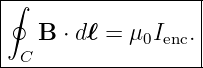
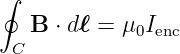
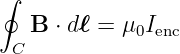
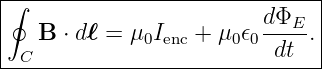
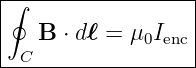
The central magnetostatic circulation law is
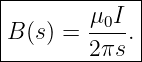
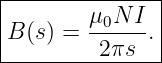
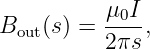
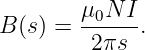
For an infinitely long straight wire,
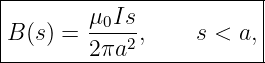
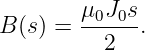
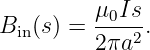
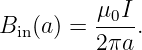
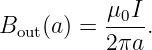
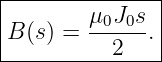
For a cylindrical wire of radius a carrying uniformly distributed current I,
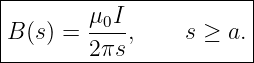
and
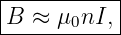
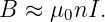
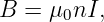
For an ideal long solenoid,
and for an ideal toroid within its winding region,
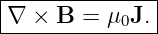
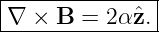
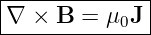
The equivalent local magnetostatic law is
These are the same definitions and conventions developed in EM12 [1, 2, 3, 5].
How to use this problem set
Attempt every exercise in Part I before consulting Part II. For each Ampère-law problem, identify
the symmetry first. Then decide whether the proposed Amperian path makes the field tangent to
the path and whether the magnitude of B is constant on the contributing segment. Only after
those geometric steps should the circulation integral be simplified.
Part I: Exercises
Exercise 1: magnetic circulation around a known circular field
A magnetic field has constant magnitude
and is everywhere tangent to a circular path of radius
The field points in the same direction as the path traversal. Find
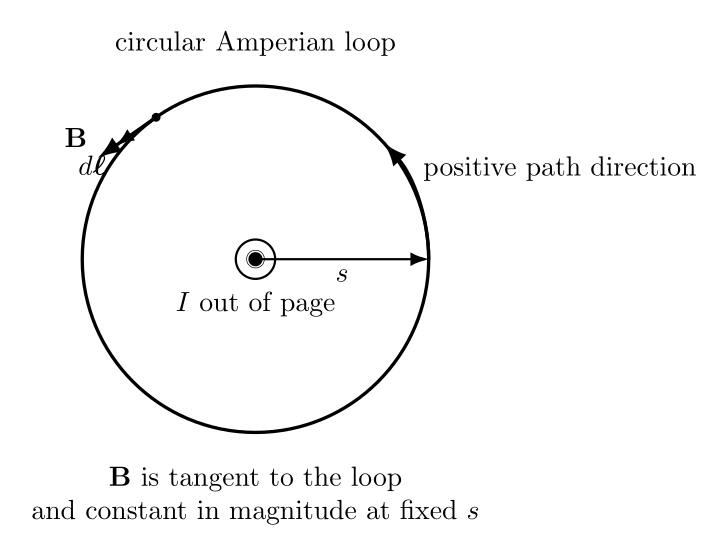
Figure. A circular Amperian loop centered on a straight current. Symmetry makes B
tangent to the loop and constant in magnitude at fixed radius.
Exercise 2: signed enclosed current
A closed Amperian path is traversed counterclockwise as viewed from the +z side. Three currents
pierce the bounded surface:
and
Find the signed enclosed current and the resulting magnetic circulation.
Exercise 3: field around a long straight wire
An infinitely long straight wire carries
Find the magnetic-field magnitude at perpendicular distance
State why a circular Amperian loop centered on the wire is a symmetry-matched path.
Exercise 4: infer current from a measured field
A magnetic-field sensor measures
at perpendicular distance
from a very long straight wire. Find the wire current.
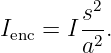
Exercise 5: enclosed current inside a uniformly current-filled wire
A cylindrical wire has radius
and carries total current
uniformly over its cross section. An Amperian circle has radius
Find:
- the enclosed current Ienc;
- the magnetic-field magnitude at that radius.
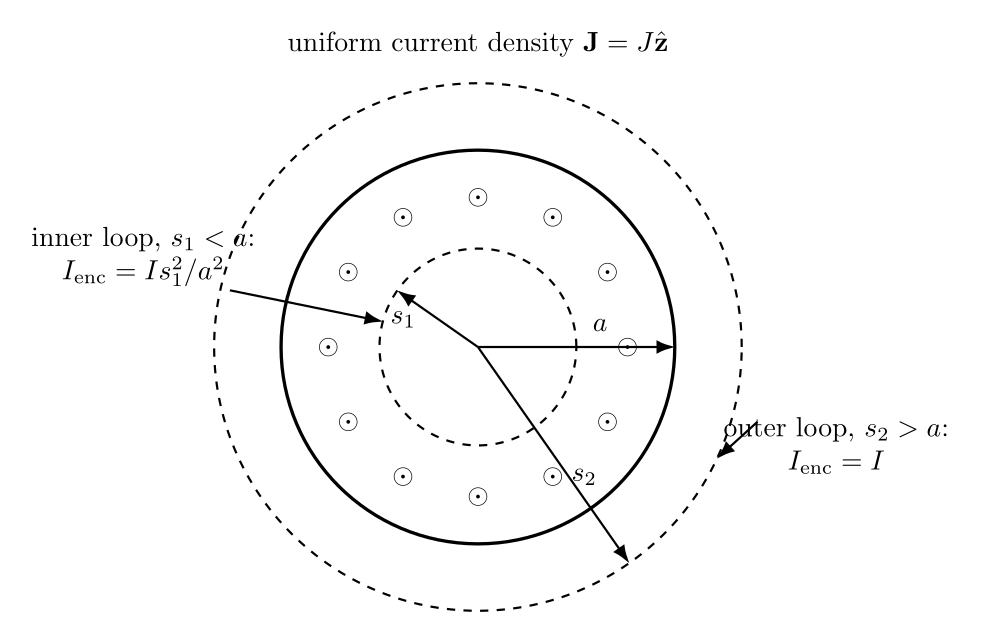
Figure. Inside a uniformly current-filled cylindrical wire, an Amperian loop encloses only
the fraction of current within its radius.
Exercise 6: where is the field largest in a uniform-current wire?
A uniformly current-filled wire has radius
and carries current
Use the inside and outside formulas to show that the magnetic field is continuous at s = a. Find
the field magnitude there and explain why this is the maximum field magnitude for this idealized
wire.
Exercise 7: field outside a finite-radius wire
A cylindrical wire carries total current
Find the magnetic field at radius
where the observation point lies outside the wire. Explain why the outside field does not depend on
the wire radius when the total current is fixed.
Exercise 8: ideal long-solenoid field
An ideal long solenoid has
and carries current
Find the interior magnetic-field magnitude.
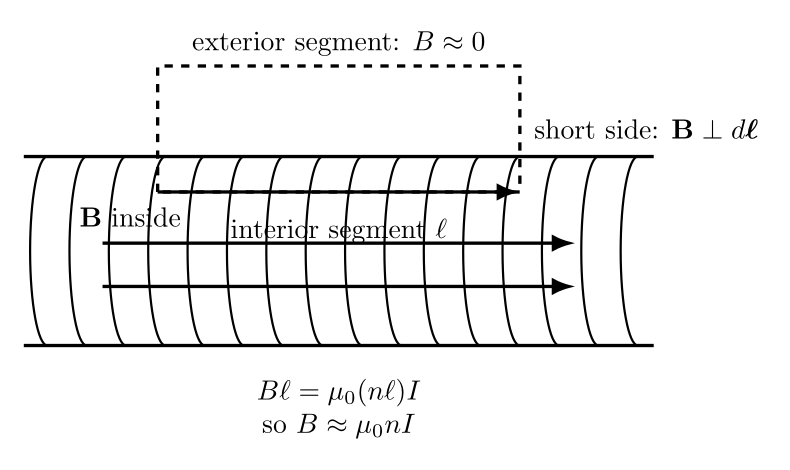
Figure. A rectangular Amperian path through an ideal long solenoid isolates the nearly
uniform interior field contribution.
Exercise 9: design the turn density of a solenoid
An ideal long solenoid must produce
with current
Find the required turn density n. If the solenoid length is
estimate the required number of turns N = nL.
Exercise 10: ideal-toroid field
An ideal toroid has
turns and carries current
Find the magnetic field within the winding region at
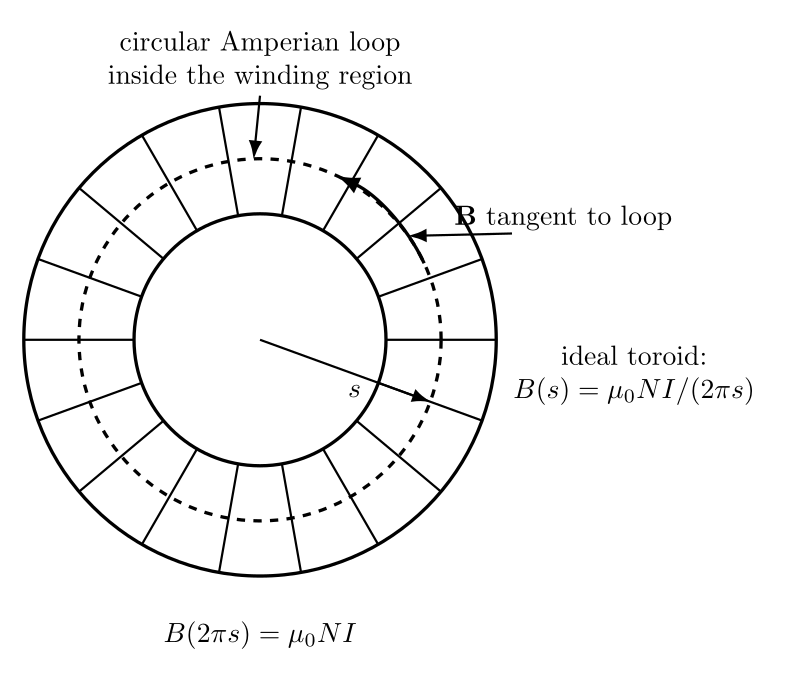
Figure. For an ideal toroid, a circular Amperian path within the winding region follows
the azimuthal magnetic field.
Exercise 11: choose the useful Amperian path
For each source below, state whether the proposed path is useful for solving directly for B, and
explain why.
- A circle centered on an infinitely long straight wire.
- A circle displaced sideways from an infinitely long straight wire.
- A rectangular path with one long side inside an ideal long solenoid and one long side
outside.
- An arbitrary irregular loop around two separated finite wires.
Your answer should distinguish between “Ampère’s law is true” and “the path lets us pull B out
of the integral.”
Exercise 12: derive the inside-wire field from current density
A cylindrical Conductor of radius a carries uniform current density
Using an Amperian circle of radius s < a, derive the magnetic-field magnitude in terms of J0 and
s. Show that
Exercise 13: differential Ampère law from a specified field
Suppose
where
Find:
- ∇× B;
- the corresponding current density J using
Exercise 14: magnetostatic limitation and Maxwell’s correction
Explain why
is not the complete law for genuinely time-varying electromagnetic fields. State the
additional term that Maxwell introduced and explain physically what quantity it depends
on.
Part II: Complete Worked Solutions
Solution 1: magnetic circulation around a known circular field
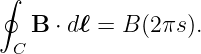
Because B is tangent to the path, points in the same direction as the traversal, and has constant
magnitude,
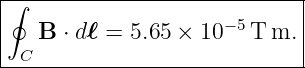
Substitute the values:
| ∮
CB ⋅ dℓ | = (1.5 × 10⁻⁴)2π(6.0 × 10⁻²) | (40)
|
| = 5.65 × 10⁻⁵ T m. | (41) |
Therefore,
Solution 2: signed enclosed current
Counterclockwise traversal as seen from +z corresponds, by the right-hand rule, to a positive
surface normal in the +z direction.
Therefore currents in +z count positive and currents in −z count negative:
| Ienc | = I1 − I2 + I3 | (43)
|
| = 5.0 − 2.0 + 1.5 | (44)
|
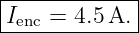
| = 4.5 A. | (45) |
Thus,
Ampère’s law then gives
| ∮
CB ⋅ dℓ | = μ0Ienc | (47)
|
| = (4π × 10−7)(4.5) | (48)
|
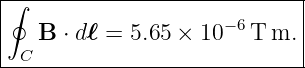
| = 5.65 × 10⁻⁶ T m. | (49) |
Therefore,
Solution 3: field around a long straight wire
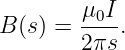
For an infinitely long straight wire,
Substitute:
| B | = 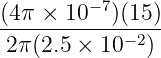 | (52)
|
| = 1.20 × 10⁻⁴ T. | (53) |
Hence,
The centered circle is useful because cylindrical symmetry guarantees that B is tangent to the
circle and that its magnitude is the same everywhere on that circle.
Solution 4: infer current from a measured field
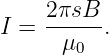
Rearrange
to obtain
Substitute:
| I | =  | (57)
|
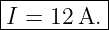
| = 12 A. | (58) |
Therefore,
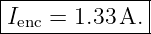
Solution 5: enclosed current inside a uniformly current-filled wire
Uniform current density means the enclosed current scales with enclosed cross-sectional
area:
Substituting,
| Ienc | = 12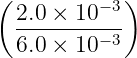 2 2 | (61)
|
| = 12 2 2 | (62)
|
| = 1.33 A. | (63) |
Thus,
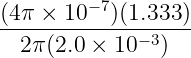
Now apply Ampère’s law:
Therefore,
| B | =  | (66)
|
| =  | (67)
|
| = 1.33 × 10⁻⁴ T. | (68) |
Hence,
Solution 6: where is the field largest in a uniform-current wire?
Inside the wire,
At s = a,
Outside the wire,
so at s = a,
Thus the two expressions agree at the surface; the field is continuous there.
Numerically,
| B(a) | = 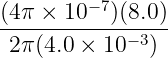 | (74)
|
| = 4.0 × 10⁻⁴ T. | (75) |
Therefore,
Inside, B ∝ s, so the field rises with radius. Outside, B ∝ 1∕s, so it falls with radius. Therefore the
maximum occurs at the surface s = a.
Solution 7: field outside a finite-radius wire
Outside the wire, the Amperian loop encloses the full current. Therefore,
Substitute:
| B | = 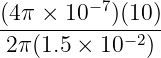 | (78)
|
| = 1.33 × 10⁻⁴ T. | (79) |
So,
Once the observation point lies outside the conductor, Ampère’s law depends only on the total
enclosed current and the observation radius. The detailed distribution of that current inside the
wire does not affect this symmetry result.
Solution 8: ideal long-solenoid field
For an ideal long solenoid,
Substitute:
| B | = (4π × 10−7)(1500)(0.60) | (82)
|
| = 1.13 × 10⁻³ T. | (83) |
Therefore,
Solution 9: design the turn density of a solenoid
From
solve for n:
Substituting,
| n | = 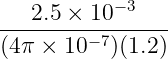 | (87)
|
| ≈ 1.66 × 10³ turns/m. | (88) |
Thus,
The turn count for L = 0.30 m is
| N | = nL | (90)
|
| ≈ (1.658 × 10³)(0.30) | (91)
|
| ≈ 497. | (92) |
Therefore about
are required.
Solution 10: ideal-toroid field
For an ideal toroid,
Substitute:
| B | = 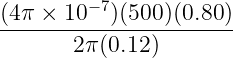 | (95)
|
| = 6.67 × 10⁻⁴ T. | (96) |
Thus,
Solution 11: choose the useful Amperian path
- Useful. A circle centered on an infinitely long straight wire matches cylindrical
symmetry. The field is tangent to the circle and has constant magnitude on it.
- Not useful for directly solving for B. Ampère’s law remains true, but the distance
to the wire varies around the off-center circle. Thus the field magnitude is not constant
and the field is not everywhere tangent to that circle.
- Useful under the ideal long-solenoid approximation. The interior long side is
parallel to the nearly uniform interior field, the exterior long side lies where the idealized
field is negligible, and the short sides are perpendicular to B.
- Generally not useful for directly solving the local field. Ampère’s law still
gives the total circulation, but neither field direction nor magnitude is generally simple
enough along an arbitrary irregular loop to extract a single B.
The distinction is important: the law remains valid under magnetostatic conditions even when a
particular path does not simplify the unknown field.
Solution 12: derive the inside-wire field from current density
For uniform current density J0, the enclosed current within radius s < a is
Cylindrical symmetry gives a magnetic field tangent to the circular Amperian loop and constant in
magnitude along it. Thus,
Cancel one factor of πs:
Therefore,
This form makes the linear dependence on radius especially clear.
Solution 13: differential Ampère law from a specified field
The field components are
Only the z component of the curl is nonzero:
| (∇× B)z | =  − − | (103)
|
| = α − (−α) | (104)
|
| = 2α. | (105) |
Therefore,
With α = 3.0 × 10⁻⁴ T/m,
Using
we obtain
| J | =  z z | (109)
|
| = 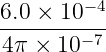 z z | (110)
|
| ≈ 4.77 × 10²z A/m2. | (111) |
Thus,
Solution 14: magnetostatic limitation and Maxwell’s correction
The simple form
is the magnetostatic form of Ampère’s law. It assumes steady currents and therefore does
not contain all sources of magnetic-field circulation in a time-varying electromagnetic
system.
Maxwell’s correction adds a term proportional to the time rate of change of electric
flux:
The extra term depends on
the rate at which electric flux through a surface bounded by C changes with time. This term allows
a changing electric field to act as a source of magnetic-field circulation even where no conduction
current crosses the surface.
That correction is essential for the later development of electromagnetic waves and antenna
radiation.
Common mistakes
- Mistake: assuming every closed path makes Ampère’s law easy to solve. The law
gives circulation; symmetry determines whether B can be removed from the integral.
- Mistake: using total current when the loop encloses only part of a distributed current.
- Mistake: ignoring the orientation sign of current through the chosen surface.
- Mistake: assuming an off-center circular path around a straight wire has constant B.
- Mistake: treating ideal solenoid and toroid expressions as exact for every finite winding
geometry.
- Mistake: applying the magnetostatic law without modification to time-varying
antenna currents.
What EM12E reinforces
The key working sequence is
For magnetostatics,
and
are two forms of the same physical law, linked by Stokes’ theorem.
The next stage of the series can now move into time-varying fields, where Maxwell’s correction
becomes essential.
References
[1] David J. Griffiths, Introduction to Electrodynamics, 4th ed., Cambridge University
Press, 2017.
[2] Edward M. Purcell and David J. Morin, Electricity and Magnetism, 3rd ed.,
Cambridge University Press, 2013.
[3] Samuel J. Ling, Jeff Sanny, and William Moebs, University Physics, Volume 2,
OpenStax, 2016, sections on Ampère’s law, solenoids, and toroids.
[4] Richard P. Feynman, Robert B. Leighton, and Matthew Sands, The Feynman Lectures
on Physics, Volume II, Addison-Wesley, 1964, chapters on magnetic fields, circulation,
and Maxwell’s equations.
[5] Massachusetts Institute of Technology, 8.02 Physics II: Electricity and Magnetism,
MIT OpenCourseWare, materials on Ampère’s law, solenoids, toroids, and
magnetic-field symmetry.

![[parent]](https://images.physicslibrary.org/images/uparrow.png)