Dot-Product Algebra and Geometric Applications
The dot product is bilinear:
In Cartesian components,
Example 1
For u = (2,−1, 3) and v = (0, 2, 4),
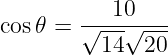
Hence
and 𝜃 ≈ 53.3∘.
Example 2: angle in a semicircle
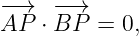
If AB is a diameter of a circle and P lies on the circle, a vector proof gives
so the inscribed angle APB is a right angle.
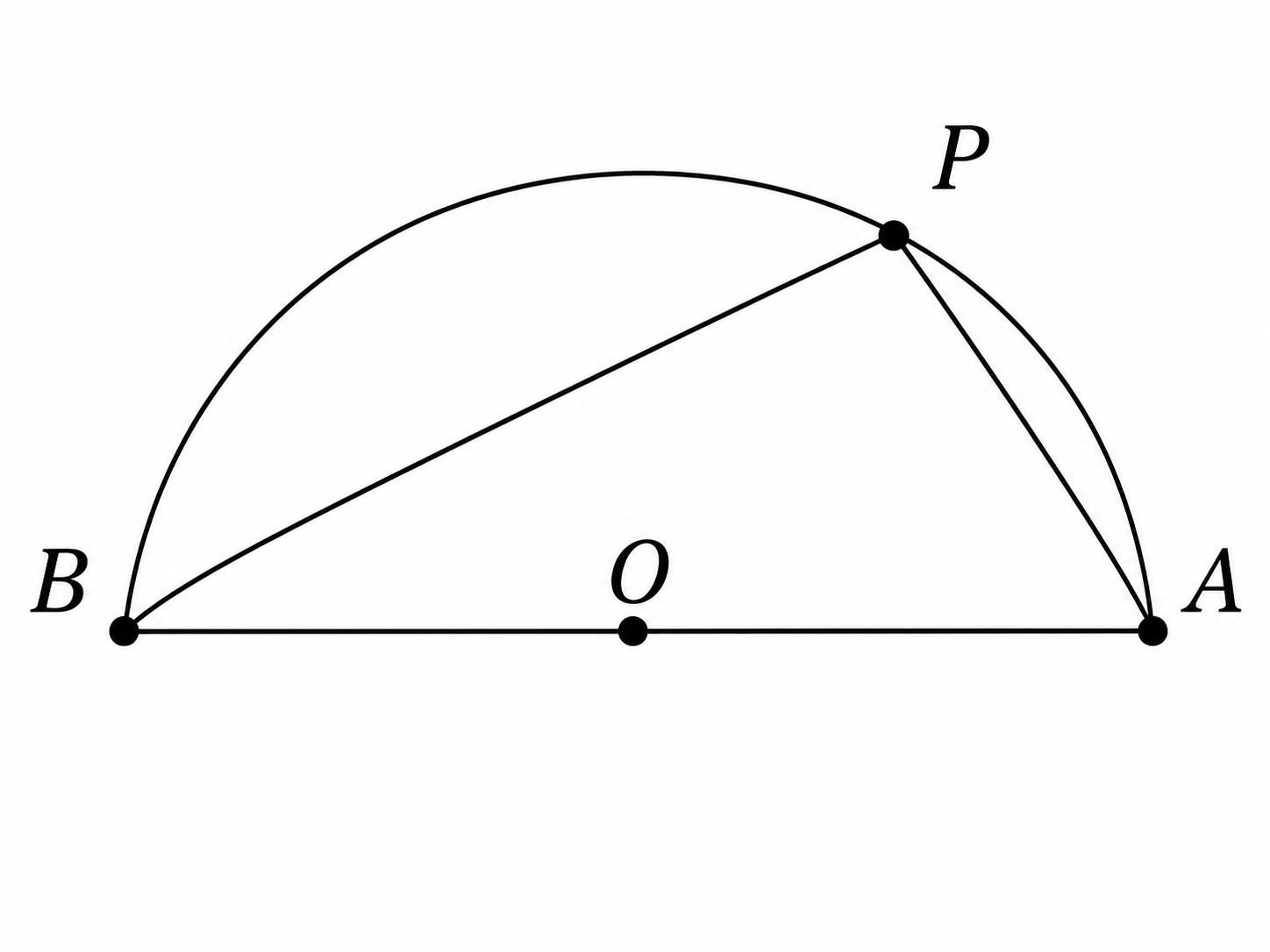
Figure 15a, modernized: dot-product proof of Thales’ theorem.
Example 3: law of cosines
For triangle ABC,
implies
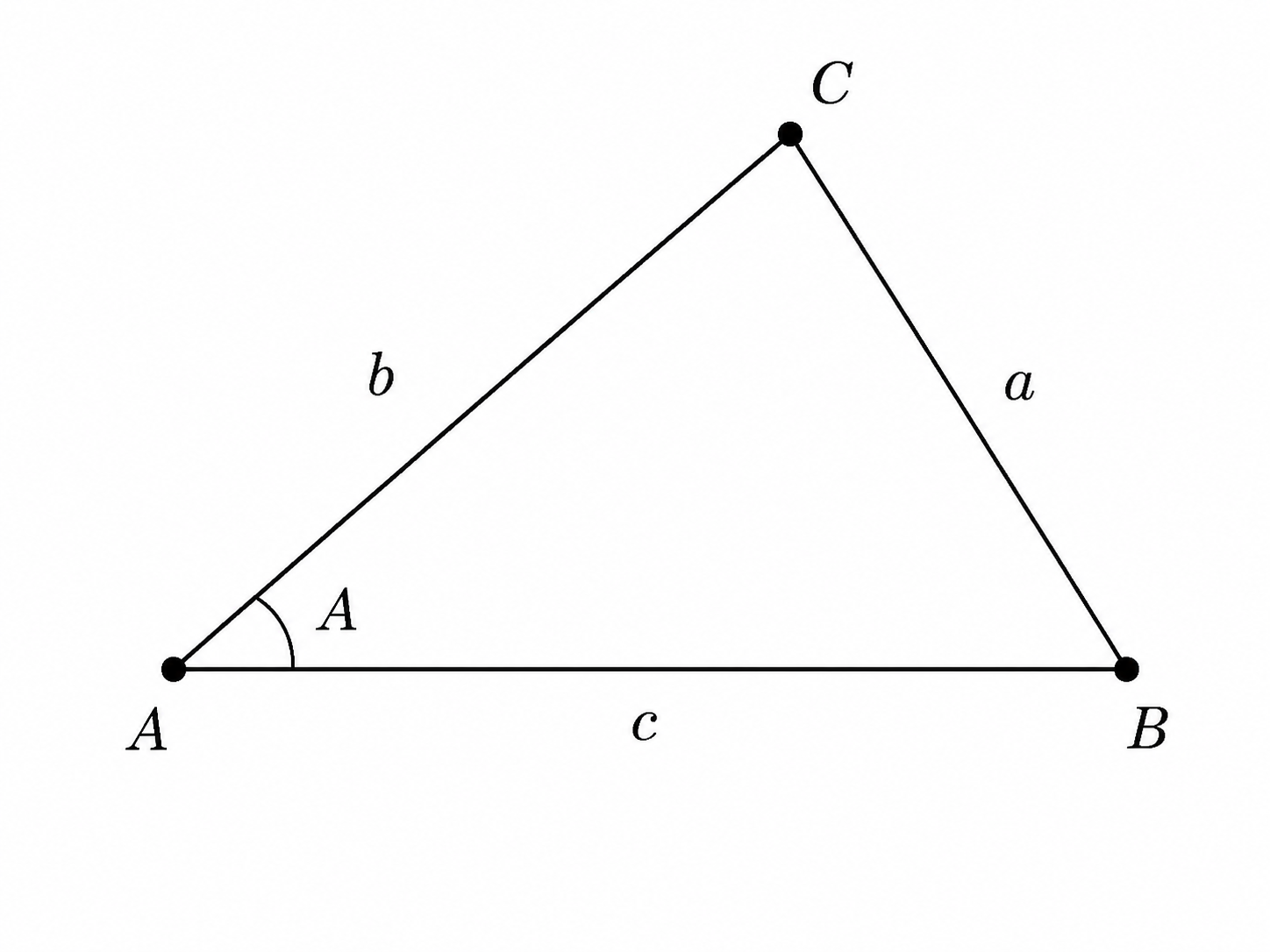
Figure 15b, modernized: vector derivation of the law of cosines.
Example 4: distance from a point to a line
For A = (3, 1,−1) and the line through B = (2, 3, 0), C = (−1, 2, 4),
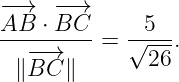
The scalar projection of  along the line is
Therefore the perpendicular distance is
Example 5: equation of a plane
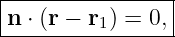
A plane through P1 = (x1,y1,z1) with Normal n = (A,B,C) satisfies
or
Thus for a plane
n = (A,B,C) is a normal vector.
Example 6: point-to-plane distance
The distance from P1 = (x1,y1,z1) to Ax + By + Cz + D = 0 is
Source problems
- Find the scalar component of (2, 3,−1) along the direction (−1,−2, 2).
- Find the component of 2î + 3ĵ + k along a line in the first octant making equal
angles with the coordinate axes.
- Find the component of î + 2ĵ −k along the direction î −ĵ + k.
- Find the angles between: (a) (1, 1, 0) and (1, 0, 1); (b) (1, 1, 1) and (1, 0, 0).
- Find the shortest distance from A = (2,−3,−4) to the line through B = (1, 2,−3) and
C = (3, 3,−5).
- Find the shortest distance from A = (1,−2, 1) to 4x − 3y + 12z − 8 = 0.
- Find the plane perpendicular to the line through A = (3, 4,−1) and B = (5, 2, 3) at
its midpoint.
- Find the angle between x − y + z + 2 = 0 and 2x + y − z + 1 = 0.
- Prove the parallelogram law
- Show that the sphere with diameter endpoints having position vectors a,b is described
by
Modern notation references
The notation and terminology in this modernized article follow standard present-day mechanics
and vector-analysis usage, particularly:
- J. R. Taylor, Classical Mechanics, University Science Books, 2005.
- D. Kleppner and R. Kolenkow, An Introduction to Mechanics, 2nd ed., Cambridge
University Press, 2014.
- H. Goldstein, C. Poole, and J. Safko, Classical Mechanics, 3rd ed., Addison–Wesley,
2002.
Source
This article is a modernized restatement of the corresponding Public Domain article in Louis
Brand, Vectorial Mechanics, John Wiley & Sons, New York, 1930, Chapter I, “Vector Algebra.”
The original 1930 edition is the source basis.

![[parent]](https://images.physicslibrary.org/images/uparrow.png)