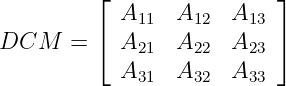
Starting with a direction cosine matrix (DCM), we need to determine the three Euler Angles. The
connection is made by comparing the DCM elements with the combined Euler 123 sequence. It is
important to note that the 12 combinations of Euler angles for a given sequence can be found from
a given DCM. The DCM matrix is
The Euler 123 sequence is
If we examine the element in coloum 1 row 3, then by inspection
A31 = sin(𝜃)
Solving for 𝜃 yields
Care must now be taken when evaluating the inverse sine. It is a multivalued function, which will
have values of 𝜃 and π − 𝜃. Analytically, the convention is to choose the principle value such
that
−π∕2 ≤ 𝜃 ≤ π∕2
If a numerical program is used, a function asin() usually does this for us. The next step is to
analyze the ratio  . Using these values from the Euler sequence we get
 =
= 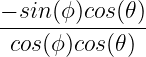
Rearranging the minus sign and using the tangent yields
tan(ϕ) = 
Solving the quadrant ambiquity caused by the inverse tangent is done by examining the signs of
the numerator and denominator. Denoting y as the numerator and x as the denominator, then the
quadrant is chosen by:
quadrant 1 ![[ ]
y x
+ +](https://images.physicslibrary.org/cache/objects/61/make4ht/DirectionCosineMatrixToEuler123Sequence7x.png)
so if x and y are both positive, then 0 ≤ ϕ ≤ π∕2. Similarily for the other quadrant
possibilites
quadrant 2 ![[ ]
y x
+ −](https://images.physicslibrary.org/cache/objects/61/make4ht/DirectionCosineMatrixToEuler123Sequence8x.png)
quadrant 3 ![[ ]
y x
− −](https://images.physicslibrary.org/cache/objects/61/make4ht/DirectionCosineMatrixToEuler123Sequence9x.png)
quadrant 4 ![[ y x ]
− +](https://images.physicslibrary.org/cache/objects/61/make4ht/DirectionCosineMatrixToEuler123Sequence10x.png)
Ofcourse, it is much simplier to use a calculator or numerical program that uses the atan2()
function which will choose the principle value. In a similar fashion we can find the final Euler angle
by looking at the ratio  which gives the relation
  =
= 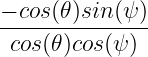
Canceling terms and rearrangeing gives us
ψ = tan−1( )
)
which uses the same method to resolove quadrant ambiguity as above. To summarize, we will give
the formulas for the conversion from a direction cosine matrix to the Euler 123 angles in Matlab
syntax. Be careful how you implement this in other numerical programs. In Matlab it goes
atan2(y,x) and in Mathematica it is ArcTan[x, y].