Definition 0.1. In Electromagnetism, the volume magnetic susceptibility, represented by
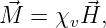
the symbol χv, is defined by
where in SI units M is the magnetization of the material (the magnetic dipole moment per
unit volume, measured in amperes per meter), and H is the magnetic field strength, also
measured in amperes per meter.
The magnetic induction B is related to H by
where μ0 is the magnetic constant and (1 + χv) is the relative permeability of the material in SI
units.
Thus, the magnetic susceptibility χv and the magnetic permeability μ are related by
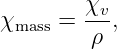
Remark 0.1. There are two other commonly used measures of susceptibility: the mass
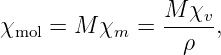
magnetic susceptibility, χg or χm, and the molar magnetic susceptibility, χmol:
and
where ρ is the density and M is the molar mass.
0.0.1 Susceptibility sign convention
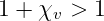
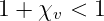
If χv is positive, then
in SI units. Materials with positive susceptibility include paramagnetic, ferromagnetic,
ferrimagnetic, and antiferromagnetic materials.
For diamagnetic materials, χv is negative, and therefore
in SI units.
0.1 Magnetic Susceptibility Tensor
For most anisotropic crystals, magnetic susceptibility cannot in general be represented by a single
scalar. Instead, it is represented by a second-rank tensor χ. The magnetization M may then
depend on the orientation of the sample and need not be parallel to the applied magnetic field
H.
The volume magnetic susceptibility tensor is defined by
with summation over the repeated index j. Here Mi is the ith component of the magnetization, Hj
is the jth component of the applied magnetic field, and χij are the components of the 3 × 3
susceptibility tensor.
References
[1] G. P. Arrighini, M. Maestro, and R. Moccia (1968). Magnetic Properties of
Polyatomic Molecules: Magnetic Susceptibility of H2O, NH3, CH4, and H2O2. J. Chem.
Phys. 49, 882–889. doi:10.1063/1.1670155.
[2] S. Otake, M. Momiuchi, and N. Matsuno (1980). Temperature Dependence
of the Magnetic Susceptibility of Bismuth. J. Phys. Soc. Jpn. 49(5), 1824–1828.
doi:10.1143/JPSJ.49.1824.
[3] J. Heremans, C. H. Olk, and D. T. Morelli (1994). Magnetic Susceptibility of Carbon
Structures. Phys. Rev. B 49(21), 15122–15125. doi:10.1103/PhysRevB.49.15122.
[4] R. E. Glick (1961). On the Diamagnetic Susceptibility of Gases. J. Phys. Chem.
65(9), 1552–1555. doi:10.1021/j100905a020.
[5] R. Dupree and C. J. Ford (1973). Magnetic susceptibility of the noble metals around
their melting points. Phys. Rev. B 8(4), 1780–1782. doi:10.1103/PhysRevB.8.1780.
[6] J. R. Zimmerman and M. R. Foster (1957). Standardization of NMR high resolution
spectra. J. Phys. Chem. 61, 282–289. doi:10.1021/j150549a006.
[7] R. Engel, D. Halpern, and S. Bienenfeld (1973). Determination of magnetic moments
in solution by nuclear magnetic resonance spectrometry. Anal. Chem. 45, 367–369.
doi:10.1021/ac60324a054.
[8] P. W. Kuchel, B. E. Chapman, W. A. Bubb, P. E. Hansen, C. J. Durrant, and M.
P. Hertzberg (2003). Magnetic susceptibility: solutions, emulsions, and cells. Concepts
Magn. Reson. A 18, 56–71. doi:10.1002/cmr.a.10066.
[9] K. Frei and H. J. Bernstein (1962). Method for determining magnetic susceptibilities
by NMR. J. Chem. Phys. 37, 1891–1892. doi:10.1063/1.1733393.
[10] R. E. Hoffman (2003). Variations on the chemical shift of TMS. J. Magn. Reson.
163, 325–331. doi:10.1016/S1090-7807(03)00142-3.