1 Introduction
In mathematics and theoretical physics, covariance and contravariance are concepts used in many
areas, generalizing in a sense invariance, i.e., the property of being unchanged under some
transformation. In mathematical terms, they occur in a foundational way in linear algebra and
multilinear algebra, Differential Geometry and other branches of geometry, category theory and
algebraic topology. In physics they are important to the treatment of vectors and other
quantities, such as tensors, that have physical meaning but are not scalars. Both special
relativity (Lorentz covariance) and general relativity (general covariance) use covariant basis
vectors.
In very general terms, duality interchanges covariance and contravariance, which is why
these concepts occur together. For purposes of practical computation using matrices,
the transpose relates two aspects (for example, two sets of simultaneous equations).
The case of a square matrix for which the transpose is also the inverse matrix, that is,
an orthogonal matrix, is one in which covariance and contravariance can typically be
treated on the same footing. This is of basic importance in the practical application of
tensors.
A major potential cause of confusion is that this duality of covariance/contravariance intervenes
every time discussion of a vector or tensor quantity is represented by its components.
This causes discussion in the mathematics and physics literature often apparently to
be using opposite conventions. It is not the convention that differs, but whether an
intrinsic or component-wise description is the primary way of thinking of quantities. This
depends on whether one is using a fixed background—a fact that switches the point of
view.
2 Contravariant
Contravariant is a mathematical term with a precise definition in tensor analysis. It specifies the
method used to derive the components by projecting the tensor quantity onto the coordinate
system being used as the basis of the tensor.
Another method is used to derive covariant tensor components. When performing tensor
transformations it is critical that the method used to map to the coordinate systems in
use be tracked so that operations may be applied correctly for accurate, meaningful
results.
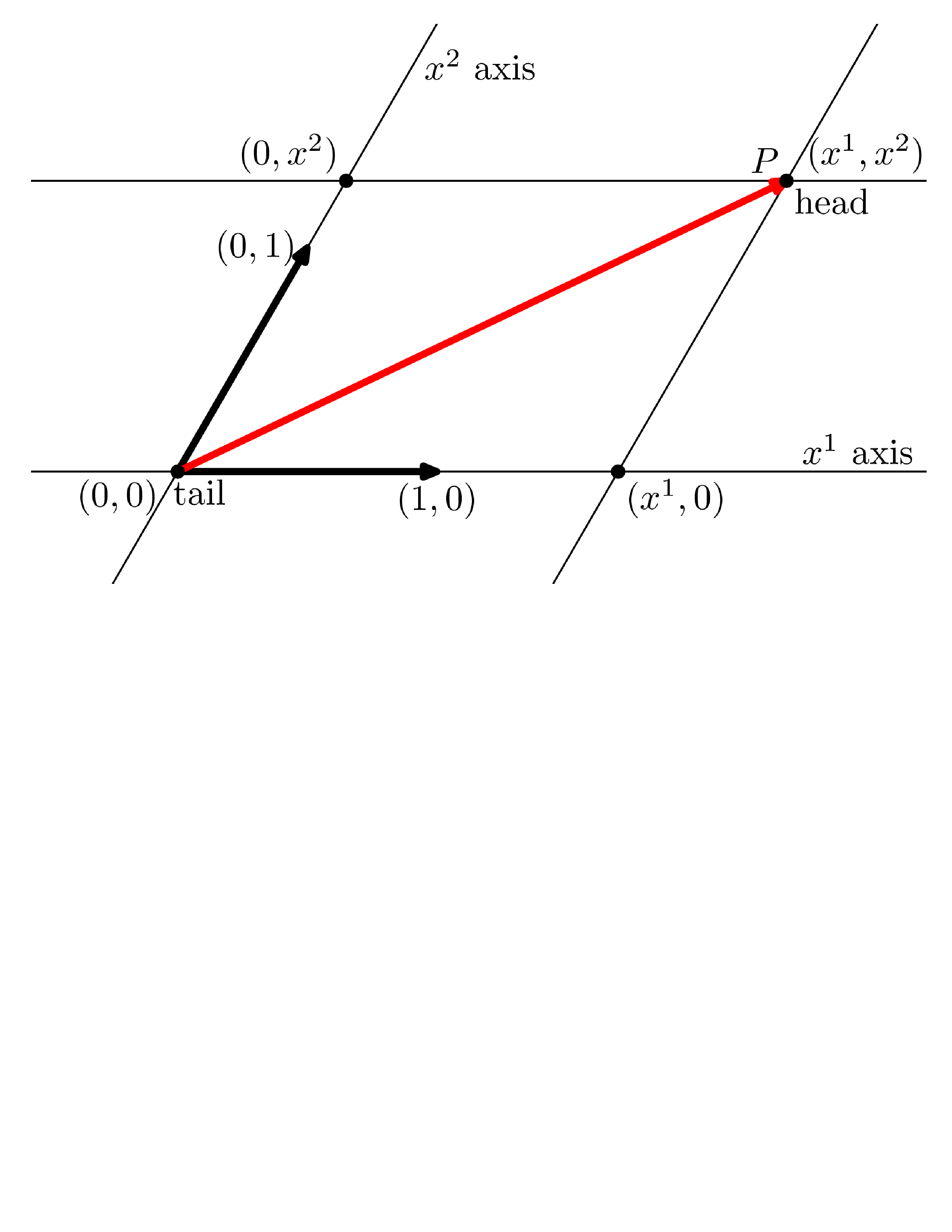
In two dimensions, for an oblique rectilinear coordinate system, contravariant coordinates of a
directed line segment can be established by placing the origin of the coordinate axes
at the tail of the vector. Parallel lines are placed through the head of the vector. The
intersection of the line parallel to the x1 axis with the x2 axis provides the x2 coordinate.
Similarly, the intersection of the line parallel to the x2 axis with the x1 axis provides the x1
coordinate.
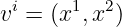
By definition, the oblique, rectilinear, contravariant coordinates of the point P above are
summarized as
Notice the superscript; this is a standard nomenclature convention for contravariant tensor
components and should not be confused with the subscript, which is used to designate covariant
tensor components.
Is there a fundamental difference in the way contravariant and covariant components can be used,
or could one simply interchange them everywhere? The answer is that in curved spaces, or in
curved coordinate systems in flat space (e.g. Cylindrical coordinates in Euclidean space), the
quantity dxi is a coordinate differential, whereas the corresponding covariant components dx
i are
obtained by lowering the index with the metric and need not themselves be coordinate differentials.
In cylindrical coordinates, for example, the angular terms acquire metric factors involving
r.
Using the definition above, the contravariant components of a position vector vi, where i = 1, 2,
can be defined as the differences between the coordinates of the head and tail on the same
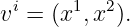
coordinate axis. Since we have placed the origin at the tail of the vector,
and hence
This result is generalized to n dimensions. Contravariance is a fundamental concept within tensor
theory and applies to tensors of all ranks over manifolds. Since whether tensor components are
contravariant or covariant, how they are mixed, and the order of operations all affect the results, it
is important to track the index positions carefully.
In modern differential-geometric language, contravariant components are associated with tangent
vectors and covariant components with covectors.
3 Use in tensor analysis
In tensor analysis, a covariant vector varies reciprocally, in the appropriate transformation-law
sense, to a corresponding contravariant vector. Expressions for lengths, areas and volumes of
objects in the vector space can then be given in terms of tensors with covariant and contravariant
indices.
On a manifold, a tensor field will typically have multiple indices, of two sorts. By a widely followed
convention, covariant indices are written as lower indices, whereas contravariant indices are upper
indices. When the manifold is equipped with a metric, covariant and contravariant indices become
closely related. Contravariant indices can be turned into covariant indices by contraction
with the metric tensor, and covariant indices can be raised using the inverse metric
tensor. In general, no such identification exists without additional structure such as a
metric.
The explanation in geometric terms is that a general tensor may have contravariant as well as
covariant indices because it is built from tangent vectors and cotangent vectors.
4 Algebra and geometry
In category theory, there are covariant functors and contravariant functors. The dual-space
construction is a standard example of a contravariant construction. Some constructions of
multilinear algebra are of mixed variance. In algebraic topology, homology is covariant while
cohomology is contravariant.
In differential geometry, tangent vectors transform by the differential (pushforward) of a
smooth map, while covectors and differential forms transform naturally by pullback. This
distinction is crucial in applications: for example, a differential form can be pulled back to a
submanifold, whereas a tangent-vector field does not admit an analogous unrestricted
pullback.
Under a coordinate transformation, contravariant tensor components transform with the Jacobian
of the new coordinates with respect to the old, while covariant tensor components transform with
the inverse Jacobian.
5 References
This entry is a derivative of the covariance and contravariance article from Wikipedia, the Free
Encyclopedia. Authors of the original article include Kevin Baas, AugPi, Charles Matthews,
Maximus Rex, and Michael Hardy. The history page of the original is here.