|
|
|
|||||||
and
For each function, determine its support relative to [0, 1]. Which of these functions belongs to Cc∞(0, 1)?
Exercise 2: Build a localized bumpConstruct explicitly a nonnegative smooth bump function centered at
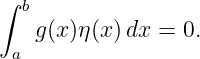
with support contained in
State the properties of the function that are important in the proof of the Fundamental Lemma.
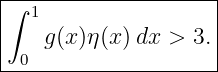
Exercise 3: Quantitative contradiction estimateSuppose g ∈ C([0, 1]) and
at some x0 ∈ (0, 1). Continuity provides a radius r > 0 such that
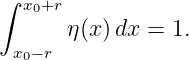
whenever |x − x0| < r. Let η ∈ Cc∞(x 0 − r,x0 + r) satisfy
Prove that
Explain why this contradicts the hypothesis of the Fundamental Lemma.
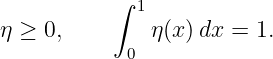
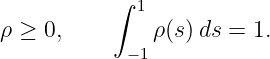
Exercise 4: A normalized bump sequence acts like a local probeLet ρ ∈ Cc∞(−1, 1) satisfy
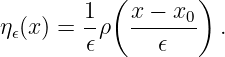
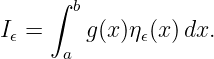
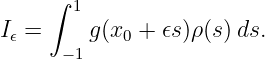
For x0 ∈ (a,b) and sufficiently small 𝜖 > 0, define
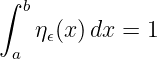
Show that
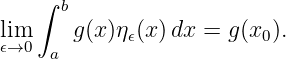
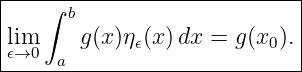
and prove that for every continuous g,
Exercise 5: A finite collection of tests has a blind spotOn [−1, 1], define two test functions
Find a nonzero quadratic function of the form
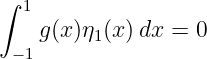
such that
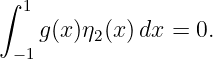
and
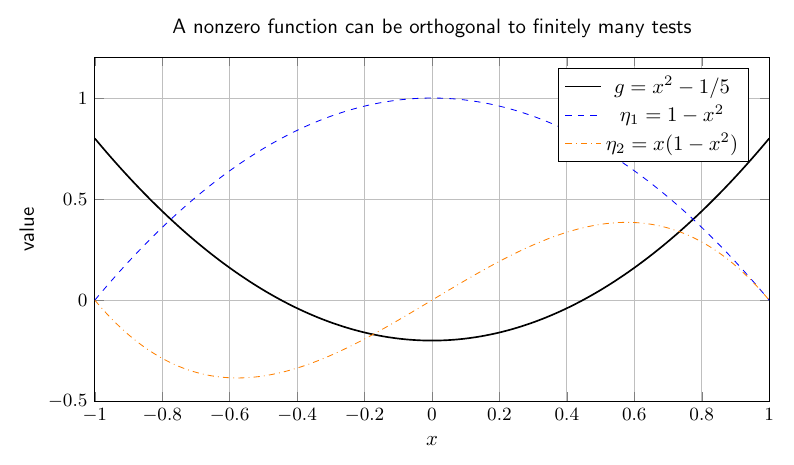
What does this demonstrate about testing against finitely many directions?
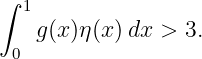
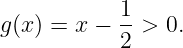
Exercise 6: A global average can hide a local signLet
Show that
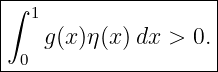
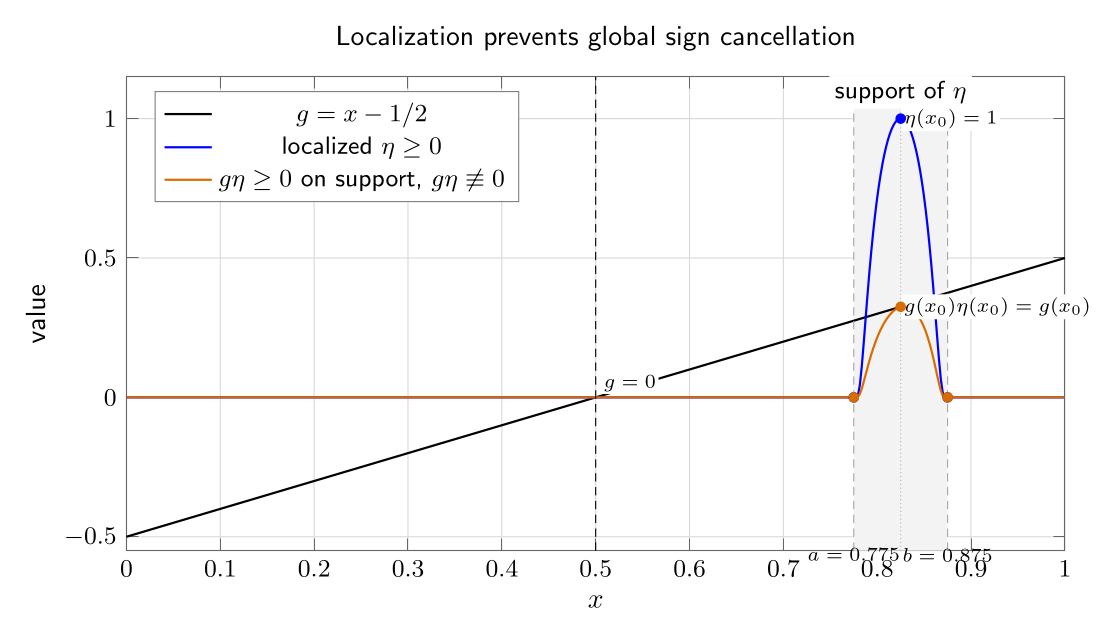
Now let η be any nonnegative, nonzero smooth bump supported in (3∕4, 9∕10). Determine the sign of
Explain the localization principle illustrated by this comparison.
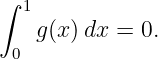
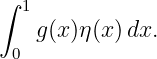
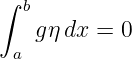
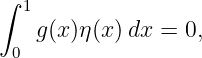
Exercise 7: Why one cannot cancel the test functionSuppose
Give two distinct mathematical reasons why the formal step
is not justified from this single integral equation. Use a concrete example to support your explanation.
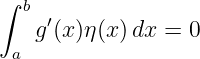
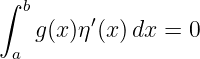
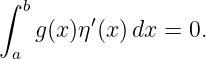
Exercise 8: Zero weak derivative implies a constantSuppose g ∈ C1([a,b]) and
for every η ∈ Cc∞(a,b). Prove that g is constant on [a,b].
2 Solutions
Solution 1: Support and compact supportThe support of a function is the closure of the set on which it is nonzero. For
the function is nonzero for every 0 < x < 1. Therefore
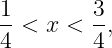
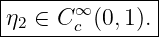
It vanishes at the endpoints, but its support reaches the boundary of the open interval (0, 1). Hence it is not compactly supported inside (0, 1). For η2, the function is nonzero precisely for
so
The standard exponential bump joins smoothly to zero with all derivatives vanishing at the endpoints of its support. Thus
For
the function is again nonzero throughout (0, 1) and vanishes only at the two endpoints. Therefore
so η3 is not compactly supported inside (0, 1) even though it satisfies fixed-endpoint conditions. This distinction is why the compact-support formulation and the fixed-endpoint formulation are related but not identical descriptions of the test class.
Solution 2: Build a localized bumpTake
and define
Then
The properties important to the Fundamental-Lemma proof are:
The exact exponential formula is secondary. The localization and sign properties are what drive the proof.
Solution 3: Quantitative contradiction estimateBecause η is supported inside (x0 − r,x0 + r),
On this support,
and
Therefore
Since η vanishes outside that interval and is normalized,
Hence
This cannot be reconciled with a hypothesis asserting that the same integral is zero for every test function. A nonzero value of continuous g has therefore been detected by a local probe.
Solution 4: A normalized bump sequence acts like a local probeFirst compute the integral of η𝜖. Substitute
Because ρ is supported in (−1, 1),
Now consider
The same substitution gives
Subtract g(x0), using the normalization of ρ:
Hence
The last integral equals one, so
Continuity of g at x0 makes the right-hand side tend to zero as 𝜖 → 0. Therefore
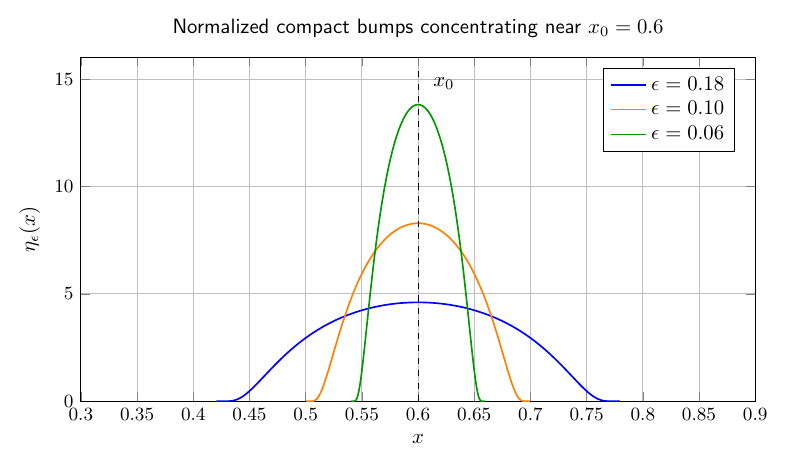
Figure. A normalized family of bumps becomes narrower and taller while retaining unit area. Integrating a continuous g against these test functions increasingly samples only the behavior near x0. This is a precise mathematical version of the statement that test functions act as local probes.
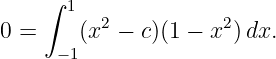
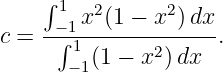
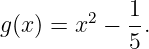
Solution 5: A finite collection of tests has a blind spotWe seek
For the first test function,
Thus
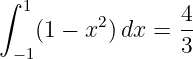
Compute
and
Therefore
So
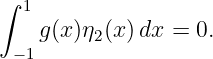
For the second test function,
The first and third factors are even and the middle factor x is odd, so the entire product is odd. Its integral over the symmetric interval [−1, 1] therefore vanishes automatically:
Figure. The nonzero quadratic g = x2 − 1∕5 is orthogonal to both selected test functions. Finitely many test directions leave an infinite-dimensional space of possible undetected functions. The Fundamental Lemma avoids this blind spot by requiring the identity for an entire separating class of localized test functions.
Solution 6: A global average can hide a local signDirectly,
Thus the global average does not reveal that g changes sign. On the interval (3∕4, 9∕10),
If η is nonnegative, nonzero, and supported there, then
and is positive on a set of positive measure. Hence
Figure. The unweighted global integral cancels positive and negative contributions. A localized nonnegative bump placed entirely in a positive region cannot experience that cancellation. This is the essence of localization: the test function can suppress irrelevant parts of the domain and interrogate one chosen neighborhood.
Solution 7: Why one cannot cancel the test functionThere are at least two independent problems with the proposed cancellation. First, an integral equation is not a pointwise equation. From
one cannot conclude
at every point. Positive and negative contributions may cancel. Second, test functions typically have zeros. Even if the product were known to vanish pointwise, division by η(x) would not be valid where η(x) = 0. For a concrete example on [0, 1], take
As shown in CV03E1,
but neither g nor gη is identically zero. The correct argument is not cancellation. It is the ability to choose many localized test functions, including ones supported entirely inside any neighborhood where a continuous g has a definite sign.
Solution 8: Zero weak derivative implies a constantStart with
Integrate by parts:
Because η has compact support inside (a,b), it vanishes near both endpoints, so
Therefore
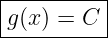
for every η ∈ Cc∞(a,b). Since g′∈ C([a,b]), the Fundamental Lemma gives
throughout (a,b). Hence
for some constant C on [a,b]. This exercise is the simplest example of a weak-derivative statement: a function whose distributional derivative is zero is constant (with suitable connectedness assumptions).
3 SummaryLocalization is the operational content of the Fundamental Lemma. Smooth bump functions can be placed inside arbitrarily small neighborhoods, normalized to behave as local averaging probes, and varied independently enough to eliminate the blind spots left by any finite collection of test directions. That is why an integral identity valid for all test functions can force a pointwise or almost-everywhere conclusion. "Calculus of Variations Examples: Localization and Test Functions" is owned by bloftin.
This object's parent. Cross-references: force, CV03E1, domain, identity, unit, formula, boundary, integral equation, testing, functions, works This is version 1 of Calculus of Variations Examples: Localization and Test Functions, born on 2026-09-10. Object id is 1147, canonical name is CalculusOfVariationsExamplesLocalizationAndTestFunctions. Accessed 253 times total. Classification:
|
|
|
|
Pending Errata and AddendaNone.
|
DiscussionNo messages.
|
Interact |
![[parent]](https://images.physicslibrary.org/images/uparrow.png)












![supp η = [0,1].
1](https://images.physicslibrary.org/cache/objects/1147/make4ht/CalculusOfVariationsExamplesLocalizationAndTestFunctions24x.png)
![[ ]
1- 3-
supp η2 = 4 ,4 .](https://images.physicslibrary.org/cache/objects/1147/make4ht/CalculusOfVariationsExamplesLocalizationAndTestFunctions26x.png)

![supp η3 = [0,1],](https://images.physicslibrary.org/cache/objects/1147/make4ht/CalculusOfVariationsExamplesLocalizationAndTestFunctions29x.png)

![( [ ]
{ ----------1-----------
η(x) = exp − 1 − ((x − 0.60 )∕0.10 )2 , |x − 0.60 | < 0.10,
(
0, |x − 0.60 | ≥ 0.10.](https://images.physicslibrary.org/cache/objects/1147/make4ht/CalculusOfVariationsExamplesLocalizationAndTestFunctions31x.png)
![supp η = [0.50,0.70].](https://images.physicslibrary.org/cache/objects/1147/make4ht/CalculusOfVariationsExamplesLocalizationAndTestFunctions32x.png)






![∫
1
I𝜖 − g(x0) = [g(x0 + 𝜖s) − g(x0)]ρ(s)ds.
−1](https://images.physicslibrary.org/cache/objects/1147/make4ht/CalculusOfVariationsExamplesLocalizationAndTestFunctions43x.png)






![∫ 1( ) [ 2 ]1
x − 1- dx = x--− x- = 0.
0 2 2 2 0](https://images.physicslibrary.org/cache/objects/1147/make4ht/CalculusOfVariationsExamplesLocalizationAndTestFunctions56x.png)



![∫ ∫
b ′ b b ′
g η dx = [gη]a − g ηdx.
a a](https://images.physicslibrary.org/cache/objects/1147/make4ht/CalculusOfVariationsExamplesLocalizationAndTestFunctions65x.png)
![b
[gη]a = 0.](https://images.physicslibrary.org/cache/objects/1147/make4ht/CalculusOfVariationsExamplesLocalizationAndTestFunctions66x.png)