|
If you've ever gone on a hike, you have probably been eager to see what lies just around the next bend in the path. Researchers are no different, and astronomers and engineers are working on the technologies that will allow us to explore even more distant parts of the universe and to see them more clearly.
The premier space facility planned for the next decade is the James Webb space telescope (Figure 6.27), which was launched on December 25, 2021. James Webb was one of the early administrators in NASA. As we write this (in December 2021), the telescope is on its way to a stable orbit point, some 1.5 million kilometers from Earth (where no astronauts can currently travel if the facility needs repair). During its 29-day journey, a number of activities must be successfully executed in order to prepare the JWST to make observations. A solar array will be deployed to provide energy, and a sunshield will be stretched out to protect the telescope from the intense heat of the Sun. The secondary and primary mirrors will then be unfolded. The primary mirror is 6 meters in diameter, made up, like the Keck telescopes, of 36 small hexagons. JWST has been designed to operate at infrared wavelengths and will have the sensitivity needed to detect the very first generation of stars, formed when the universe was only a few hundred million years old.
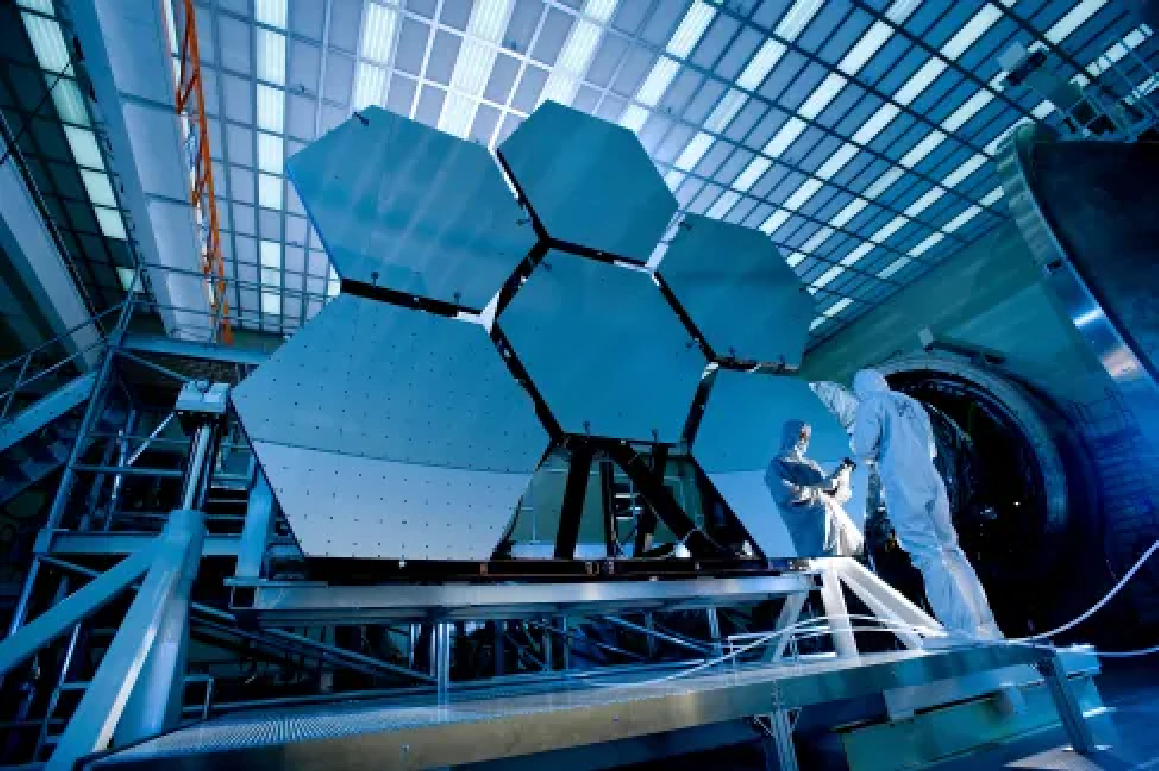
Figure 6.27 James Webb Space Telescope (JWST). This image shows some of the mirrors of the JWST as they underwent cryogenic testing. The mirrors were exposed to extreme temperatures in order to gather accurate measurements on changes in their shape as they heated and cooled. (credit: NASA/MSFC/David Higginbotham/Emmett Given)
Watch the video to learn more about the James Webb Space Telescope and how it will build upon the work that Hubble has allowed us to begin in exploring the universe. Visit NASA's James Webb Space Telescope site to keep track of how the JWST is doing.
On the ground, astronomers have started building the Vera Rubin Observatory,1 which has an 8.4-meter telescope with a significantly larger field of view than any existing telescopes. It will rapidly scan the sky to find transients, phenomena that change quickly, such as exploding stars and chunks of rock that orbit near Earth. It is expected to see first light in 2022.
The international gamma-ray community is planning the Cherenkov Telescope Array (CTA), two arrays of telescopes, one in each hemisphere, which will indirectly measure gamma rays from the ground. The CTA will measure gamma-ray energies a thousand times as great as the Fermi telescope can detect.
Several groups of astronomers around the globe interested in studying visible light and the infrared are exploring the feasibility of building ground-based telescopes with mirrors larger than 30 meters across. Stop and think what this means: 30 meters is one-third the length of a football field. It is technically impossible to build and transport a single astronomical mirror that is 30 meters or larger in diameter. The primary mirror of these giant telescopes will consist of smaller mirrors, all aligned so that they act as a very large mirror in combination.
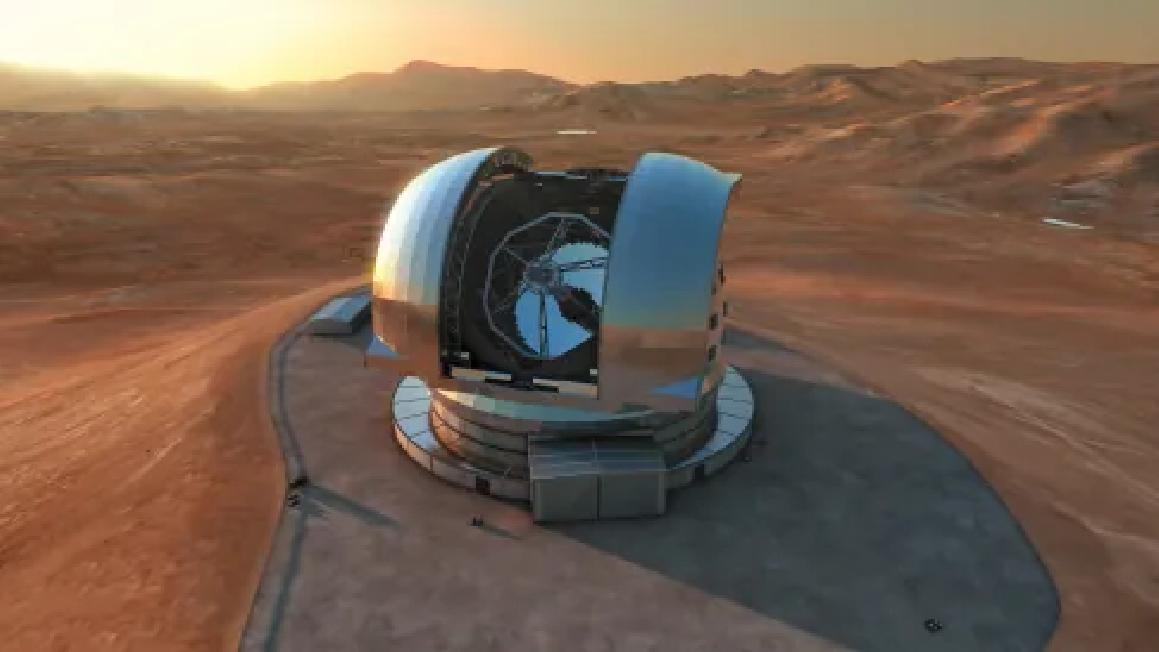
The most ambitious of these projects is the European Extremely Large Telescope (ELT) (Figure 6.28). (Astronomers try to outdo each other not only with the size of these telescopes, but also their names!) The design of the European ELT calls for a 39.3-meter primary mirror, which will follow the Keck design and be made up of 798 hexagonal mirrors, each 1.4 meters in diameter and all held precisely in position so that they form a continuous surface. Construction on the site in the Atacama Desert in Northern Chile started in 2014, and operations are expected to begin in about 2025.
International consortia with major contributions from U.S. astronomers have developed plans for the construction of two large new telescopes. One is a Thirty-Meter Telescope (TMT) for which the preferred site is Maunakea in Hawaii. The design of this telescope is similar to that of the European ELT and will make use of 492 hexagonal elements. Each segment is about 1.44 meters (56.6 inches) across corners. The segments are closely spaced, with gaps between the segments only 2.5 mm (0.1 inch) wide.
The Giant Magellan Telescope (GMT) is the second ELT project with major participation by U.S. astronomers. The GMT is also a segmented mirror telescope that employs seven stiff monolith 8.4-meter mirrors as segments. Construction has started at the selected site, which is near the Las Campanas Observatory on the southern edge of the Atacama Desert.
These giant telescopes will combine light-gathering power with high-resolution imaging. These powerful new instruments will enable astronomers to tackle many important astronomical problems. As just one example, they provide us images and spectra of planets around other stars and thus, perhaps, give us the first real evidence (from the chemistry of these planets' atmospheres) that life exists elsewhere.
Figure 6.28 Artist's Conception of the European Extremely Large Telescope. The primary mirror in this telescope is 39.3 meters across. The telescope is under construction in the Atacama Desert in Northern Chile. (credit: ESO/L. Calçada)
Check out the fun diagram comparing the sizes of the largest planned and existing telescopes to a regulation basketball and tennis court.
Access for free at openstax.org.
This entry is a derivative work of the original March 9, 2022 release identified in [1].
[1] Andrew Fraknoi, David Morrison, and Sidney C. Wolff, Astronomy 2e. Houston, Texas: OpenStax, March 9, 2022. Digital ISBN 978-1-951693-50-3. Textbook content produced by OpenStax in this edition is licensed under the Creative Commons Attribution 4.0 International License (CC BY 4.0), except where otherwise noted. Changes: converted to LaTeX for PhysicsLibrary. Access for free at openstax.org.
Footnotes
- 1
- The observatory is named after the American astronomer whose work led us to the understanding that much of the universe is made of a mysterious substance that scientists call dark matter (which we explain in The mass of the Galaxy).
|