The Wien Displacement Law can be used to find the peak wavelength of a blackbody at a
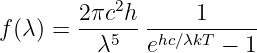
given temperature. Planck’s radiation law gives us a function of λ and temperature
so we can find the maximum of this function and hence the peak wavelength emitted
[1].
So for a given T we have
To find the peak of this function differentiate with respect to λ and set it equal to 0
Use the product rule to carry out this differentiation
Next use the chain rule to get
Apply the chain rule again
Multiply both sides by λ6(ehc∕λkT − 1)
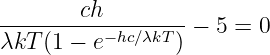
Pull the e term into the denominator and divide out 2πc2h to get
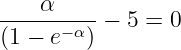
This leaves us with a transendental function, which must be solved numerically
Set α =  and substitute into above
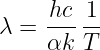
After solving this equation for α, the result yields Wien’s Law
rearranging
A simple way to find α is to use Newton’s Method. This can be done by hand or with your
favorite numerical program. Some matlab routines have been attached to see how to get
α.
To use Newton’s Method we need we rewrite and arrange (8) to get
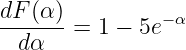
We also need the first derivative of this so
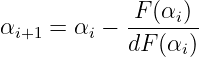
Then through iteration we can converge on the solution
For our accuracy needs we choose 1x10⁻⁸ so we stop iterating when
In matlab you can run WienConstant.m which depends on fWien.m and dfWien.m and will get a
value for α. So we see
Plugging this value into (10) and evaluating the other constants yields the Wien Displacement
Law, which gives the peak wavelength for a given temperature of a blackbody.
Note that the temperature must be in Kelvin [K] and then λ will have units of meters [m]. At
different temperatures a blackbody’s peak wavelength is displaced, hence the name Wien’s
Displacement Law.
[1] Krane, K., ”Modern Physics.” Second Edition. New York, John Wiley & Sons, 1996.










![2.897x10 −3 [Km ]
λ = -----------------
T](https://images.physicslibrary.org/cache/objects/20/make4ht/WienDisplacementLaw16x.png)