Wave Mechanics: Average Power of a Sinusoidal Wave
WM19 derived the instantaneous power carried by a transverse wave on an ideal stretched
string,
For the right-moving sinusoidal wave
WM19 obtained
The instantaneous power oscillates between zero and a maximum value. In many measurements,
however, the quantity of greatest interest is the power averaged over one or many complete cycles.
WM20 derives that average carefully and develops several equivalent forms and physical
interpretations.
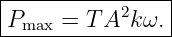
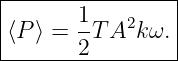
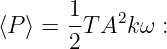
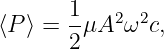
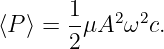
The central result is
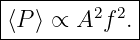
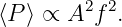
For fixed string properties, average power therefore scales as the square of both amplitude and
frequency [1, 2, 3].
1 Instantaneous power is not constant
Define the phase
Then the instantaneous power is
where
Because
we have
for this right-moving wave.

Figure. Normalized instantaneous power varies as sin 2𝜃. The horizontal dashed line shows
the cycle average, one-half of the peak power.
Notice an important point: the average displacement of a sinusoidal wave over one cycle is zero,
but its average power is not zero. Power depends quadratically on the wave amplitude through
products of derivatives, not linearly on the displacement itself.
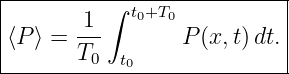
2 Definition of the time average
Let the temporal period be
The average power at a fixed position x over one period is
For a periodic steady wave, the result does not depend on the starting time t0 as long as the
averaging interval spans a complete period.
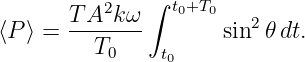
Substitute
Then
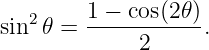
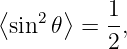
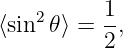
3 Why the average of sine squared is one-half
At fixed x,
so
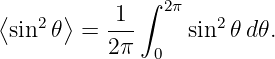
During one temporal period, the phase changes by 2π. Therefore averaging over time is equivalent
to averaging sin 2𝜃 over one complete phase cycle:
Use
Then
 | =  ∫
02π ∫
02π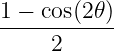 d𝜃 d𝜃 | (18)
|
| =  ![[π ]](https://images.physicslibrary.org/cache/objects/1187/make4ht/WaveMechanicsAveragePowerOfASinusoidalWave21x.png) | (19)
|
| =  . . | (20) |

Figure. The cycle average of sin 2𝜃 is 1∕2. Geometrically, the area under one complete
cycle equals the area of a rectangle of the same width and height 1∕2.
4 Average power in the first useful form
Since
we obtain
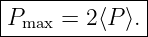
The peak and average powers are therefore related by
This factor of two is specific to the sinusoidal sin 2 variation.
5 Equivalent form using linear mass density and wave speed
For an ideal string,
so
Also,
or
Substitute into
| ⟨P⟩ | =  (μc2)A2 (μc2)A2 ω ω | (29)
|
| =  μA2ω2c . μA2ω2c . | (30) |
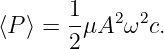
This is one of the most useful engineering forms because it separates the wave amplitude and
frequency from the medium properties [3, 1].
6 Frequency form
Using
we obtain
| ⟨P⟩ | =  μA2(2πf)2c μA2(2πf)2c | (32)
|
| = 2π2μA2f2c . | (33) |
For a fixed string, meaning fixed μ and c,
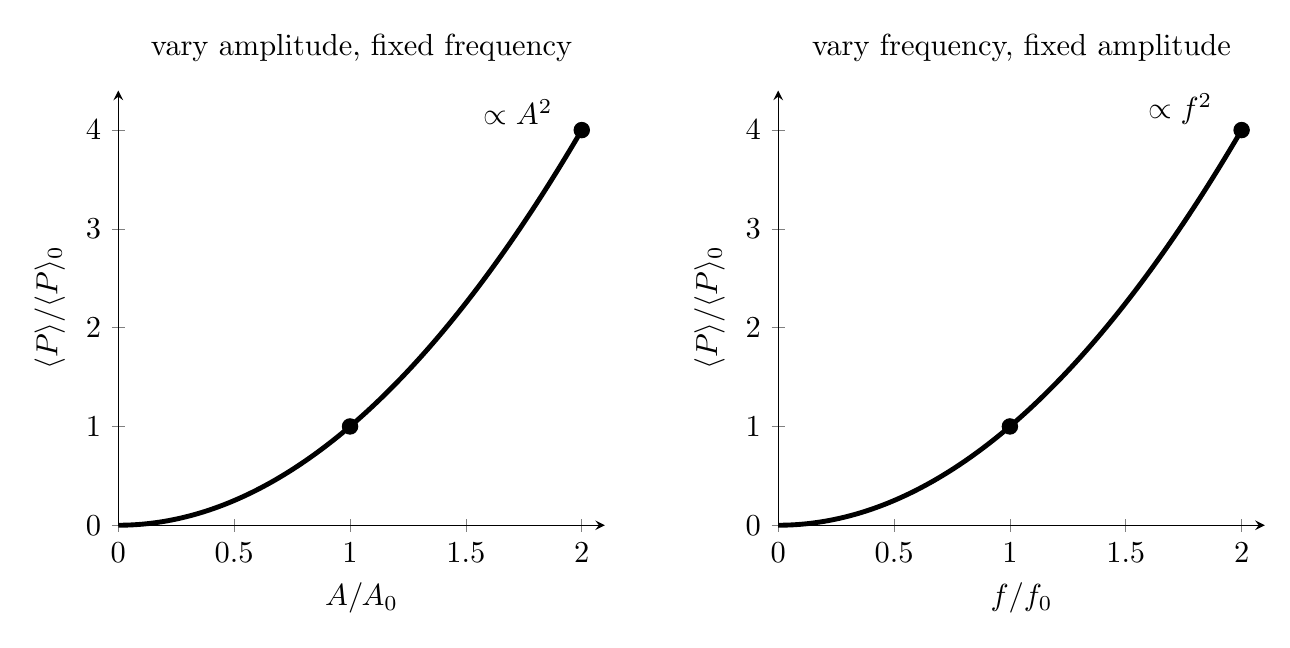
Figure. For fixed string properties, doubling amplitude multiplies average power by four,
and doubling frequency also multiplies average power by four.
Thus:
- A → 2A gives ⟨P⟩→ 4⟨P⟩;
- f → 2f gives ⟨P⟩→ 4⟨P⟩;
- doubling both gives a factor of 16.
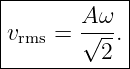
7 RMS transverse velocity form
The transverse material velocity is
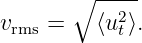
Its root-mean-square value is
Since
we have
Therefore
| μcvrms2 | = μc | (39)
|
| = ⟨P⟩ . | (40) |
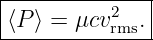
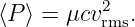
So another useful form is
The quantity μc will later appear naturally in the discussion of mechanical wave impedance.
8 Average power and average energy density
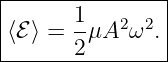
WM18 found for a sinusoidal traveling wave
Comparing with
we obtain
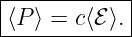
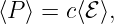
This is the average version of the more general traveling-wave relation developed in
WM19.
9 Energy in one wavelength crosses in one period
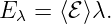
The average energy contained in one wavelength is
The wave travels one wavelength in one period, so
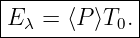
Therefore
| Eλ | = ⟨ℰ⟩cT0 | (47)
|
| = ⟨P⟩T0. | (48) |
Hence
This has a direct interpretation: during one oscillation period, one wavelength of the traveling
pattern moves past a fixed observation point, carrying with it the energy associated with that
wavelength.

Figure. Because cT0 = λ, the energy crossing a fixed point during one period equals the
average energy stored in one wavelength of a steady sinusoidal traveling wave.
10 Time average and spatial average
At a fixed time, the sinusoidal power varies through space as
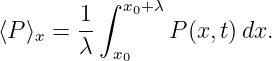
A spatial average over one wavelength is
Since the phase changes by 2π over one wavelength, the same sin 2 average appears.
Thus
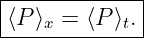
This equality holds for the steady sinusoidal traveling wave because one complete wavelength in
space corresponds to one complete phase cycle, just as one period in time does.
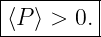
11 Direction and sign
For a right-moving sinusoidal wave under the WM19 sign convention,
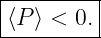
For the corresponding left-moving wave,
The magnitude is the same if amplitude, frequency, and medium properties are the same. In many
contexts the phrase “average power carried” refers to the positive magnitude. When direction
matters, the signed form should be stated explicitly.
12 A perfect standing wave is different
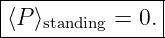
A perfect Standing Wave is formed from equal counter-propagating waves. WM19 showed that its
instantaneous local power generally oscillates in sign, but
This does not mean that the standing wave contains no energy. It means that there is no net
time-averaged energy transport through a fixed position.
13 Worked Example 1: Compute average and peak power
A sinusoidal wave has
on a string with
Find the wave speed, average power, and peak instantaneous power.
Solution
First,
| c | =  | (58)
|
| =  | (59)
|
| ≃ 79.1 m/s. | (60) |
The angular frequency is
Convert the amplitude:
Now use
Thus
| ⟨P⟩ | =  (0.012)(0.0040)2(157.1)2(79.1) (0.012)(0.0040)2(157.1)2(79.1) | (64)
|
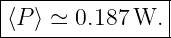
| ≃ 0.187 W. | (65) |
Therefore
Since
we obtain
14 Worked Example 2: Use the TA2kω form
A right-moving sinusoidal wave has
on a string under Tension
Find the average power.
Solution
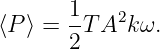
Use
With
we obtain
| ⟨P⟩ | =  (60)(0.0030)2(4.0)(200) (60)(0.0030)2(4.0)(200) | (73)
|
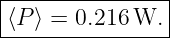
| = 0.216 W. | (74) |
Thus
15 Worked Example 3: Required amplitude for a specified average power
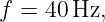
A sinusoidal wave travels on a string with
At
what amplitude is required to carry
Solution
Start with
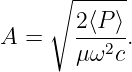
Solve for A:
The angular frequency is
Therefore
| A | = 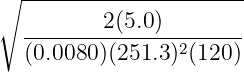 | (82)
|
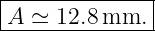
| ≃ 1.28 × 10⁻² m. | (83) |
Thus
16 Worked Example 4: Scaling without recomputing from scratch
A wave initially carries average power P0. Its amplitude is changed to
and its frequency is changed to
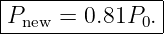
while the string itself is unchanged. Find the new average power as a fraction of P0.
Solution
For a fixed string,
Therefore
 | = (0.60)2(1.50)2 | (88)
|
| = 0.36(2.25) | (89)
|
| = 0.81. | (90) |
Hence
Even though the frequency increased, the reduction in amplitude was large enough that the
average power decreased overall.
17 Worked Example 5: RMS transverse velocity
At one location in a sinusoidal traveling wave, the transverse material velocity has
The string has
Find the average power.
Solution
Use
Then
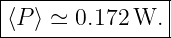
| ⟨P⟩ | = (0.020)(70)(0.35)2 | (95)
|
| = 0.1715 W. | (96) |
Thus
18 Worked Example 6: Energy per wavelength and energy per period
A sinusoidal traveling wave has average energy density
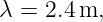
wavelength
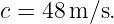
and speed
Find the period, the average power, the energy in one wavelength, and verify that the same
amount of energy crosses a point during one period.
Solution
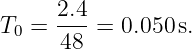
The period follows from
Thus
Average power is
so
The energy in one wavelength is
The energy crossing a point during one period is
Therefore
19 Common mistakes
- Mistake: averaging the displacement and concluding that zero mean displacement
means zero mean power. Power is quadratic in wave derivatives.
- Mistake: forgetting the factor 1∕2 from ⟨sin 2𝜃⟩.
- Mistake: confusing peak instantaneous power with average power. For a sinusoidal
traveling wave, Pmax = 2⟨P⟩.
- Mistake: applying ⟨P⟩∝ A2f2 while simultaneously changing the string properties.
That scaling assumes μ and c remain fixed.
- Mistake: forgetting that signed power is negative for a left-moving wave under the
WM19 convention.
- Mistake: assuming a standing wave carries zero energy because its average power
is zero. A standing wave stores and exchanges energy locally even though its net
time-averaged transport vanishes.
20 What WM20 adds to the sequence
WM19 established the instantaneous conservation law and the signed power flow
WM20 turns that instantaneous quantity into a cycle-averaged transport rate for sinusoidal waves.
The key result is
This is the form that will later connect naturally to intensity, impedance, reflection/transmission
coefficients, and harmonic-wave treatments in other physical systems.
References
References
[1] A. P. French, Vibrations and Waves, M.I.T. Introductory Physics Series, W. W.
Norton & Company, 1971.
[2] Frank S. Crawford, Jr., Waves, Berkeley Physics Course, Volume 3, McGraw-Hill,
1968.
[3] William Moebs, Samuel J. Ling, and Jeff Sanny, University Physics, Volume 1,
OpenStax, 2016, Section 16.4, “Energy and Power of a Wave.”
[4] Howard Georgi, The Physics of Waves, Prentice Hall, 1993.
[5] Massachusetts Institute of Technology, 8.03SC Physics III: Vibrations and Waves,
MIT OpenCourseWare, Fall 2016.
[6] Richard P. Feynman, Robert B. Leighton, and Matthew Sands, The Feynman Lectures
on Physics, Volume I, Chapter 47, “Sound. The Wave Equation.”