1. FOR at least two centuries the geometrical representation of the negative and imaginary
algebraic quantities, −1 and has been a favourite subject of speculation with mathematicians.
The essence of almost all of the proposed processes consists in employing such expressions to
indicate the DIRECTION, not the length, of lines.
2. Thus it was long ago seen that if positive quantities were measured off in one direction along a
fixed line, a useful and lawful convention enabled us to express negative quantities of the same kind
by simply laying them off on the same line in the opposite direction. This convention is an essential
part of the Cartesian method, and is constantly employed in Analytical Geometry and Applied
Mathematics.
3. Wallis, towards the end of the seventeenth century, proposed to represent the impossible roots of
a quadratic equation by going out of the line on which, if real, they would have been laid off. This
construction is equivalent to the consideration of as a directed unit-line perpendicular to that
on which real quantities are measured.
4. In the usual notation of Analytical Geometry of two dimensions, when rectangular axes are
employed, this amounts to reckoning each unit of length along Oy as +, and on Oy′ as −;
while on Ox each unit is +1, and on Ox′ it is −1. T. Q. I.
If we look at these four lines in circular order, i.e. in the order of positive rotation (that of the
northern hemisphere of the earth about its axis, or opposite to that of the hands of a watch), they
give
In this series each expression is derived from that which precedes it by multiplication by the factor
. Hence we may consider as an operator, analogous to a handle perpendicular to the
plane of xy, whose effect on any line in that plane is to make it rotate (positively) about the origin
through an angle of 90o.
5. In such a system, (which seems to have been first developed, in 1805, by Buee) a point in the
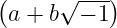
plane of reference is defined by a single imaginary expression. Thus a + b may be considered as
a single quantity, denoting the point, P, whose coordinates are a and b. Or, it may be used as an
expression for the line OP joining that point with the origin. In the latter sense, the expression
a + b implicitly contains the direction, as well as the length, of this line; since, as we see at
once, the direction is inclined at an angle tan −1b∕a to the axis of x, and the length is .
Thus, say we have
the line OP considered as that by which we pass from one extremity, O, to the other, P. In this
sense it is called a vector. Considering, in the plane, any other vector,
the addition of these two lines obviously gives
and we see that the sum is the diagonal of the parallelogram on OP, OQ. This is the law of the
composition of simultaneous velocities; and it contains, of course, the law of subtraction of one
directed line from another.
6. Operating on the first of these symbols by the factor , it becomes −b + a; and
now, of course, denotes the point whose x and y coordinates are −b and a; or the line
joining this point with the origin. The length is still , but the angle the line
makes with the axis of x is tan(−a∕b); which is evidently greater by π∕2 than before the
operation.
7. De Moivre’s theorem tends to lead us still further in the same direction. In fact, it is easy to see
that if we use, instead of , the more general factor cos α + sin α, its effect on any line is
to turn it through the (positive) angle α in the plane of x,y. [Of course the former factor, , is
merely the particular case of this, when α = π∕2.]
Thus = a cos α − b sin α + ,
by direct multiplication. The reader will at once see that the new form indicates that a
rotation through an angle α has taken place, if he compares it with the common formulae
for turning the coordinate axes through a given angle. Or, in a less simple manner,
thus
Length =
= as before.
Inclination to axis of x
8. We see now, as it were, why it happens that
In fact, the first operator produces m successive rotations in the same direction, each through the
angle α; the second, a single rotation through the angle ma.
9. It may be interesting, at this stage, to anticipate so far as to remark that in the theory of
quaternions the analogue of
is
where
Here, however, ω is not the algebraic , but is any directed unit-line whatever in
space.
10. In the present century Argand, Warren, Mourey, and others, extended the results of Wallis and
Buee. They attempted to express as a line the product of two lines each represented by a symbol
such a + b. To a certain extent they succeeded, but all their results remained confined to two
dimensions. The product, II, of two such lines was defined as the fourth proportional to unity and
the two lines, thus
or
The length of II is obviously the product of the lengths of the factor lines; and its direction makes
an angle with the axis of x which is the sum of those made by the factor lines. From this result the
quotient of two such lines follows immediately.
11. A very curious speculation, due to Servois and published in 1813 in Gergonne’s Annales, is one
of the very few, so far as has been discovered, in which a well-founded guess at a possible mode of
extension to three dimensions is contained. Endeavouring to extend to space the form
a + b for the plane, he is guided by analogy to write for a directed unit-line in space the
form
where α,β,γ are its inclinations to the three axes. He perceives easily that p,q,r must be
non-reals: but, he asks, ”seraient-elles imaginaires reductibles a la forme generale A + B?”
The i,j,k of the Quaternion Calculus furnish an answer to this question. (See Chap. II.) But it
may be remarked that, in applying the idea to lines in a plane, a vector OP will no longer be
represented (as in 5) by
but by
And if, similarly.
the addition of these two lines gives for OR (which retains its previous signification)
12. Beyond this, few attempts were made, or at least recorded, in earlier times, to extend the
principle to space of three dimensions; and, though many such had been made before 1843, none,
with the single exception of Hamilton’s, have resulted in simple, practical methods; all,
however ingenious, seeming to lead almost at once to processes and results of fearful
complexity.
For a lucid, complete, and most impartial statement of the claims of his predecessors in this field
we refer to the Preface to Hamilton’s Lectures on Quaternions. He there shews how his long
protracted investigations of Sets culminated in this unique system of tridimensional-space
geometry.
13. It was reserved for Hamilton to discover the use and properties of a class of symbols which,
though all in a certain sense square roots of −1, may be considered as real unit lines, tied down
to no particular direction in space; the expression for a vector is, or may be taken to
be,
but such vector is considered in connection with an extraspatial magnitudew, and we have thus
the notion of a QUATERNION
This is the fundamental notion in the singularly elegant, and enormously powerful, Calculus of
Quaternions.
While the schemes for using the algebraic to indicate direction make one direction in space
expressible by real numbers, the remainder being imaginaries of some kind, and thus lead to
expressions which are heterogeneous; Hamilton’s system makes all directions in space equally
imaginary, or rather equally real, there by ensuring to his Calculus the power of dealing with space
indifferently in all directions.
In fact, as we shall see, the Quaternion method is independent of axes or any supposed
directions in space, and takes its reference lines solely from the problem it is applied
to.
14. But, for the purpose of elementary exposition, it is best to begin by assimilating it as closely as
we can to the ordinary Cartesian methods of Geometry of Three Dimensions, with which the
student is supposed to be, to some extent at least, acquainted. Such assistance, it will be found,
can (as a rule) soon be dispensed with; and Hamilton regarded any apparent necessity for an oc
casional recurrence to it, in higher applications, as an indication of imperfect development in the
proper methods of the new Calculus.
We commence, therefore, with some very elementary geometrical ideas, relating to the theory of
vectors in space. It will subsequently appear how we are thus led to the notion of a
Quaternion.
15. Suppose we have two points A and B in space, and suppose A given, on how many numbers
does B′s relative position depend?
If we refer to Cartesian coordinates (rectangular or not) we find that the data required
are the excesses of B′s three coordinates over those of A. Hence three numbers are
required.
Or we may take polar coordinates. To define the moon’s position with respect to the earth we must
have its Geocentric latitude and longitude, or its Right Ascension and Declination, and, in
addition, its distance or radius-vector. Three again.
16. Here it is to be carefully noticed that nothing has been said of the actual coordinates of either
A or B, or of the earth and moon, in space; it is only the relative coordinates that are
contemplated.
Hence any expression, as AB, denoting a line considered with reference to direction and currency
as well as length, (whatever may be its actual position in space) contains implicitly
three numbers, and all lines parallel and equal to AB, and concurrent with it, depend
in the same way upon the same three. Hence, all lines which are equal, parallel, and
concurrent, may be represented by a common symbol, and that symbol contains three distinct
numbers. In this sense a line is called a VECTOR, since by it we pass from the one
extremity, A, to the other, B; and it may thus be considered as an instrument which
carries A to B: so that a vector may be employed to indicate a definite translation in
space.
[The term ”currency” has been suggested by Cayley for use instead of the somewhat vague
suggestion sometimes taken to be involved in the word ”direction.” Thus parallel lines have the
same direction, though they may have similar or opposite currencies. The definition of a vector
essentially includes its currency.]
17. We may here remark, once for all, that in establishing a new Calculus, we are at liberty to give
any definitions whatever of our symbols, provided that no two of these interfere with, or contradict,
each other, and in doing so in Quaternions simplicity and (so to speak) naturalness were the
inventor’s aim.
18. Let AB be represented by α, we know that α involves three separate numbers, and that these
depend solely upon the position of B relatively to A. Now if CD be equal in length
to AB and if these lines be parallel, and have the same currency, we may evidently
write
where it will be seen that the sign of equality between vectors contains implicitly equality in
length, parallelism in direction, and concurrency. So far we have extended the meaning
of an algebraical symbol. And it is to be noticed that an equation between vectors,
as
,
contains three distinct equations between mere numbers.
19. We must now define + (and the meaning of - will follow) in the new Calculus. Let A,B,C be
any three points, and (with the above meaning of = ) let
If we define + (in accordance with the idea (16) that a vector represents a translation) by the
equation
or
we contradict nothing that precedes, but we at once introduce the idea that vectors are to be
compounded, in direction and magnitude, like simultaneous velocities. A reason for this may be
seen in another way if we remember that by adding the (algebraic) differ ences of the Cartesian
coordinates of B and A, to those of the coordinates of C and B, we get those of the coordinates of
C and A. Hence these coordinates enter linearly into the expression for a vector. (See, again,
5.)
20. But we also see that if C and A coincide (and C may be any point)
for no vector is then required to carry A to C. Hence the above relation may be written, in this
case,
or, introducing, and by the same act defining, the symbol −,
Hence, the symbol −, applied to a vector, simply shews that its currency is to be reversed.
And this is consistent with all that precedes; for instance,
and
or
are evidently but different expressions of the same truth.
21. In any triangle, ABC, we have, of course,
and, in any closed polygon, whether plane or gauche,
In the case of the polygon we have also
These are the well-known propositions regarding composition of velocities, which, by Newton’s
second law of motion, give us the geometrical laws of composition of forces acting at one
point.
22. If we compound any number of parallel vectors, the result is obviously a numerical multiple of
any one of them.
Thus, if A,B,C are in one straight line,
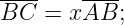
where x is a number, positive when B lies between A and C, otherwise negative: but such that its
numerical value, independent of sign, is the ratio of the length of BC to that of AB. This is at
once evident if AB and BC be commensurable; and is easily extended to incommensurables by the
usual reductio ad absurdum.
23. An important, but almost obvious, proposition is that any vector may be resolved, and in one
way only, into three components parallel respectively to any three given vectors, no two of which are
parallel, and which are not parallel to one plane.
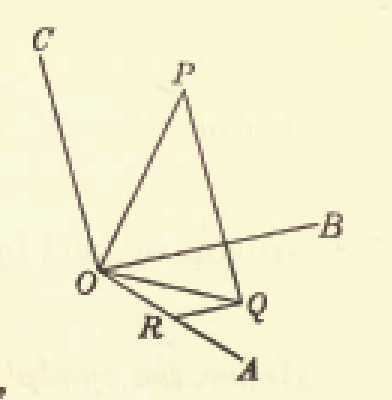
Let OA, OB, OC be the three fixed c vectors, OP any other vector. From P draw PQ parallel to
CO, meeting the plane BOA in Q. [There must be a definite point Q, else PQ, and therefore CO,
would be parallel to BOA, a case specially excepted.] From Q draw QR parallel to BO, meeting
OA in R. Then we have OP =OR +RQ +QP ( 21), and these components are respectively
parallel to the three given and these components are respectively parallel to the three given
vectors. By 22 we may express OR as a numerical multiple of OA, RQ of OB, and QP of OC.
Hence we have, generally, for any vector in terms of three fixed non-coplanar vectors,
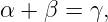
α,β,γ,
which exhibits, in one form, the three numbers on which a vector depends (16). Here x,y,z are
perfectly definite, and can have but single values.
24. Similarly any vector, as OQ, in the same plane with OA and OB, can be resolved (in one way
only) into components OR, RQ, parallel respectively to OA and OB; so long, at least, as these two
vectors are not parallel to each other.
25. There is particular advantage, in certain cases, in em ploying a series of three mutually
perpendicular unit-vectors as lines of reference. This system Hamilton denotes by i,j,k.
Any other vector is then expressible as
Since i,j,k are unit-vectors, x,y,z are here the lengths of conterminous edges of a rectangular
parallelepiped of which ρ is the vector-diagonal; so that the length of ρ is, in this case,
Let
be any other vector, then (by the proposition of 23) the vector equation
obyiously involves the following three equations among numbers,
Suppose i to be drawn eastwards, j northwards, and k upwards, this is equivalent merely to saying
that if two points coincide, they are equally to the east (or west) of any third point,
equally to the north (or south) of it, and equally elevated above (or depressed below) its
level.
26. It is to be carefully noticed that it is only when α,β,γ are not coplanar that a vector equation
such as
or
necessitates the three numerical equations
For, if α,βγ be coplanar (24), a condition of the following form must hold
Hence
and the equation
now requires only the two numerical conditions
27. The Commutative and Associative Laws hold in the combination of vectors by the signs + and
−. It is obvious that, if we prove this for the sign +, it will be equally proved for −, because −
before a vector (20) merely indicates that it is to be reversed before being considered
positive.
Let A,B,C,D be, in order, the corners of a parallelogram; we have, obviously,
And
Hence the commutative law is true for the addition of any two vectors, and is therefore generally
true.
Again, whatever four points are represented by A,B,C,D, we have
or substituting their values for AD,BD,AC respectively, in these three expressions,
And thus the truth of the associative law is evident.
28. The equation
where ρ is the vector connecting a variable point with the origin, β a definite vector, and x
an indefinite number, represents the straight line drawn from the origin parallel to β
(22).
The straight line drawn from A, where OA = α, and parallel to β, has the equation
In words, we may pass directly from O to P by the vector OP or ρ; or we may pass first to A, by
means of OA or α, and then to P along a vector parallel to β (16).
"Vectors and Their Composition" is owned by bloftin.
This is version 10 of Vectors and Their Composition, born on 2006-05-08, modified 2006-05-16.
Object id is 171, canonical name is VectorsAndTheirComposition.
Accessed 3148 times total.

![[parent]](https://images.physicslibrary.org/images/uparrow.png)
 has been a favourite subject of speculation with mathematicians.
The essence of almost all of the proposed processes consists in employing such expressions to
indicate the DIRECTION, not the
has been a favourite subject of speculation with mathematicians.
The essence of almost all of the proposed processes consists in employing such expressions to
indicate the DIRECTION, not the  as a directed unit-line perpendicular to that
on which real quantities are measured.
as a directed unit-line perpendicular to that
on which real quantities are measured.
 , and on
  ;
while on
;
while on 
 . Hence we may consider
  as an
as an  may be considered as
a single quantity, denoting the point,
may be considered as
a single quantity, denoting the point,  implicitly contains the
  .
Thus, say we have
.
Thus, say we have



 , it becomes
  ; and
now, of course, denotes the point whose
; and
now, of course, denotes the point whose  , but the angle the line
makes with the axis of x is tan(
, but the angle the line
makes with the axis of x is tan( , the more general factor cos
  sin
sin  , is
merely the particular case of this, when
, is
merely the particular case of this, when 
 =
= 


 as before.






 , but is
  . To a certain extent they succeeded, but all their results remained confined to two
dimensions. The product, II, of two such lines was defined as the fourth proportional to unity and
the two lines, thus
. To a certain extent they succeeded, but all their results remained confined to two
dimensions. The product, II, of two such lines was defined as the fourth proportional to unity and
the two lines, thus


 for the plane, he is guided by analogy to write for a directed unit-line in space the
form
for the plane, he is guided by analogy to write for a directed unit-line in space the
form

 ?”
The
?”
The 





 to indicate direction make one direction in space
expressible by real numbers, the remainder being imaginaries of some kind, and thus lead to
expressions which are heterogeneous; Hamilton’s system makes all directions in space equally
imaginary, or rather equally real, there by ensuring to his Calculus the
to indicate direction make one direction in space
expressible by real numbers, the remainder being imaginaries of some kind, and thus lead to
expressions which are heterogeneous; Hamilton’s system makes all directions in space equally
imaginary, or rather equally real, there by ensuring to his Calculus the