When a point moves with uniform speed along the arc of a circle, its velocity is constantly
changing in direction, and hence the point has an acceleration even though there is no change in
the magnitude of its velocity.
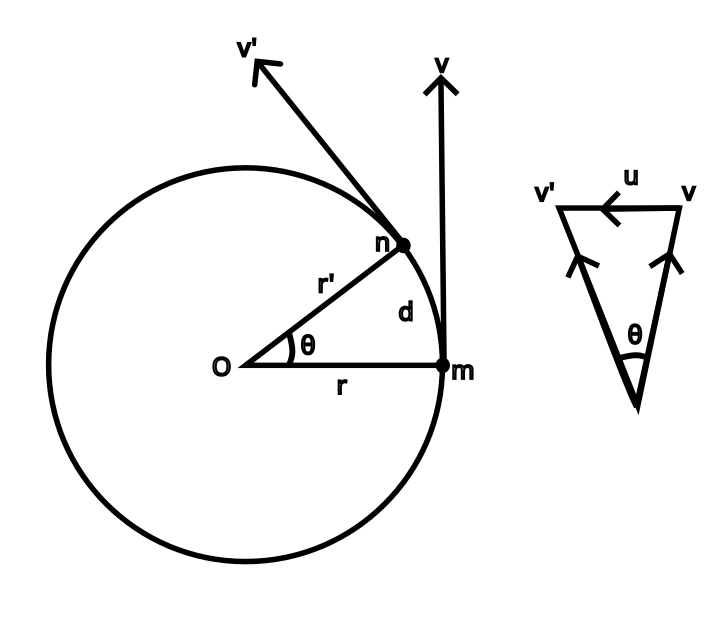
Let a point move with uniform speed along the arc of the circle whose center is in
Figure 1.
Figure 1:1.
When the point is at , its velocity is , and is perpendicular to the radius .
When the point has reached , its velocity is , perpendicular to the radius .
v′ is a vector which is obtained by adding the vector to the vector v hence u is the change in
velocity.
If the points m and n are taken very near together, v and v′ are very nearly parallel and u is
perpendicular to v, i.e., the change of velocity is toward the center of the circle. If t units of time
are required for the point to move from m to n, this change of velocity occurs in t units of time,
and
is the average rate of change of velocity. In the limiting case under consideration, i.e., when the
distance between m and n approaches zero, this average rate of change of velocity becomes the
acceleration and
From Figure 1 it is apparent that, for small angles
or
Substituting this value of u in the equation
we have
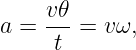
being the angular velocity of the radius. may be substituted for ω,
in which case
Substituting ωr for v in the same equation, we obtain an express for acceleration a in terms of
angular velocity ω,
thus:
This is called the centripetal acceleration. It is always directed toward the center of the circle in
whose circumference the point is moving. If v is measured in cm per second, u is also measured in
cm per second, and u∕t must be measured in cm per second per second. When the foot is
taken as the unit of length, the acceleration a is measured in feet per second per second.
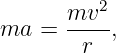
If a massparticlem has a uniform circular motion, it will have an acceleration toward the center,
and hence a continuous force,
must act to pull it toward the center. This force is called the centripetal force; and its equal and
opposite reaction, called the centrifugal force, is the force that the mass exerts away from the
center. These forces vary as the mass, as the square of the speed, and, for a given speed, inversely
as the radius of the curve.
This article is a derivative work of the public domain in [1].
References
[1] Randall, Harrison, Williams Neil, Colby, Walter, ”General College Physics” Harper
and Brothers Publishers, New York and London, 1929.
Exact browser explorer for radius, tangential speed, starting angle, inward acceleration and a second point on a disk; four Julia reference trajectories, source, tests and an offline archive.
This is version 4 of uniform circular motion, born on 2025-03-02, modified 2026-09-28.
Object id is 976, canonical name is UniformCircularMotion.
Accessed 2587 times total.
 of the circle whose center is
  in
Figure 1.
in
Figure 1.
 , its velocity is
  , and is perpendicular to the radius
  .
When the point has reached
.
When the point has reached  , its velocity is
  , perpendicular to the radius
  .
.
 to the vector


 being the
  may be substituted for