Earth’s atmosphere blocks most radiation at wavelengths shorter than visible light, so we can only
make direct ultraviolet, X-ray, and gamma ray observations from space (though indirect gamma
ray observations can be made from Earth). Getting above the distorting effects of the atmosphere
is also an advantage at visible and infrared wavelengths. The stars don’t “twinkle” in space, so the
amount of detail you can observe is limited only by the size of your instrument. On the other hand,
it is expensive to place telescopes into space, and repairs can present a major challenge. This is
why astronomers continue to build telescopes for use on the ground as well as for launching into
space.
Airborne and Space Infrared Telescopes
Water vapor, the main source of atmospheric interference for making infrared observations, is
concentrated in the lower part of Earth’s atmosphere. For this reason, a gain of even a few hundred
meters in elevation can make an important difference in the quality of an infrared observatory site.
Given the limitations of high mountains, most of which attract clouds and violent storms, and the
fact that the ability of humans to perform complex tasks degrades at high altitudes, it was natural
for astronomers to investigate the possibility of observing infrared waves from airplanes and
ultimately from space.
Infrared observations from airplanes have been made since the 1960s, starting with a
15-centimeter telescope on board a Learjet. From 1974 through 1995, NASA operated a
0.9-meter airborne telescope flying regularly out of the Ames Research Center south of San
Francisco. Observing from an altitude of 12 kilometers, the telescope was above 99% of the
atmospheric water vapor. More recently, NASA (in partnership with the German Aerospace
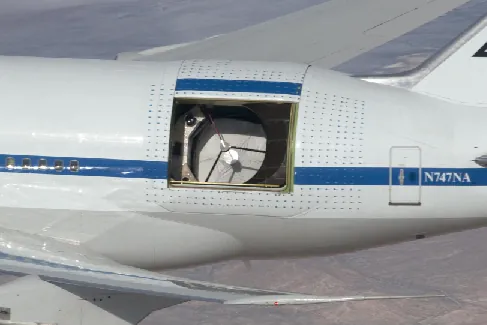
Center) has constructed a much larger 2.5-meter telescope, called the Stratospheric
Observatory for Infrared Astronomy (SOFIA), which flies in a modified Boeing 747SP (Figure
6.23).
Figure 6.23 Stratospheric Observatory for Infrared Astronomy (SOFIA). SOFIA allows
observations to be made above most of Earth’s atmospheric water vapor. (credit: NASA)
Link to Learning
To find out more about SOFIA, watch this video provided by NASA’s Armstrong Flight Research
Center.
Getting even higher and making observations from space itself have important advantages for
infrared astronomy. First is the elimination of all interference from the atmosphere. Equally
important is the opportunity to cool the entire optical system of the instrument in order to nearly
eliminate infrared radiation from the telescope itself. If we tried to cool a telescope within the
atmosphere, it would quickly become coated with condensing water vapor and other gases, making
it useless. Only in the vacuum of space can optical elements be cooled to hundreds of degrees below
freezing and still remain operational.
The first orbiting infrared observatory, launched in 1983, was the Infrared Astronomical Satellite
(IRAS), built as a joint project by the United States, the Netherlands, and Britain. IRAS was
equipped with a 0.6-meter telescope cooled to a temperature of less than 10 K. For the first time,
the infrared sky could be seen as if it were night, rather than through a bright foreground of
atmospheric and telescope emissions. IRAS carried out a rapid but comprehensive survey of the
entire infrared sky over a 10-month period, cataloging about 350,000 sources of infrared
radiation. Since then, several other infrared telescopes have operated in space with much
better sensitivity and resolution due to improvements in infrared detectors. The most
powerful of these infrared telescopes is the 0.85-meter Spitzer Space Telescope, which
launched in 2003. A few of its observations are shown in Figure 6.24. With infrared
observations, astronomers can detect cooler parts of cosmic objects, such as the dust clouds
around star nurseries and the remnants of dying stars, that visible-light images don’t
reveal.
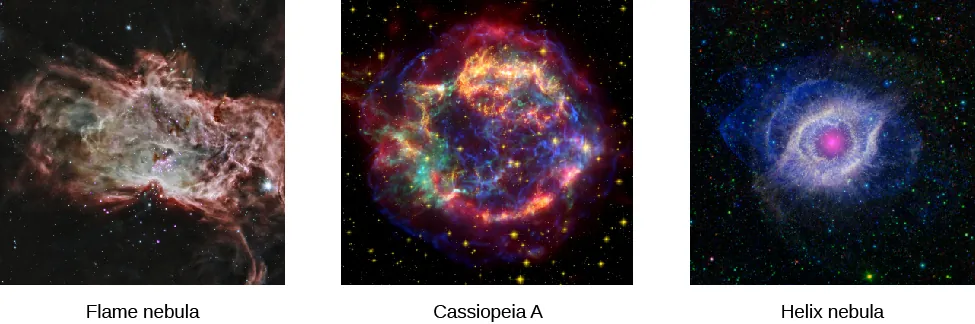
Figure 6.24 Observations from the Spitzer Space Telescope (SST). These infrared images—a region
of star formation, the remnant of an exploded star, and a region where an old star is losing its
outer shell—show just a few of the observations made and transmitted back to Earth
from the SST. Since our eyes are not sensitive to infrared rays, we don’t perceive colors
from them. The colors in these images have been selected by astronomers to highlight
details like the composition or temperature in these regions. (credit “Flame nebula”:
modification of work by NASA (X-ray: NASA/CXC/PSU/K. Getman, E. Feigelson,
M. Kuhn & the MYStIX team; Infrared: NASA/JPL-Caltech); credit “Cassiopeia A”:
modification of work by NASA/JPL-Caltech; credit “Helix nebula”: modification of work by
NASA/JPL-Caltech)
Hubble Space Telescope
In April 1990, a great leap forward in astronomy was made with the launch of the Hubble Space
Telescope (HST). With an aperture of 2.4 meters, this is the largest telescope put into space so far.
(Its aperture was limited by the size of the payload bay in the Space Shuttle that served as its
launch vehicle.) It was named for Edwin Hubble, the astronomer who discovered the
expansion of the universe in the 1920s (whose work we will discuss in the chapters on
Galaxies).
HST is operated jointly by NASA’s Goddard Space Flight Center and the Space Telescope Science
Institute in Baltimore. It was the first orbiting observatory designed to be serviced by Shuttle
astronauts and, over the years since it was launched, they made several visits to improve or replace
its initial instruments and to repair some of the systems that operate the spacecraft (Figure
6.1)—though this repair program has now been discontinued, and no more visits or improvements
will be made.
With the Hubble, astronomers have obtained some of the most detailed images of astronomical
objects from the solar system outward to the most distant galaxies. Among its many
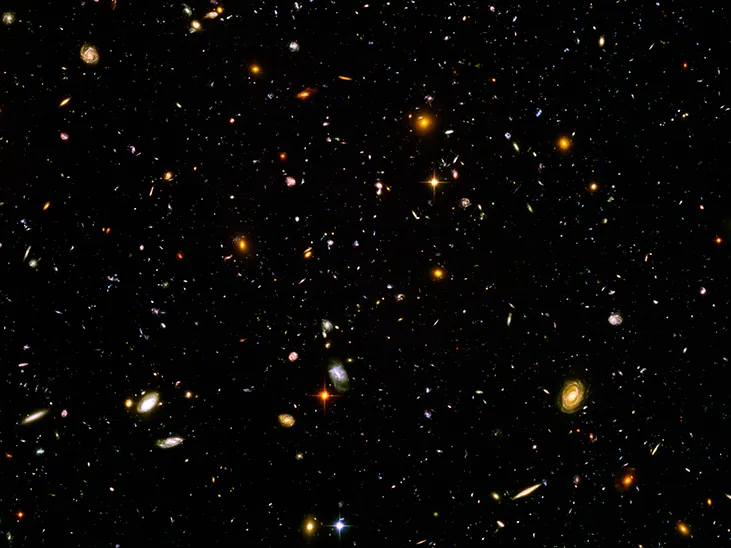
great achievements is the Hubble Ultra-Deep field, an image of a small region of the
sky observed for almost 100 hours. It contains views of about 10,000 galaxies, some
of which formed when the universe was just a few percent of its current age (Figure
6.25).
Figure 6.25 Hubble Ultra-Deep Field (HUDF). The Hubble Space Telescope has provided an image
of a specific region of space built from data collected between September 24, 2003, and January 16,
2004. These data allow us to search for galaxies that existed approximately 13 billion years ago.
(credit: modification of work by NASA)
The HST’s mirror was ground and polished to a remarkable degree of accuracy. If we were to scale
up its 2.4-meter mirror to the size of the entire continental United States, there would be no hill or
valley larger than about 6 centimeters in its smooth surface. Unfortunately, after it was launched,
scientists discovered that the primary mirror had a slight error in its shape, equal to roughly 1/50
the width of a human hair. Small as that sounds, it was enough to ensure that much of the
light entering the telescope did not come to a clear focus and that all the images were
blurry. (In a misplaced effort to save money, a complete test of the optical system had
not been carried out before launch, so the error was not discovered until HST was in
orbit.)
The solution was to do something very similar to what we do for astronomy students with
blurry vision: put corrective optics in front of their eyes. In December 1993, in one
of the most exciting and difficult space missions ever flown, astronauts captured the
orbiting telescope and brought it back into the shuttle payload bay. There they installed
a package containing compensating optics as well as a new, improved camera before
releasing HST back into orbit. The telescope now works as it was intended to, and further
missions to it were able to install even more advanced instruments to take advantage of its
capabilities.
High-Energy Observatories
Ultraviolet, X-ray, and direct gamma-ray (high-energy electromagnetic wave) observations can be
made only from space. Such observations first became possible in 1946, with V2 rockets captured
from Germany after World War II. The US Naval Research Laboratory put instruments on these
rockets for a series of pioneering flights, used initially to detect ultraviolet radiation from the Sun.
Since then, many other rockets have been launched to make X-ray and ultraviolet observations of
the Sun, and later of other celestial objects.
Beginning in the 1960s, a steady stream of high-energy observatories has been launched into orbit
to reveal and explore the universe at short wavelengths. Among recent X-ray telescopes is the
Chandra X-ray Observatory, which was launched in 1999 (Figure 6.26). It is producing X-ray
images with unprecedented resolution and sensitivity. Designing instruments that can collect and
focus energetic radiation like X-rays and gamma rays is an enormous technological challenge. The
2002 Nobel Prize in physics was awarded to Riccardo Giacconi, a pioneer in the field of building
and launching sophisticated X-ray instruments. In 2008, NASA launched the Fermi Gamma-ray
Space Telescope, designed to measure cosmic gamma rays at energies greater than any previous
telescope, and thus able to collect radiation from some of the most energetic events in the
universe.
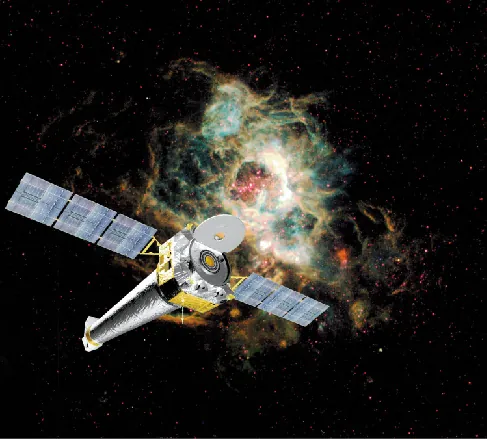
Figure 6.26 Chandra X-Ray Satellite. Chandra, the world’s most powerful X-ray telescope,
was developed by NASA and launched in July 1999. (credit: modification of work by
NASA)
One major challenge is to design “mirrors” to reflect such penetrating radiation as X-rays and
gamma rays, which normally pass straight through matter. However, although the technical details
of design are more complicated, the three basic components of an observing system, as we
explained earlier in this chapter, are the same at all wavelengths: a telescope to gather
up the radiation, filters or instruments to sort the radiation according to wavelength,
and some method of detecting and making a permanent record of the observations.
Table 6.4 lists some of the most important active space observatories that humanity has
launched.
Gamma-ray detections can also be made from Earth’s surface by using the atmosphere as the
primary detector. When a gamma ray hits our atmosphere, it accelerates charged particles (mostly
electrons) in the atmosphere. Those energetic particles hit other particles in the atmosphere and
give off their own radiation. The effect is a cascade of light and energy that can be detected on the
ground. The VERITAS array in Arizona and the H.E.S.S. array in Namibia are two such
ground-based gamma-ray observatories.
Table 6.4: Recent Observatories in Space
| Observatory | Date operation Began | Bands of the spectrum | Notes | Website |
| Hubble Space Telescope (HST) | 1990 | visible, UV, IR | 2.4-m mirror; images and spectra | www.hubblesite.org |
| Chandra X-Ray Observatory | 1999 | X-rays | X-ray images and spectra | www.chandra.si.edu |
| XMM-Newton | 1999 | X-rays | X-ray spectroscopy | www.cosmos.esa.int/web/xmm-newton |
| International Gamma-Ray Astrophysics Laboratory (INTEGRAL) | 2002 | X- and gamma-rays | higher resolution gamma-ray images | sci.esa.int/integral/ |
| Spitzer Space Telescope | 2003 | IR | 0.85-m telescope | www.spitzer.caltech.edu |
| Fermi Gamma-ray Space Telescope | 2008 | gamma-rays | first high-energy gamma-ray observations | fermi.gsfc.nasa.gov |
| Kepler | 2009 | visible-light | planet finder | kepler.nasa.gov |
| Wide-field Infrared Survey Explorer (WISE) | 2009 | IR | whole-sky map, asteroid searches | www.nasa.gov/mission_pages/WISE/main |
| Gaia | 2013 | visible-light | Precise map of the Milky Way | sci.esa.int/gaia/ |
| Transiting Exoplanet Survey Satellite (TESS) | 2018 | visible-light | Planet finder | tess.mit.edu |
Attribution
Access for free at openstax.org.
Bibliography
This entry is a derivative work of the original March 9, 2022 release identified in [1].
[1] Andrew Fraknoi, David Morrison, and Sidney C. Wolff, Astronomy 2e. Houston, Texas:
OpenStax, March 9, 2022. Digital ISBN 978-1-951693-50-3. Textbook content produced by
OpenStax in this edition is licensed under the Creative Commons Attribution 4.0 International
License (CC BY 4.0), except where otherwise noted. Changes: converted to LaTeX for
PhysicsLibrary. Access for free at openstax.org.