Physics Library
 An open source physics library
Encyclopedia | Forums | Docs | Random |  
Login
create new user
Username:
Password:
forget your password?
Main Menu
Sections

Meta

Talkback

Downloads

Information
[parent] single stage rocket burnout height (Example)

Applying Newton’s laws to rocket motion is not only exciting, but also quite instructional. Problems involving rocket motion illustrate how to use Newton’s 2nd law when mass is not constant. Here we will look at how high a single stage rocket will go under the influence of gravity. To make the problem manageable, a few simplifying assumptions are made:

  • Motion in the y direction only
  • drag is neglected
  • Constant burn rate for rocket
  • force due to gravity is constant
  • Rocket does not escape Earth’s gravity
  • Ideal rocket
  • Lots of other miscellaneous terms

To familiarize the reader with what is involved in this calculation, we will start with the answer and then derive the equation. So the max altitude the rocket will achieve is given by

         gt2b    vemf tb    ( mf )          v2b
ymax = − --- +  --------ln   ---  + vetb + ---
          2     mi − mf      mi            2g
(1)

Description of variables:

tb: Time that the rocket is burning fuel (given)
g: acceleration of Gravity (given)
mf: Final mass of rocket after burn (given)
mi: Initial mass of rocket (given)
vb: velocity of rocket at burnout (calculated)
ve: Exhaust velocity, velocity of the fuel as it is ejected out of the Rocket (given)

The problem is best approached by breaking it into two parts. First, we calculate the altitude that the rocket reaches when all its fuel is burned. After burnout, the rocket still climbs to a higher altitude until gravity finally brings its velocity to zero. Think of it like shooting a bullet into the sky, after the initial thrust of the gun, the bullet still goes higher (duh!). So the second calculation is to add the distance traveled after burnout.

The goal is to apply Newton’s 2nd law, so let us start there. For our one dimensional case

F = ma  =  − mg
(2)

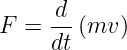
Since we do not have constant mass throughout the rocket burn, we also have

F  = -d (mv )
     dt
(3)

Using the chain rule and setting (2) equal to (3)
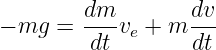
        dm--       dv-
− mg  =  dt ve + m dt

multiply by dt

− mgdt =  vedm  + mdv
(4)

We still have three differentials, so we cannot directly integrate this equation. Since we are assuming a constant burn rate k and it is positive

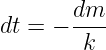
dm--
 dt = − k

so

       dm--
dt = −  k

plug this into (4) to get

mg-dm  = v dm  + mdv
 k        e

Separate variables to setup the integration

(mg      )
 ----− ve  dm  = mdv
  k

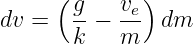
divide by m

      (g    ve)
dv =   --−  --  dm
       k    m

integrate

∫        ∫           ∫
   v        m g-       m  ve
    dv =      kdm  −      m dm
  vi        mi         mi

The initial velocity of the rocket is zero, so carrying out the integration gives us the velocity at a given mass

        g
v(m ) = --(m  − mi) − veln(m ) + veln (mi )
        k

simlify using properties of the log function

        g-                 -m-
v(m ) = k (m  − mi) − veln(mi )
(5)

It is time to take care of the constant k.

dm
----= − k
 dt

rearrange

dm  = − kdt

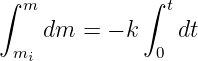
integrate

∫ m           ∫ t
    dm  = − k    dt
 mi            0

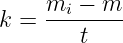
m − mi  = − kt

which gives

k = mi-−-m--
       t

Note the sign, we have a positive k, since mi will always be bigger than m (the rocket is ejecting mass). Plug this into (5).

                          (    )
       g (m − mi )t          m
v(t) = --(m--−-m-)- − veln  m--
           i                  i

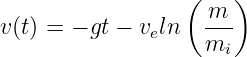
cancel terms to get

                 ( m  )
v(t) = − gt − veln   ---
                   mi

While this equation gives us the velocity of the rocket at burnout, we also want altitude. As usual, integrate velocity to get position

dy-=  v(t)
dt

∫           ∫             (    )
  y            tb             m
    dy = − g    tdt − veln  ---  dt
 0            0             mi

To integrate the last term, we need to replace dt with dm, since m is a function of t
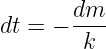
dt = − dm--
        k

∫ y         ∫ tb        ∫ mf    (   )
   dy =  − g    tdt + ve     ln   m--  dm
 0           0        k  mi       mi

All but the last term are simple. For the lazy, an integral table can be used to solve it.

∫ y         ∫ t         ∫ m     (   )
               b      ve    f     m--
 0 dy =  − g 0  tdt + k  m   ln   mi   dm
                           i

               ∫       (    )
       gt2b   ve   mf     m
y =  − -2-+  k-     ln   m--  dm
                 mi        i

Use typical integral substitution technique for the last term, so set

     m
w =  m--
       i

dw =  dm--
      mi

dm  = midw

substituting this in leaves us with
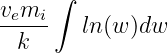
     ∫
vemi-
 k     ln (w )dw

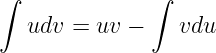
Integrating the logarithm function is done through integration by parts

∫              ∫
   udv =  uv −   vdu
(6)

setting

u = ln(w )  dv = 1dw

then differentiating and integrating yields
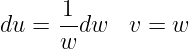
     1
du = --dw   v = w
     w

plugging these into (6) gives

∫                       ∫
                           w-
   ln (w )dw =  wln (w ) −    w dw

which is equal to

∫

   ln (w )dw =  wln (w ) − w

so going back to the original integral and evaluating the limits we have

                  (      (     )               (    )      )
       gt2b   vemi   mf     mf      mf     mi     mi     mi
y =  − -2-+  -k---  m--ln  -m-   − -m- −  m-ln   m--  + m--
                      i       i      i      i      i      i

simplfying and using ln(1) = 0

      gt2   v m  ( m     ( m  )    m      )
y = − --b + -e--i  --fln   --f  −  --f+  1
       2      k    mi      mi      mi

plug in k and expand

        2              (    )
y = − gtb + -vemf-tb-ln   mf-  +  ve(mf--−-mi)-tb-
       2    mi − mf      mi         mi − mf

finally, except for the last term, we get equation (1)

         2              (    )
y =  − gtb+  -vemf-tb-ln   mf-  + v t
       2     mi − mf      mi      e b
(7)

To find how much more altitude is gained after burnout, we note that there is no more thrust and rocket is under constant acceleration, g, so we go back to Newton’s 2nd law

F = ma

with a constant force due to gravity

F = − mg  = ma

a = − g

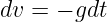
dv
--- = − g
 dt

dv =  − gdt

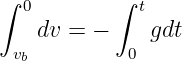
integrate to get velocity

∫          ∫
  0          t
   dv =  −    gdt
 vb         0

0 − vb = − gt

vb = gt

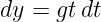
integrate again to get distance traveled

dy-
dt =  gt

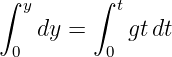
dy = gtdt

∫  y     ∫  t

  0 dy =   0 gtdt

so the distance traveled after burnout is

      2
y = gt-
     2

combining this with the distance traveled during the burn (7), yields equation (1), the total distance rocket traveled

                           (    )
         gt2b    vemf-tb--    mf-           v2b-
ymax = −  2  +  m  − m  ln   m    + vetb + 2g
                 i     f       i
(8)

0.1 References

[1] Ellis, R., Gulick, D. ”Calculus” Harcourt Brace Jovanovich, Inc., Orlando, FL, 1991.

[2] Etgen, G. ”Calculus” John Wiley & Sons, New York, 1999.

[3] Marion, J., Thornton, S. ”Classical Dynamics of Particles and systems” Fourth Edition, Harcourt College Publishers, Fort Worth, 1995.

[4] Ketsdever, A. ”Launch Vehicle Analysis”, lecture notes, University of Colorado at Colorado Springs, Spring 2006.


"single stage rocket burnout height" is owned by bloftin.
(view preamble)
View style:

This object's parent.

Cross-references: systems, position, function, velocity, acceleration, force, drag, mass, motion, Newton's laws

This is version 14 of single stage rocket burnout height, born on 2006-06-18, modified 2026-05-29.
Object id is 187, canonical name is SingleStageRocketBurnoutHeight.
Accessed 5325 times total.

Classification:
Physics Classification45.50.Dd (General motion)
 45.50.Pk (Celestial mechanics )
 45.50.-j (Dynamics and kinematics of a particle and a system of particles)
Pending Errata and Addenda
None.
Discussion
Style: Expand: Order:

No messages.

Interact
rate | post | correct | update request | add example | add (any)